
Tacoma was founded in 1872 by teetotaler and former general Morton Matthew McCarver, who gave the city its first name — Commencement City. When the Northern Pacific Railroad chose Commencement Bay as the western terminus for its transcontinental line, it built a new depot south of the original settlement and named it New Tacoma, eventually creating two independent city governments on the bay. By the 1880s, Tacoma was growing rapidly, with lumber mills, streetcar lines, wharves, and new neighborhoods shaping the city’s identity. The photos below capture what Tacoma looked like during that defining decade.
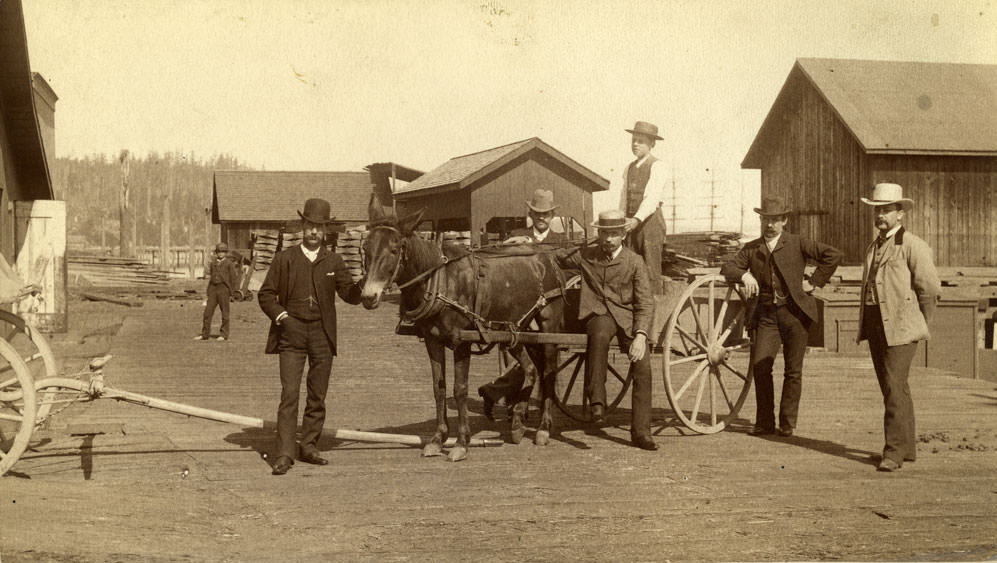
Five men stand by a mule-drawn wagon in a yard with small wooden buildings in the background, possibly the Tacoma Mill Company, Tacoma, WA. One man stands in the wagon, holding the reins. Isaac G. Davidson, photographer.
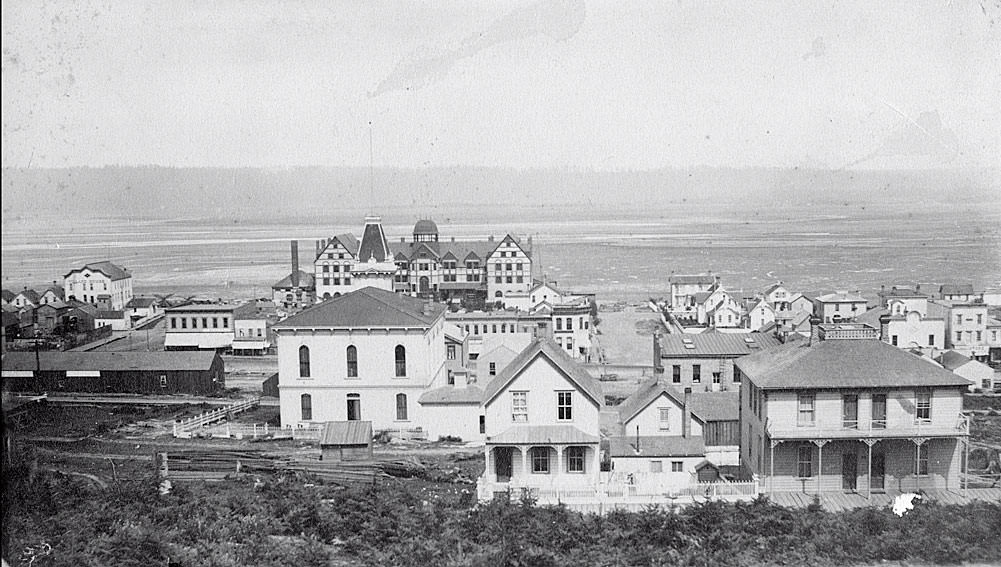
The Tacoma Hotel is a large building just left of the middle in the distance. The white building with a spire just in front of the Tacoma Hotel is the Pierce County Courthouse. The tall white house is another early Tacoma hotel. The Villard House is on the far left.
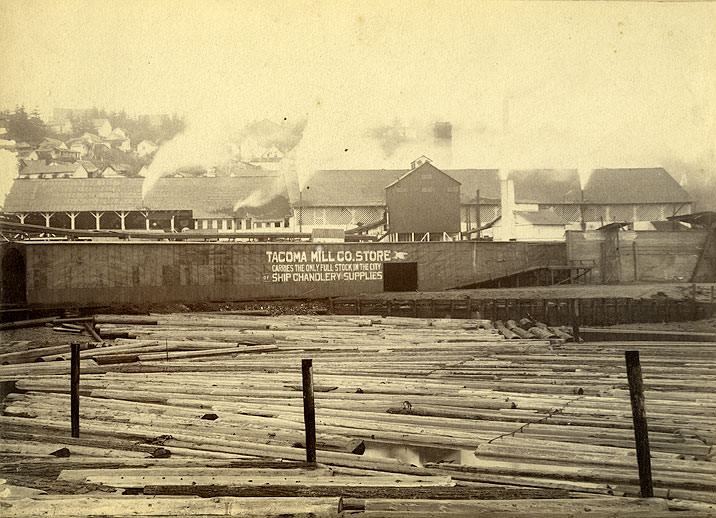
A dock, covered railroad track, and mill buildings are across the image center. The sign on the building covering the railroad track reads: Tacoma Mill Co. Store, Carries the Only Full Stock in the City of Ship Chandlery Supplies. A hand pointing to the right of the image is beside the sign. Houses on a hill are visible in the left image background. Smoke coming from mill buildings obscures the background on the right side of the image.
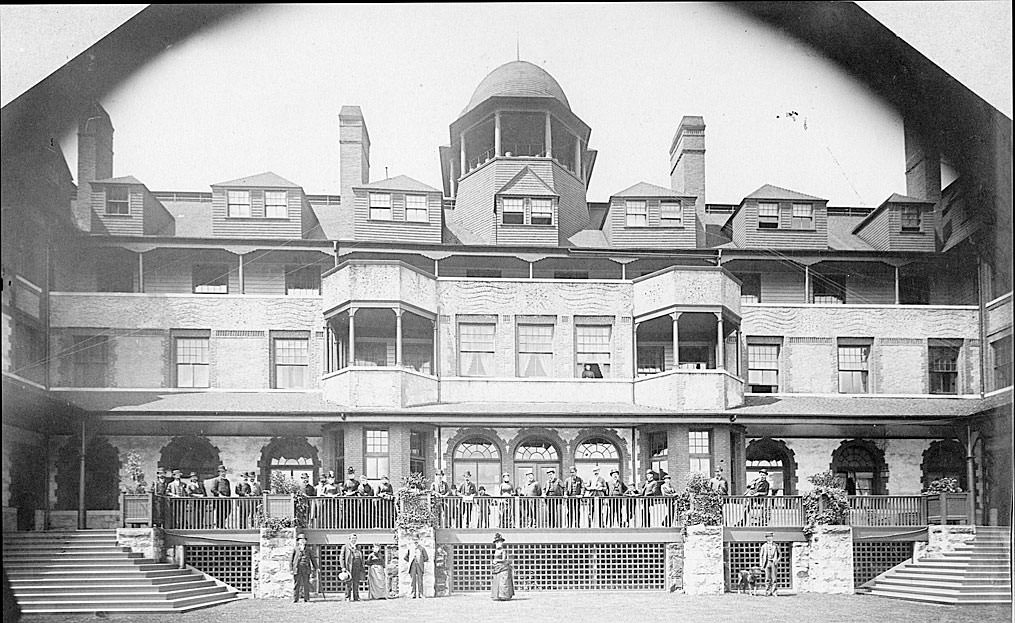
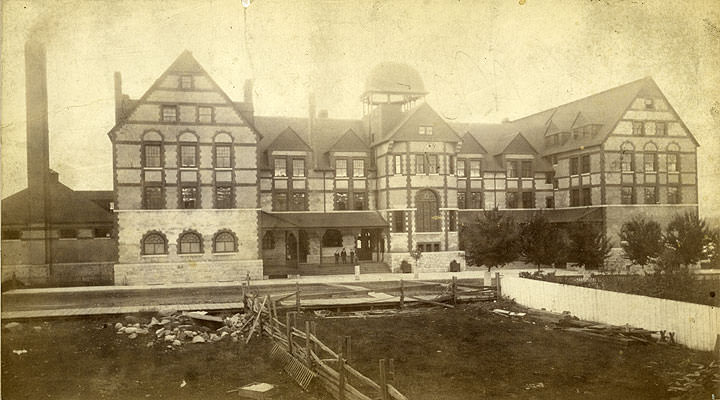
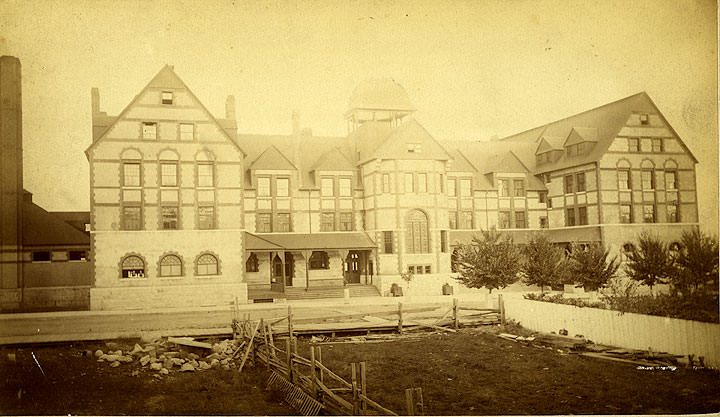
The image shows the center of the U-shaped structure — an elaborate three-story building with multiple gables at the roofline and a domed cupola on top. On the wide porch just above ground level.
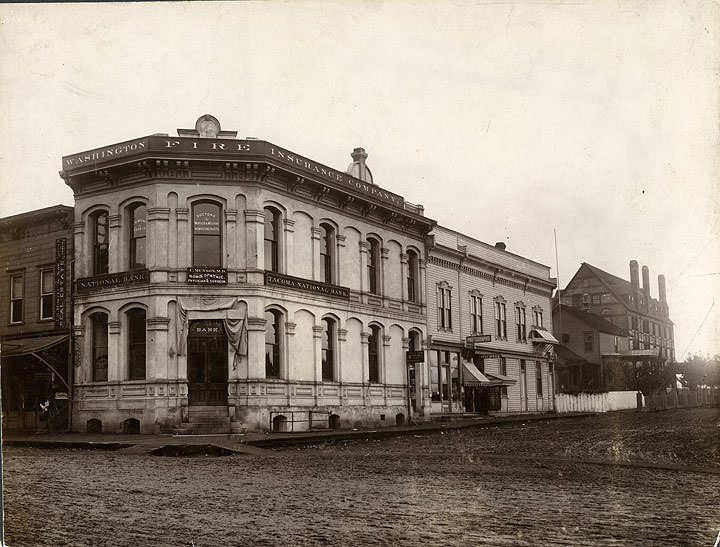
Signs on the building adjacent to the bank building, on South Tenth Street, in the right of the image read: Post Office; Photographs — the photo studio of I.G. Davidson. A display case is at the street-level entrance. The Tacoma Hotel is in the background on the right side of the image.
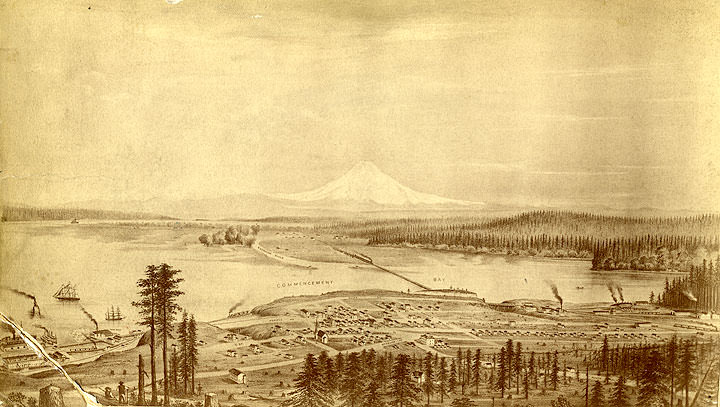
A few buildings are in the lower center foreground, and a partially visible train is shown, with industrial buildings in the lower right and near the lower left edge. Commencement Bay is beyond the land. Two sailing ships are in the lower left of the image.
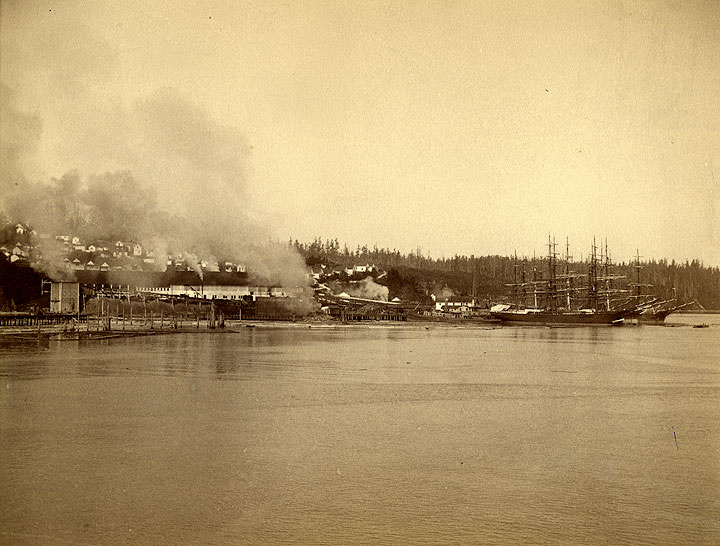
The lumber mill opened in 1869 as Hanson, Ackerson & Co., became the Tacoma Mill Co. in 1884, and was demolished in 1922. Three or four sailing ships are by the docks in the center-right of the image. Smoke rises from the mill buildings. Houses are built on the slope in the left center of the image behind the mill buildings.
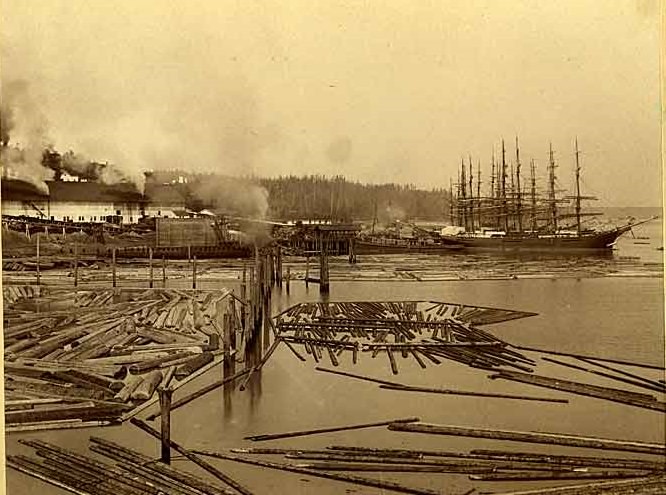
Log ponds are in the foreground. On the right side of the image, a few sailing ships are moored side by side by the mill docks. Tree-covered land is in the background.
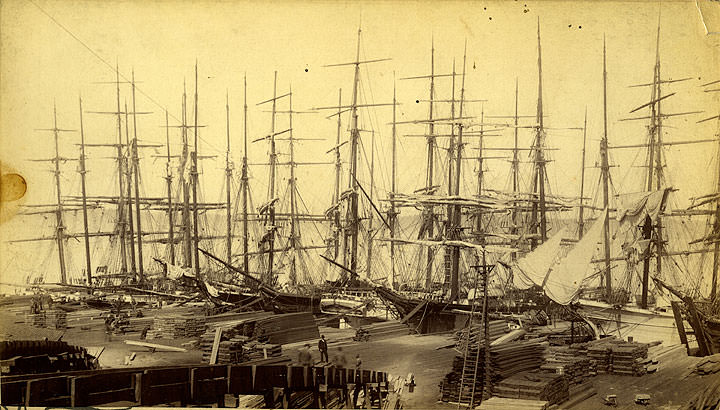
With many piles of lumber ready for loading, the wharf is at the lower edge of the image. A few men are standing on the pier, and two loaded wheelbarrows are near the lower right corner of the image.
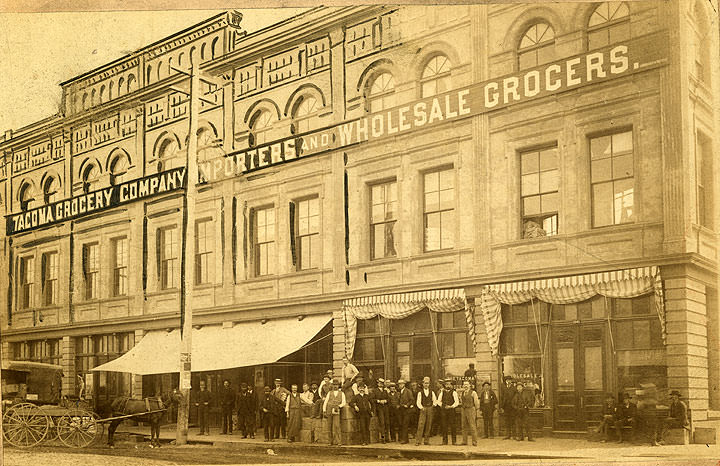
Some people are sitting on a stack of large packages on the sidewalk. The sign on the three-story building reads: Tacoma Grocery Company, Importers, and Wholesale Grocers. A horse-drawn delivery wagon is near the left edge of the image. John S. Baker was the company treasurer.
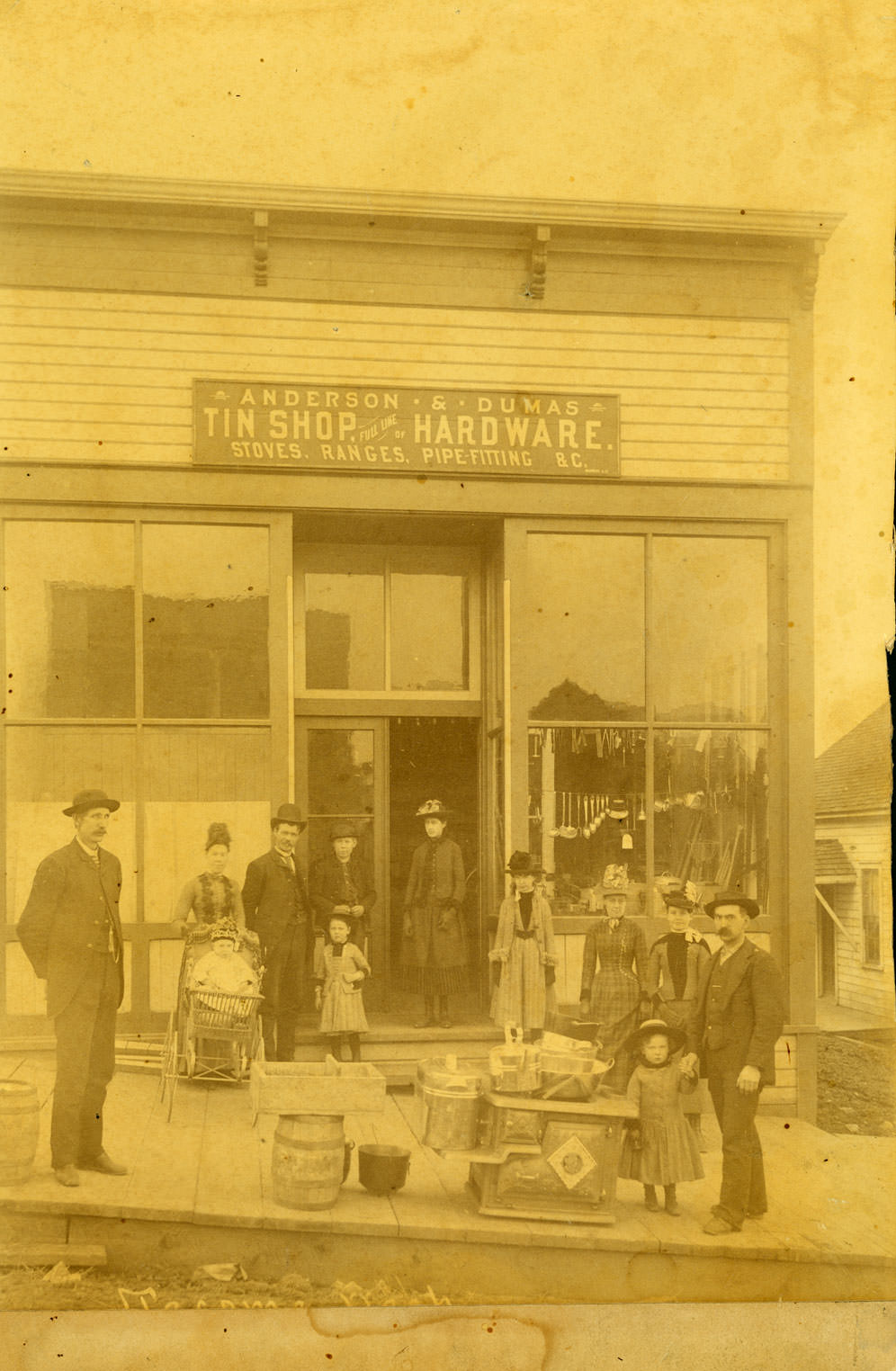
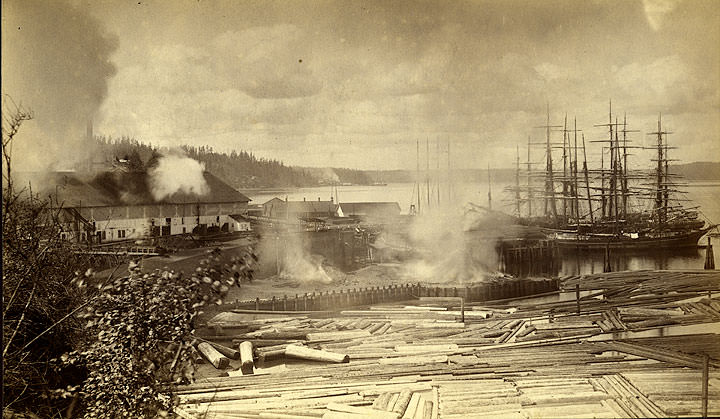
Many logs are in a log pond in the foreground of the image. Smoke obscures part of the image in the center. Three or four lumber schooners are moored together in the center-right of the image. Puget Sound is in the background.
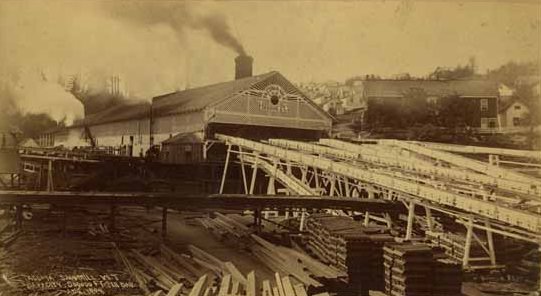
Piles of stacked cut lumber are visible, and smoke emerges from the sawmill smokestacks, but no workers are present.
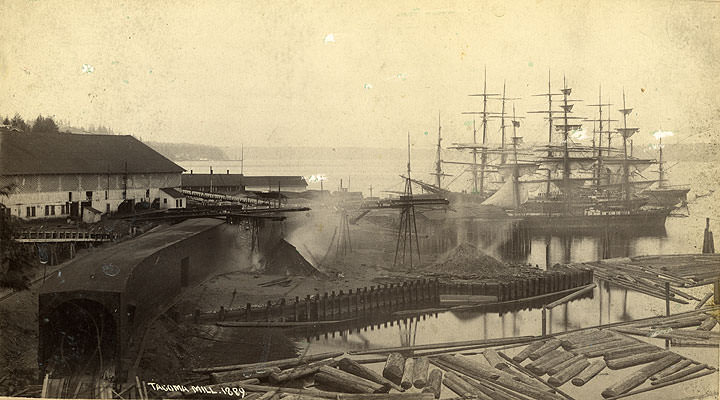
A covered railroad track and company buildings are on the left side of the image. A log pond and a pile of smoking sawdust on land are in the center foreground.
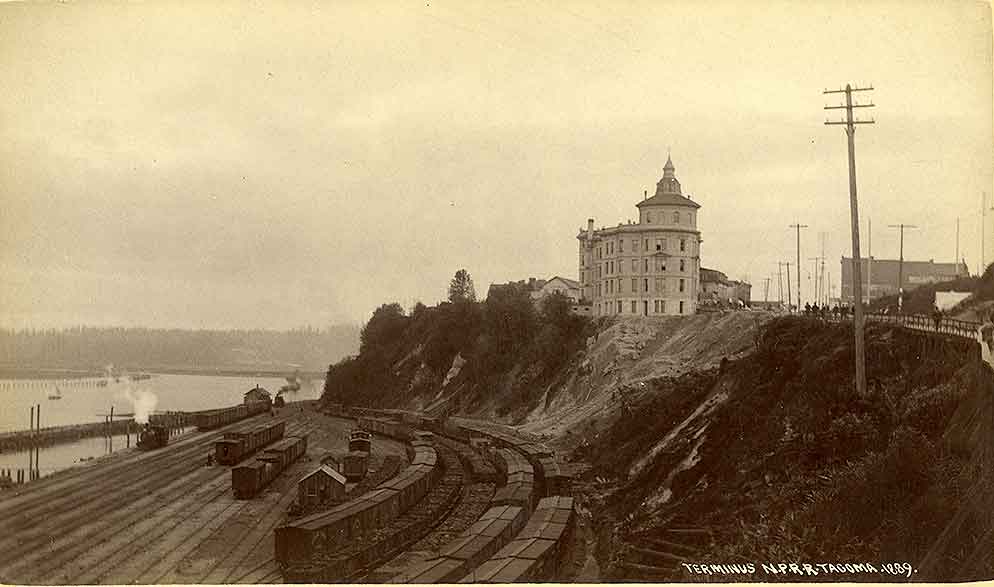
The photo shows the Half Moon yard in the foreground. At 7th and Pacific in Tacoma, the headquarters for the Northern Pacific sits on the hill above the railroad yard and Commencement Bay.
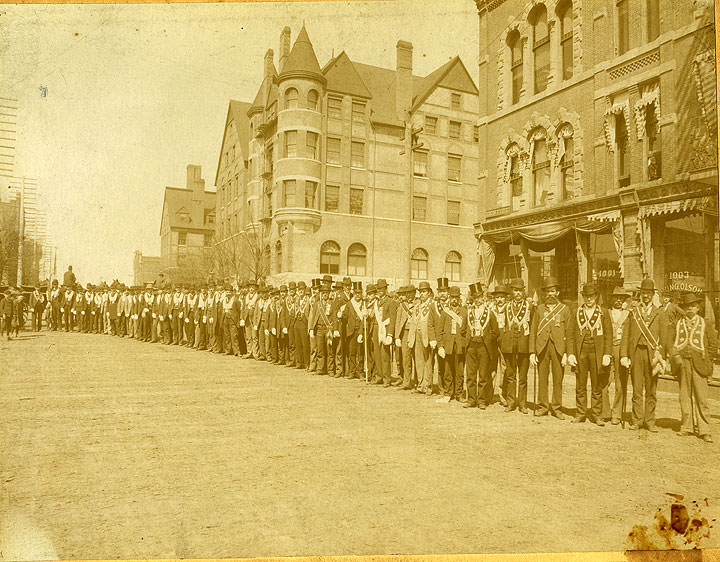
The men are lined up in a single line in front of the Tacoma Hotel on A Street in Tacoma. The men are wearing sashes around their necks and are members of the Independent Order of Odd Fellows.
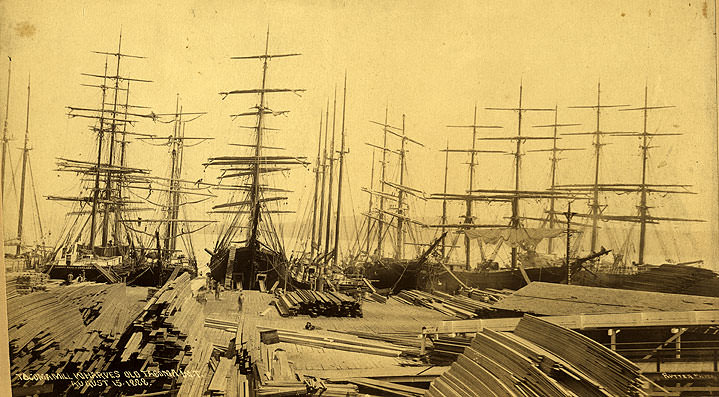
The masts of at least eight sailing ships, some loading lumber from the piers, are in the background.
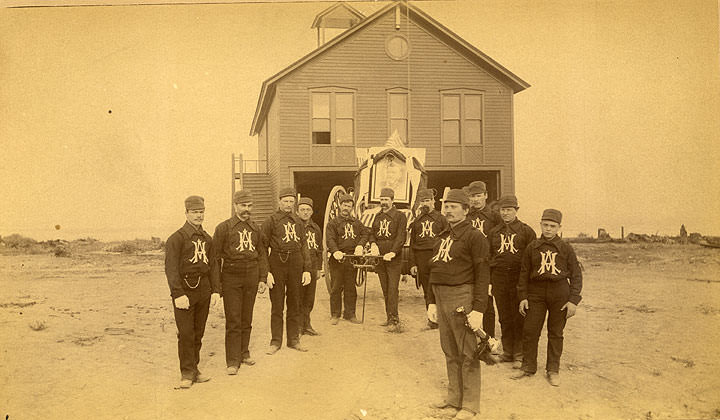
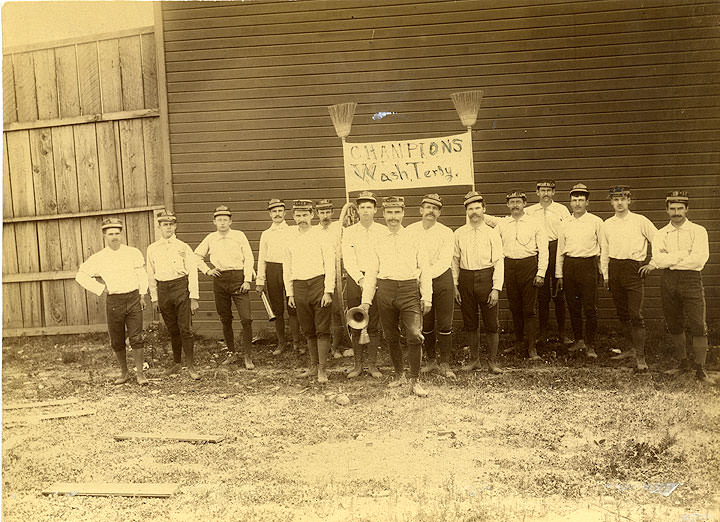
15 Tacoma Volunteer Fire Department firefighters are standing outdoors, posing in a group, Tacoma, Pierce County, W.T., 1887. They are in uniform, except they are not wearing jackets. Two men hold fire horns.
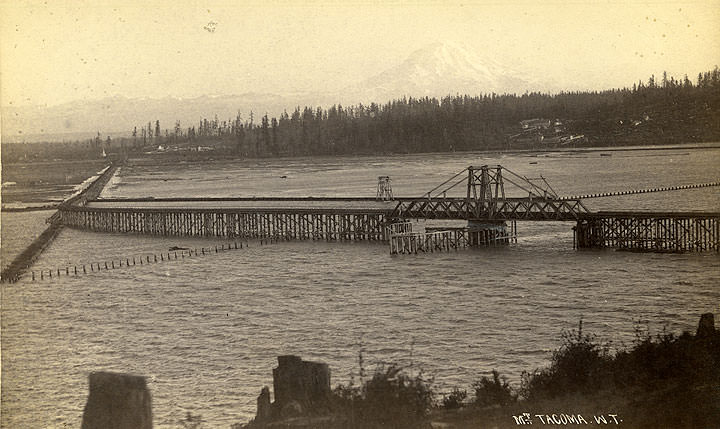
A trestle railroad bridge over a waterway in Tacoma, Pierce County. The image is taken from land, and low foliage is in the foreground. The trestle bridge runs horizontally across the center of the image, making a 90-degree angle into the background near the left edge. The rotating bridge span is on the right side of the image.
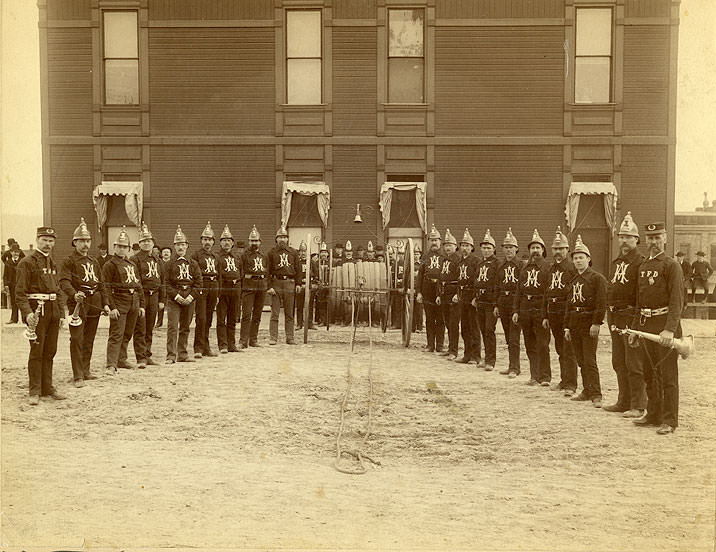
The men are lined up in a V formation outside of a tall clapboard building. They wear uniforms with a monogram on their breast that reads H.A. or A.H., and peaked fire hats. Three are holding nozzles.
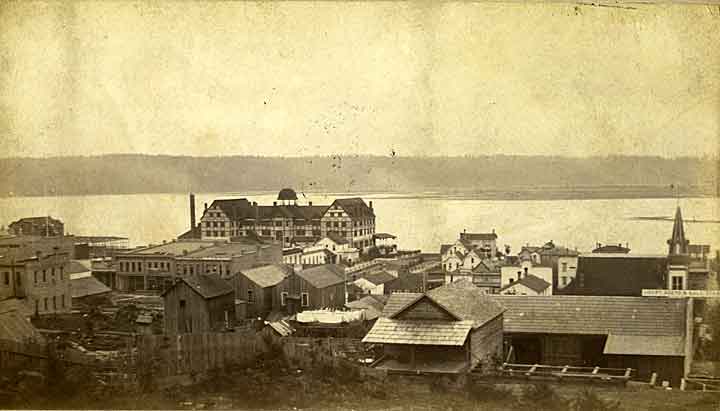
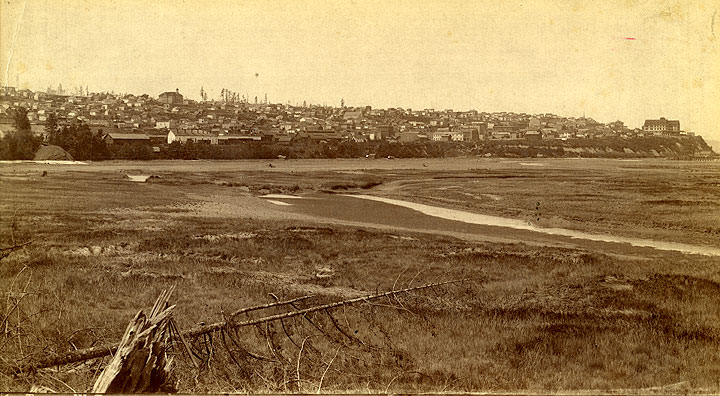
Buildings included the Tacoma Hotel and the First Presbyterian Church at the far right. Commencement Bay and the undeveloped area across from the bay are visible in the background. “C” Street is now Broadway.
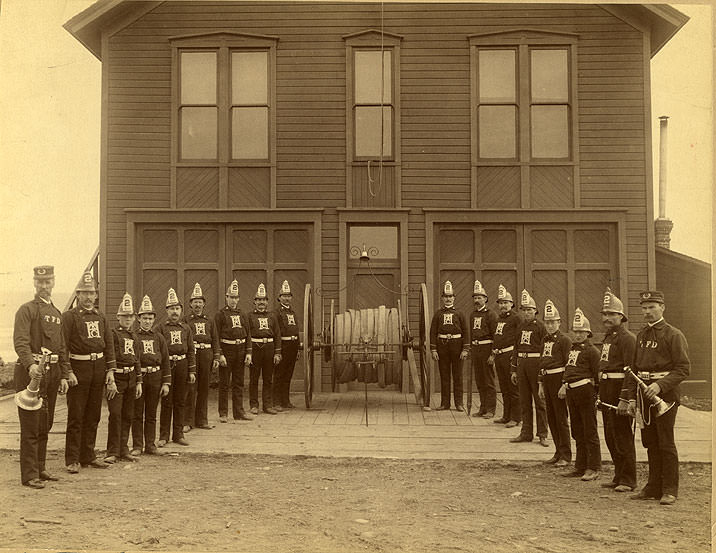
In the center, the firefighters posed in a semicircle with their hose wagon, which has a bell on top. Three of the men are holding horns. In Tacoma, Eagle Hose Company No. 2, 1st ward, was located on A Street between 12th and 13th.
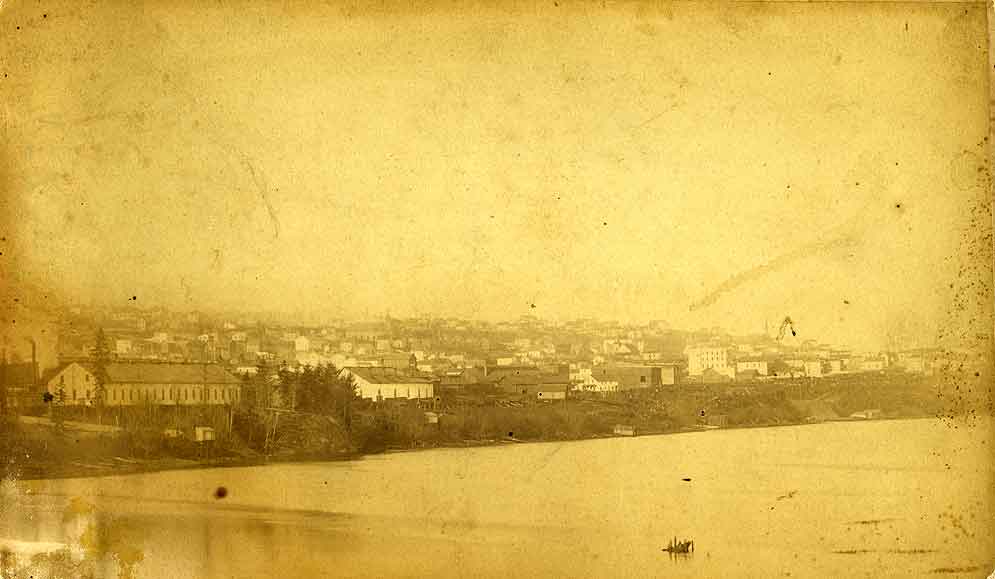
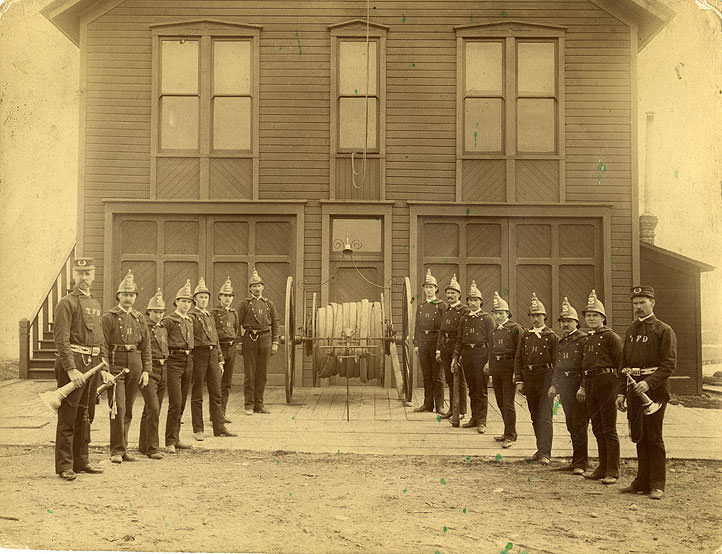
The photo shows the firefighters from Hose Co. No. 3, posed in a semicircle with their hose wagon, which has a bell on top, in the center. Three of the men are holding horns. Chief A. D. Rainey is on the left front holding a horn.
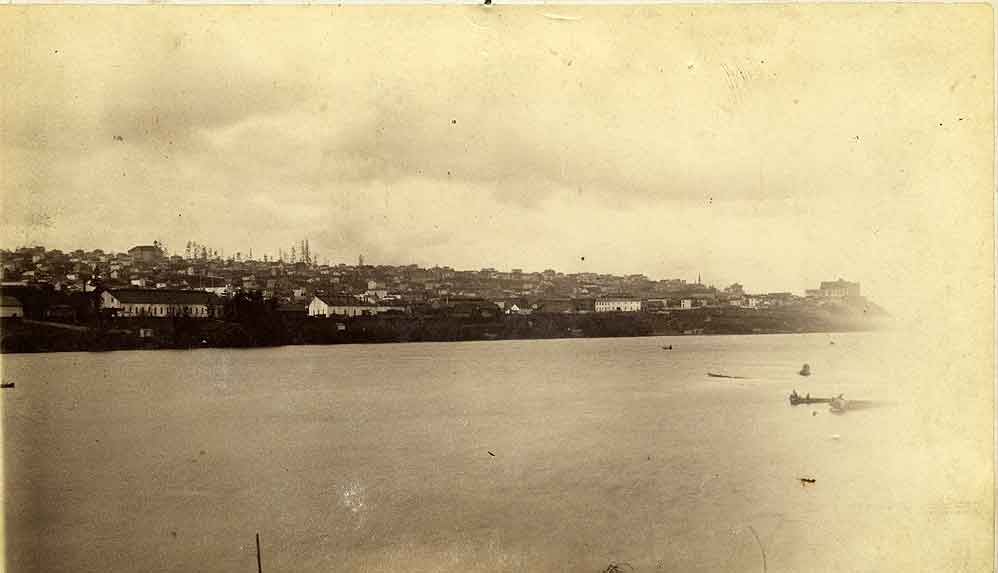
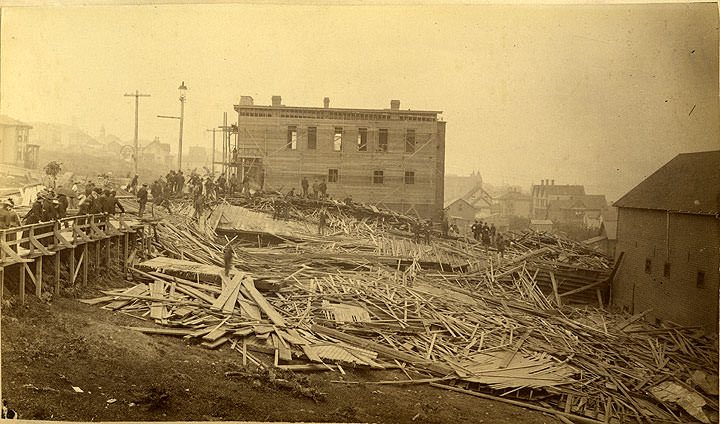
The remains of several frame buildings at the corner of Tacoma Avenue and South Seventeenth Street were collapsed by the most destructive storm to ever hit Tacoma. On the left side of the image, several men and women look at the debris from the elevated sidewalk. Several men stand atop the debris.
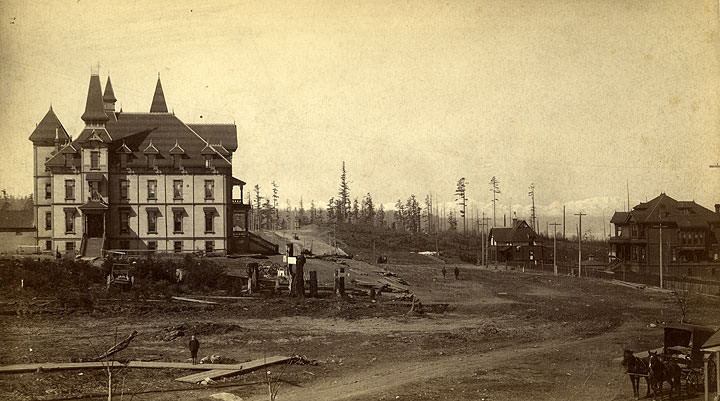
In the center-left of the image, Annie Wright Seminary is viewed from the side at Tacoma Avenue North and Division Avenue, along dirt roads in Tacoma. The view looks northwest on Tacoma Avenue North, which runs at an angle in the center of the image. The present Vista Del Rey Apartments at 319 Tacoma Avenue North is near the tall tree in the center background. A few tree stumps and two wagons are amidst random vegetation on the side of the school.
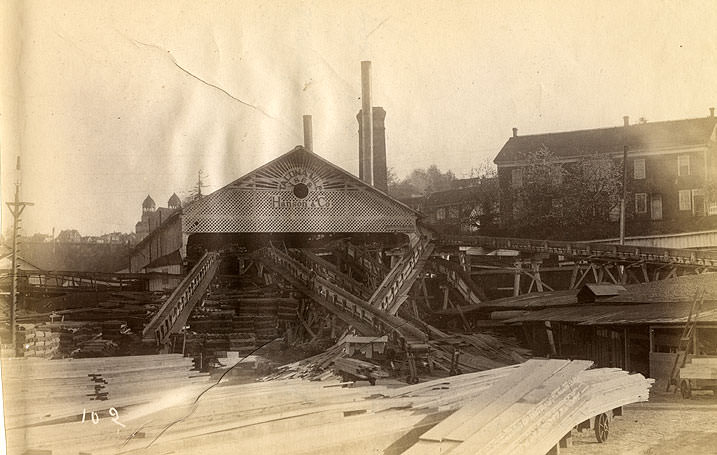
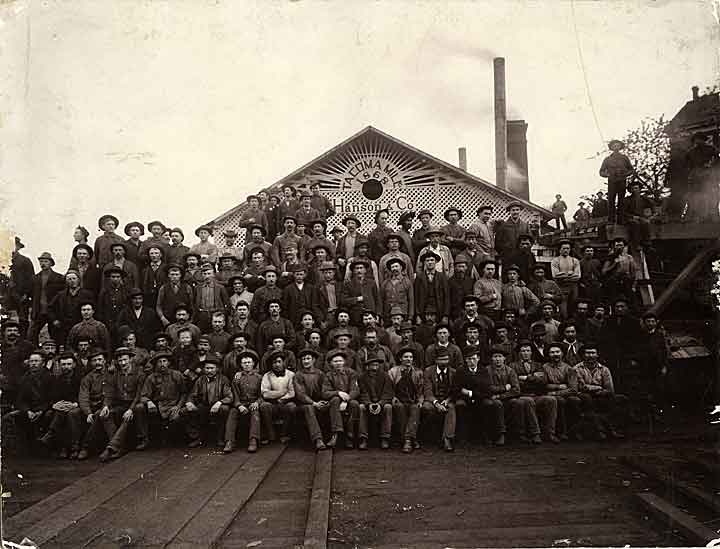
In the center of the photograph is a long, elevated building with an opening extending the width of the building and several belts extending from ground level to the opening. Unmilled lumber is stacked all around the building. A sign at the roof peak reads Tacoma Mill 1865, Hanson & Co. In the foreground are stacks of milled lumber. To the right of the building is a two-story residential structure, and in the distance are smokestacks and the two steeples of a large building.
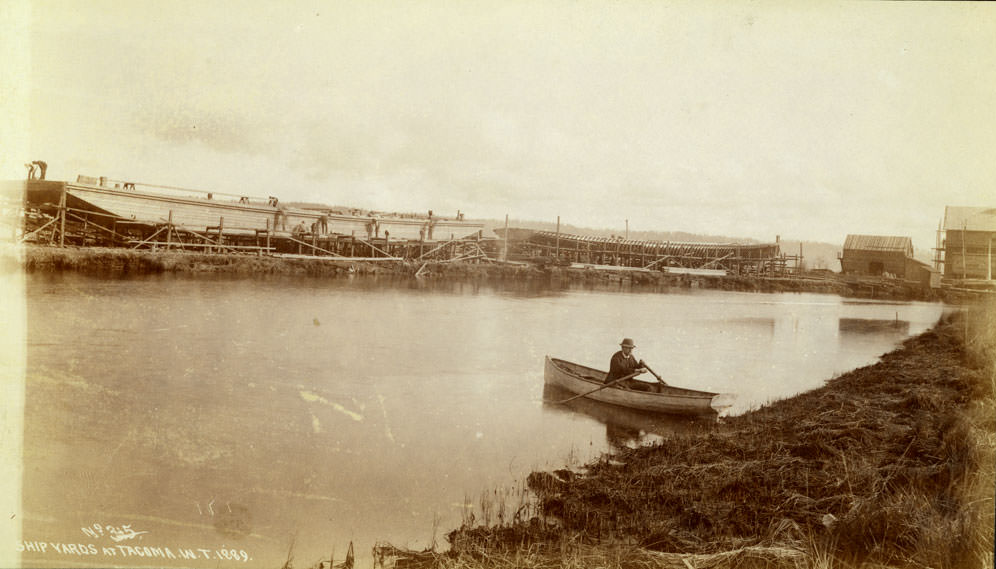
A man in a rowboat is in a waterway next to an unnamed shipyard in Tacoma. Shipyard workers are working on a vessel in the background.
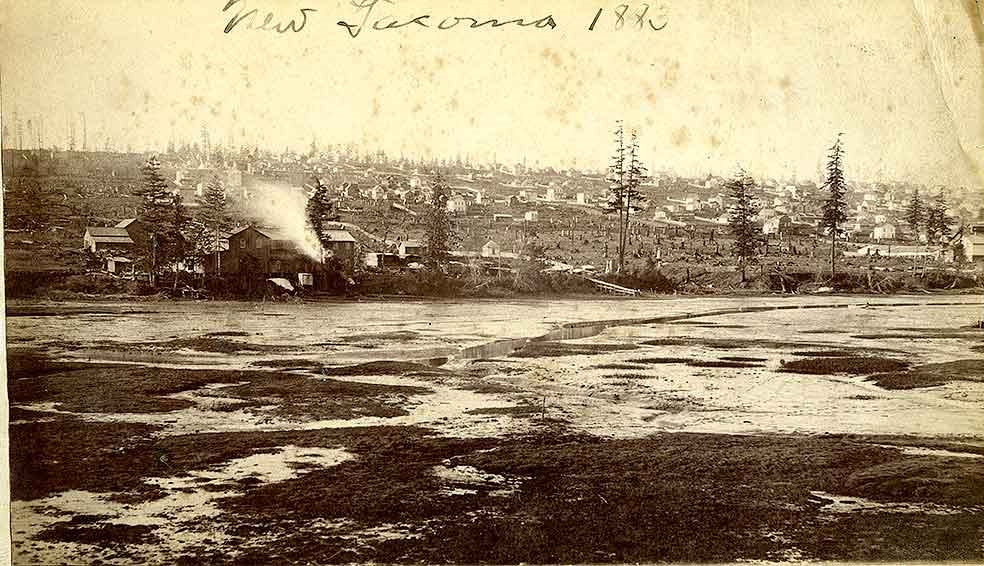
The photo was taken from the tideflats and shows a two-story building on the left, an expanse of tree stumps extending up the hill, and numerous houses on the right side of the photo extending from the water up the hill.
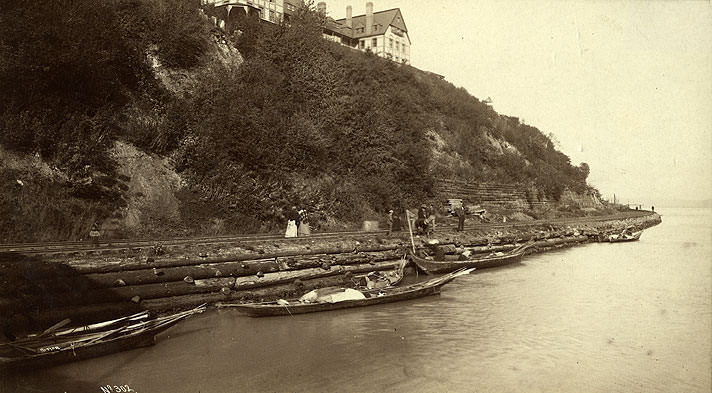
Two Puyallup women, a child, and a few men are standing on railroad tracks running along Commencement Bay below the Tacoma Hotel, which is partially visible on the bluff above the water.
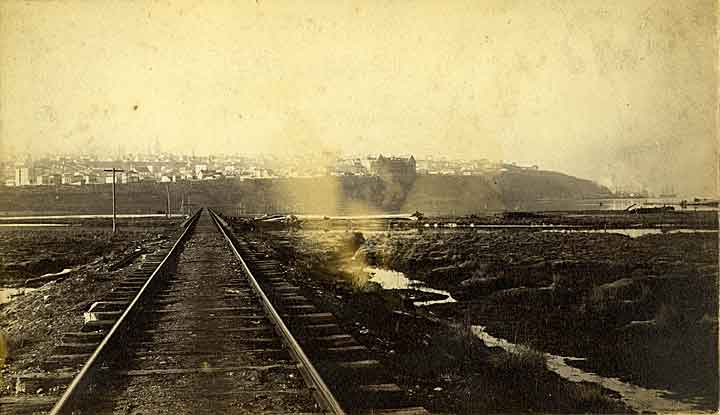
The perspective is from a train traveling on the tracks leading to Tacoma. Areas of standing water are located along the sides of the railroad tracks. The Tacoma waterfront area and a small section of Commencement Bay are visible in the distance.
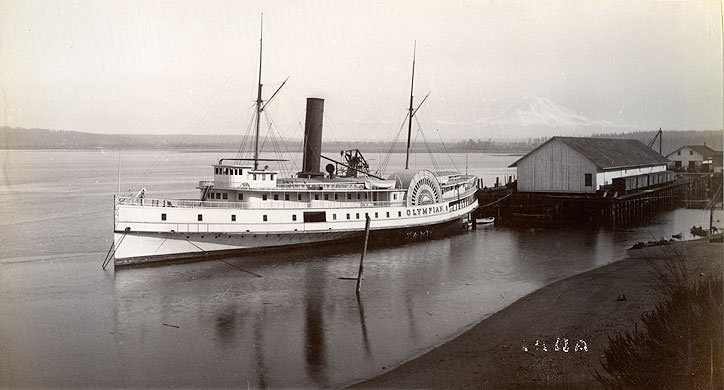
The ship is viewed from the bow end of the port side, in the center of the image. A building on a wharf is in the center-right of the image. The mainland is at the lower right corner. Mount Rainier is faintly visible in the right background.
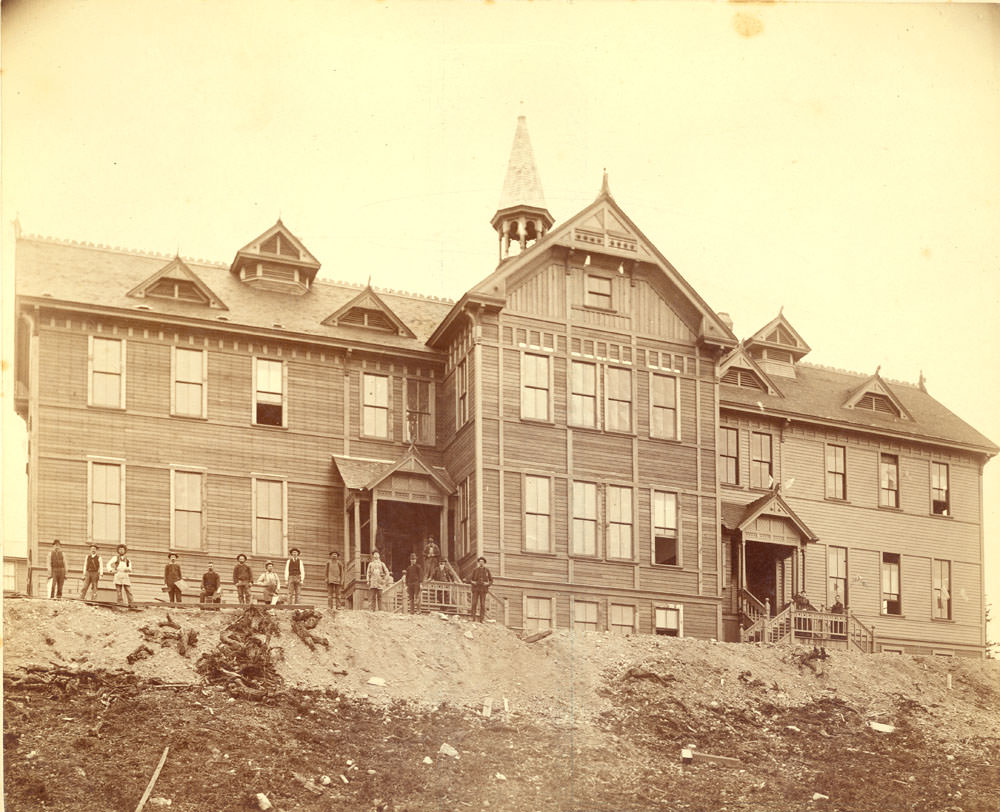
The photo shows a large two-story wood-framed building with two women and 14 men in working clothes standing outside. A bell tower is behind the central area of the building.
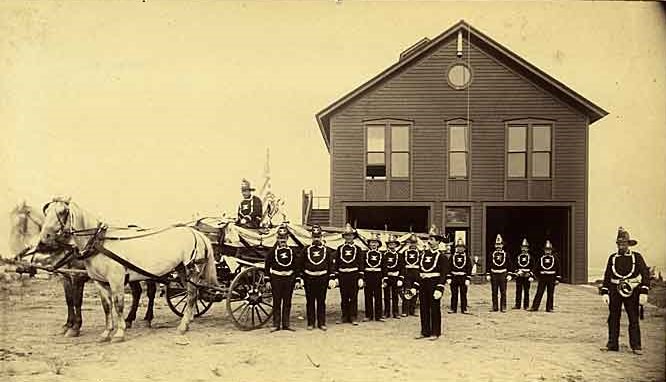
Twelve men stand at attention. The man near the right edge of the image may be holding a megaphone under his arm. Another man may be holding a bugle in his hand. A hook and ladder wagon are partially visible behind the men in the center. The horse team drawing the wagon is visible on the left side of the image.
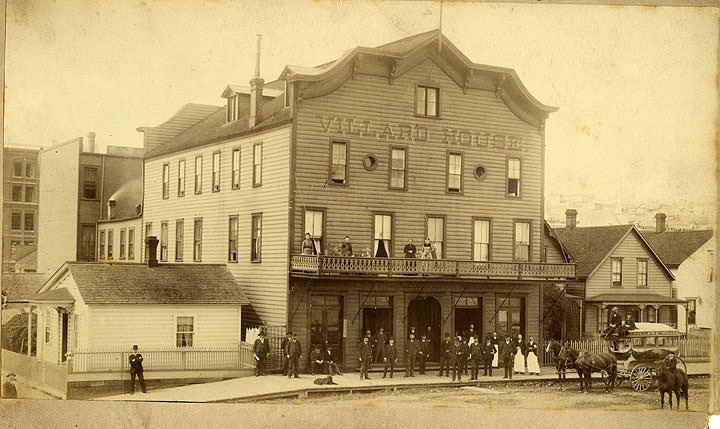
Several men, including three employees wearing long aprons, pose standing in front of the building. A dog lies on the sidewalk. Four women pose on the second-floor open balcony extending across the front. Two men sit atop a three-horse-drawn carriage with “Villard House” on the top, on the dirt road in front of the building. A man on horseback is nearby.
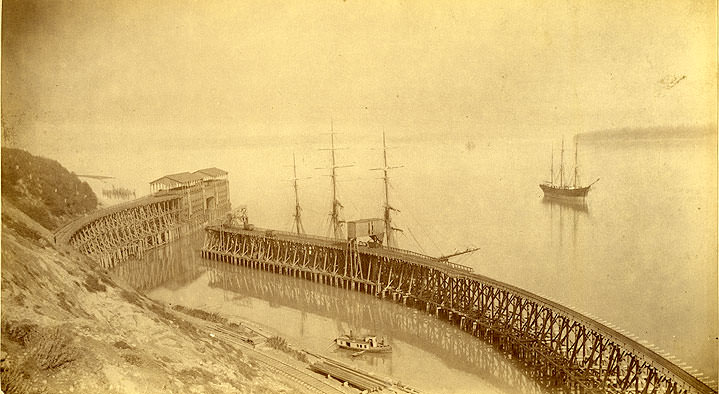
A small boat, possibly a tugboat, is on the small pond created by the curve of one bunker. A sailing ship is partially visible on the far side of the bunker. Another is in the water on the right side of the image.
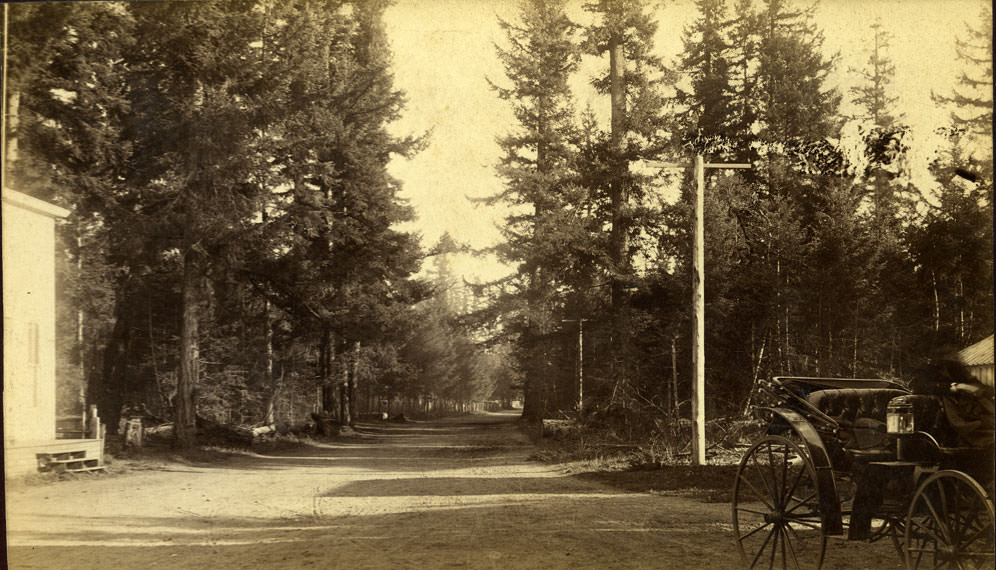
An open carriage is partially visible in the lower right foreground, and the corner of a wooden building is at the left edge of the photo. Tall evergreens line both sides of the dirt road extending into the center background.
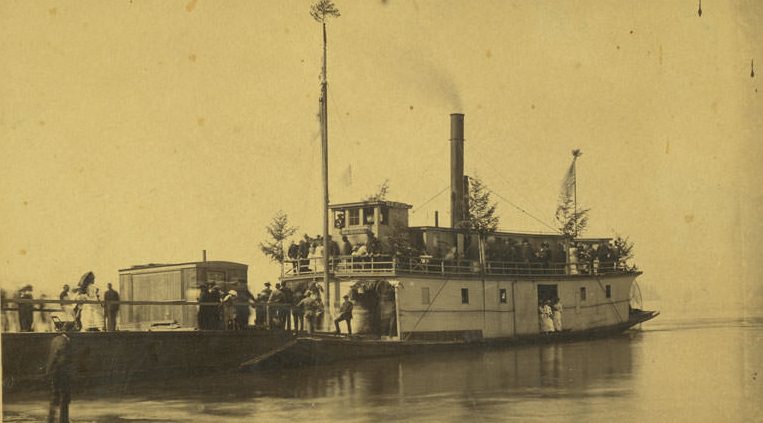
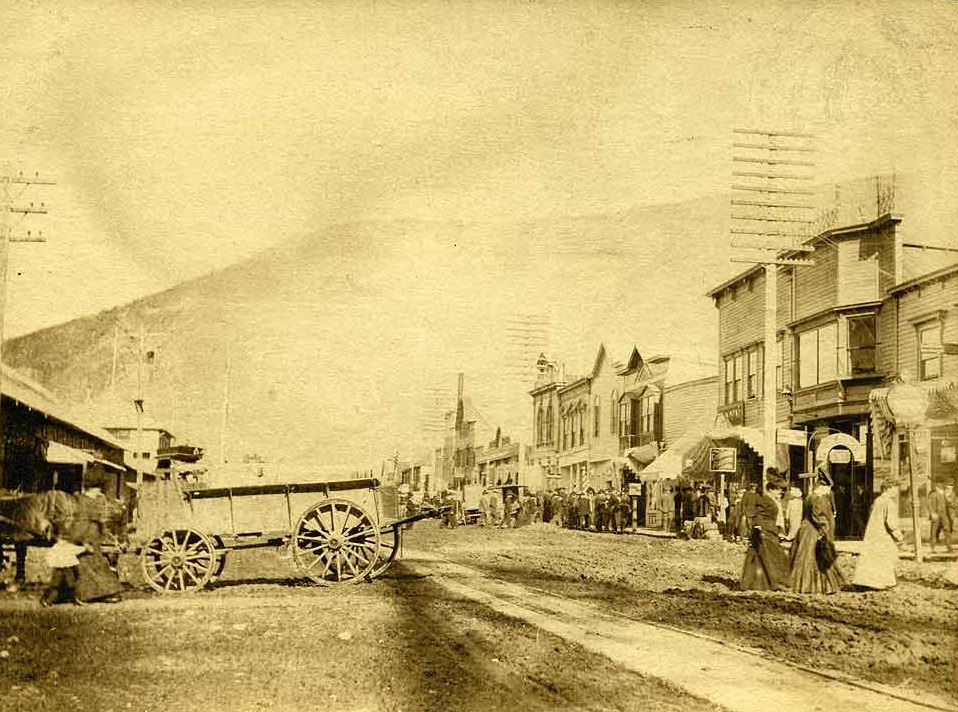
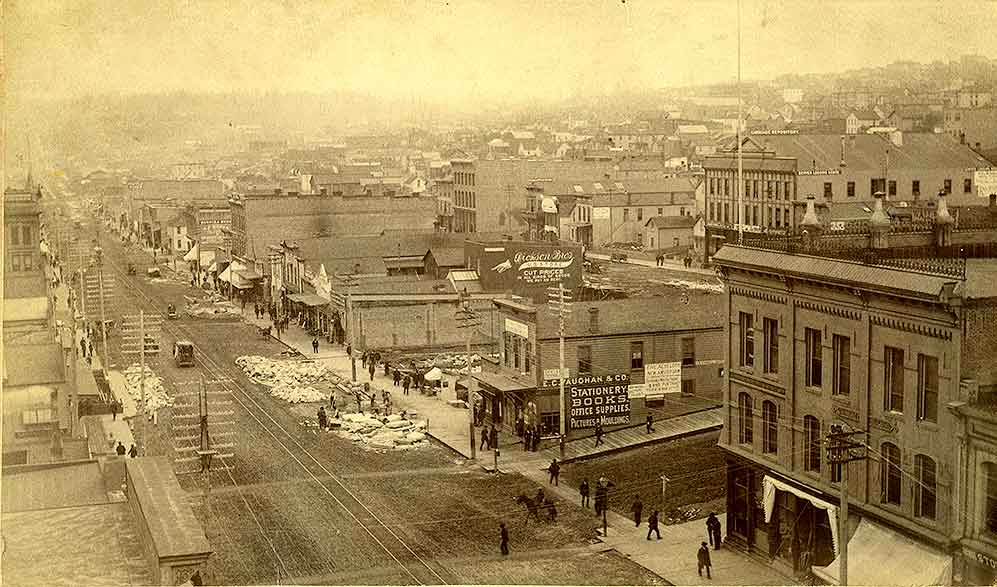
There are several two- and three-story buildings on the right side of the photo with a wooden sidewalk in front of them. Men and women are walking on the sidewalk and crossing the dirt road.
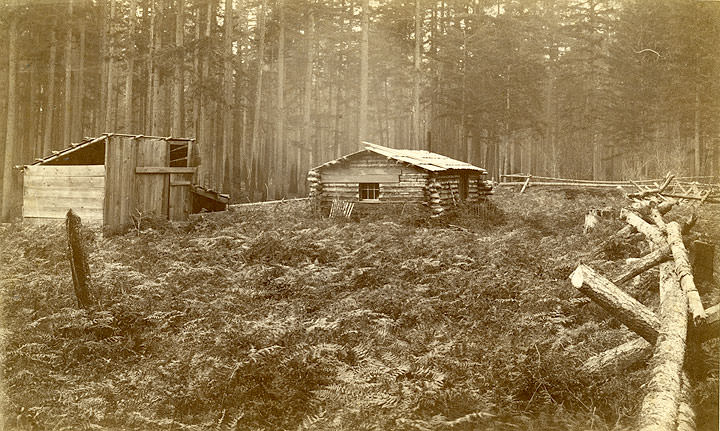
A shed is on the left side of the image. Ferns cover the foreground. A split-rail fence encloses the cabin on the right side of the image and behind the cabin. Dense trees are in the background.
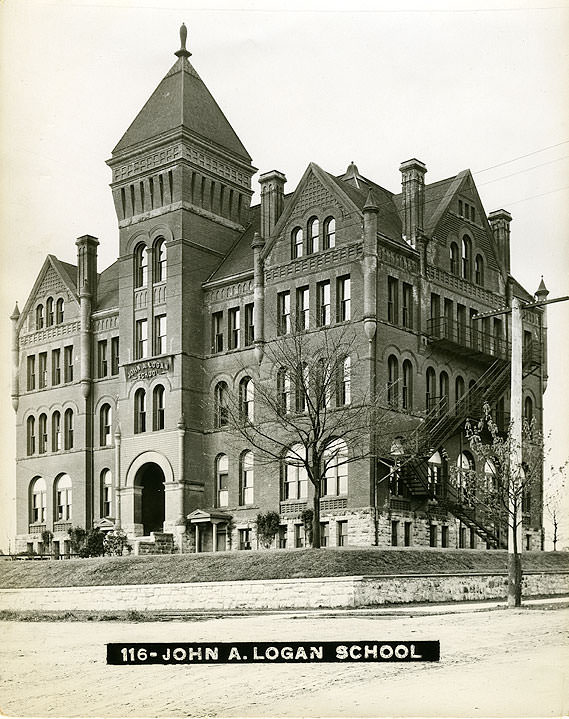
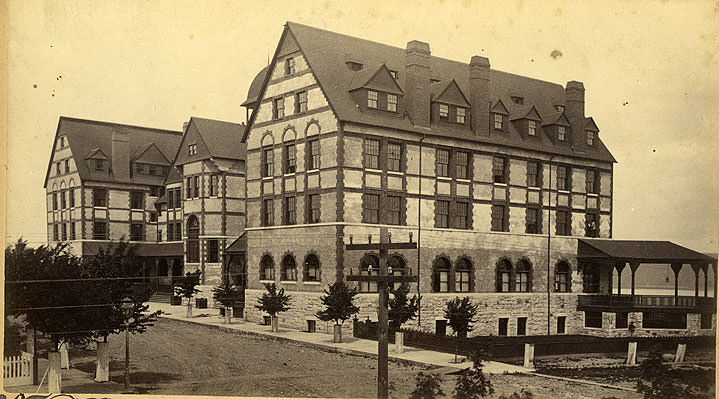
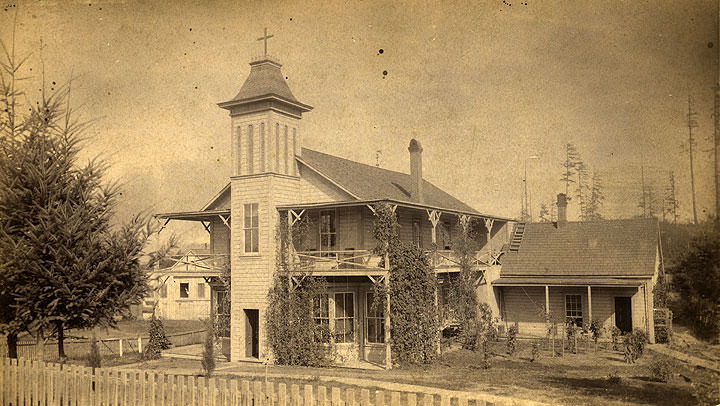
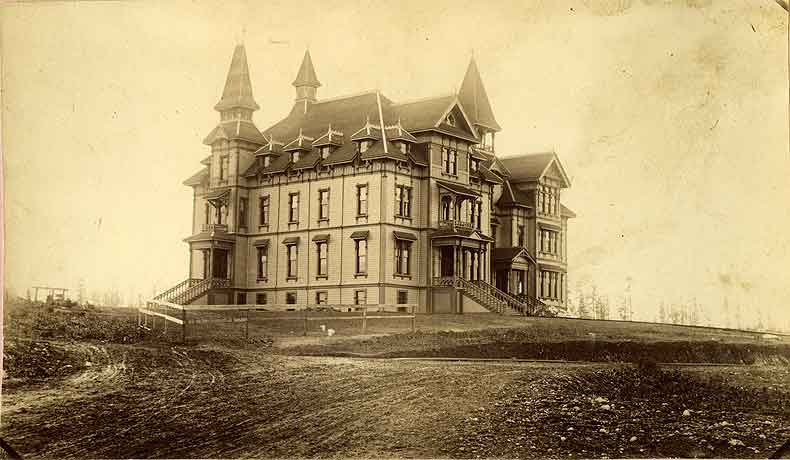
The building was built in 1889, with Proctor & Dennis as architects, and was demolished in 1925. It was the first location for Puget Sound University, later the University of Puget Sound.
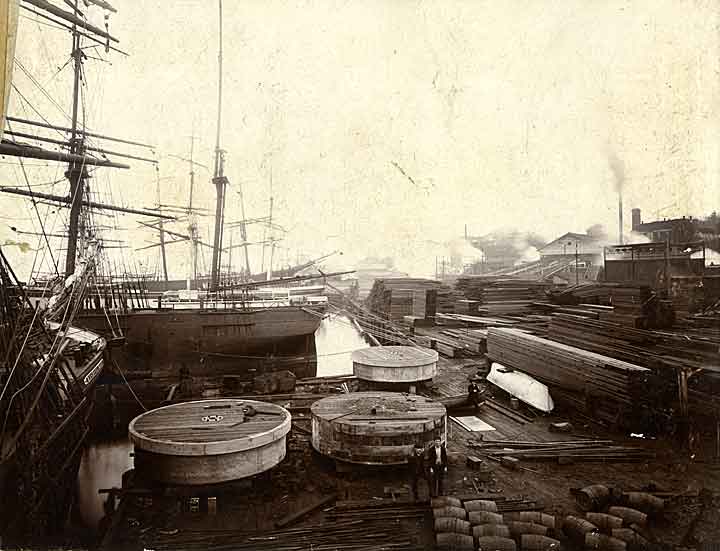
The mill company buildings are visible in the center-right background. Stacks of lumber are on the dock in the center-right of the image. The dock extends into the lower foreground. Barrels lie sideways on the dock near the lower right edge of the image. Two men are standing in front of one of three low, wide-diameter circular objects, partially covered with wood, sitting on the dock above the center of the image’s lower edge. They may be millstones. Another man rests against the hull of a small overturned boat nearby. The sides of possibly four sailing ships are moored by the dock area in the center-left of the image.
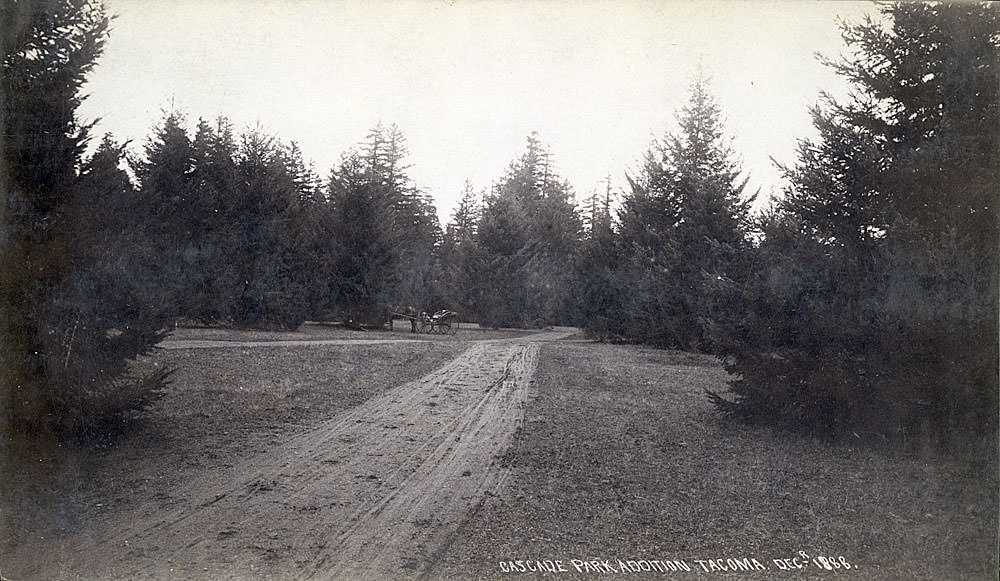
The Cascade Park Addition was platted in 1888. South 40th Street bordered it on the north and South 48th on the south, between Union and Lawrence in South Tacoma, not far from the Northern Pacific Railroad shops. In this image, a dirt road leads from the foreground and intersects with another dirt road running left to right in the center of the image. A horse harnessed to an open buggy stands in the grass just to the left of where the two roads intersect. Several tall evergreen trees line the roads.
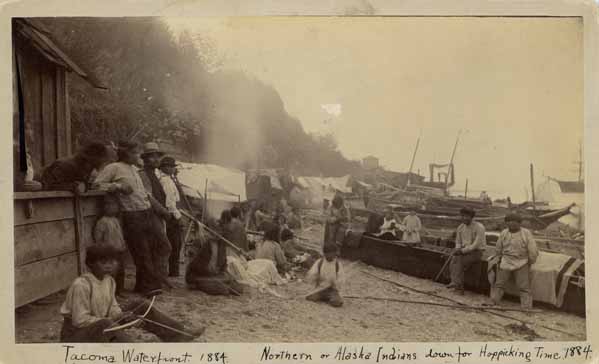
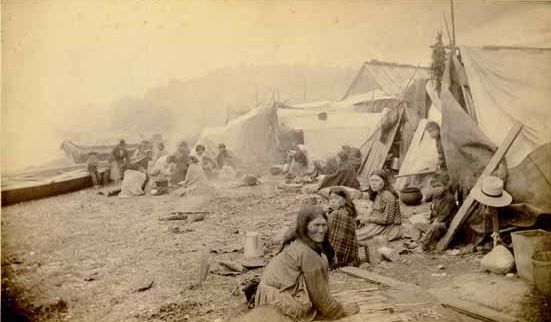
The young boy in the left foreground holds a bow and arrow. Other people rest seated on canoes or beach areas. Many canoes and tents are visible.
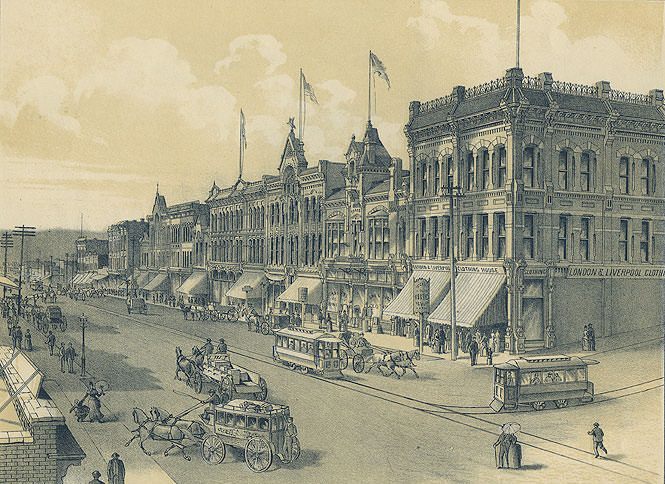
There are two Tacoma Street Railway cars and several horse-drawn vehicles. The verso is labeled Tacoma Ave. North from 9th St.
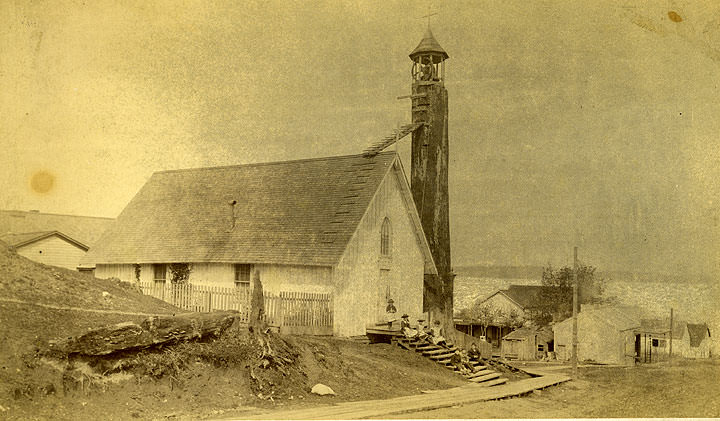
Four girls and three boys sit on the church steps. A bell is visible in the tower next to the church. Commencement Bay is partially visible in the background.
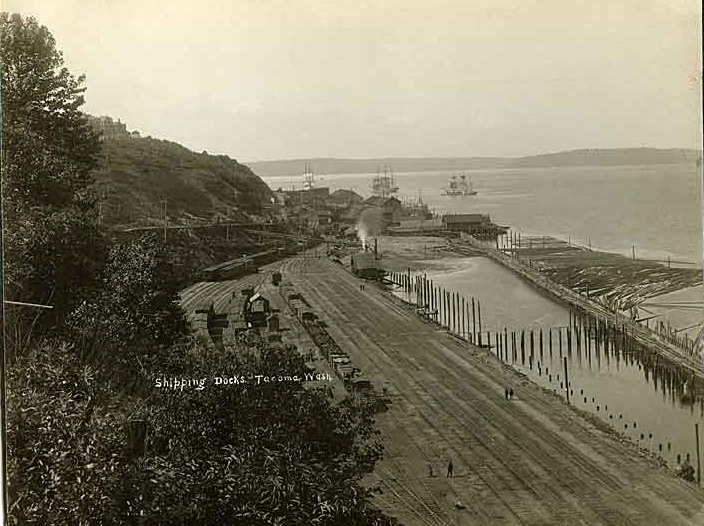
A log pond near the shore is near the center of the right edge of the image. Buildings, probably on shipping docks, are visible in the upper center. Three sailing ships are in Puget Sound beyond the buildings. A partially wooded hillside rises above the railroad yard on the left side of the image.
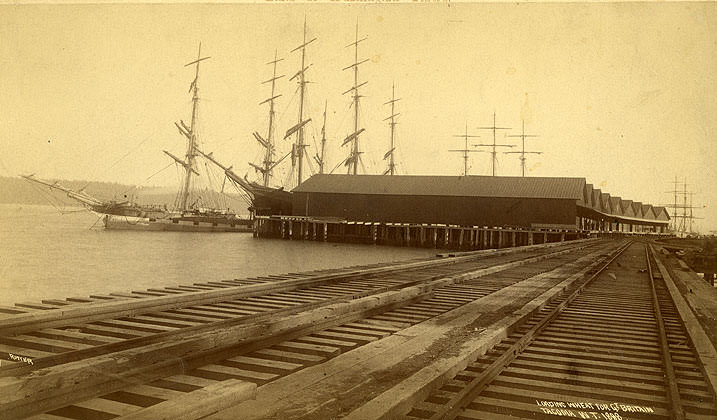
Railroad tracks are prominent in the foreground, and the warehouses are in the center of the image.
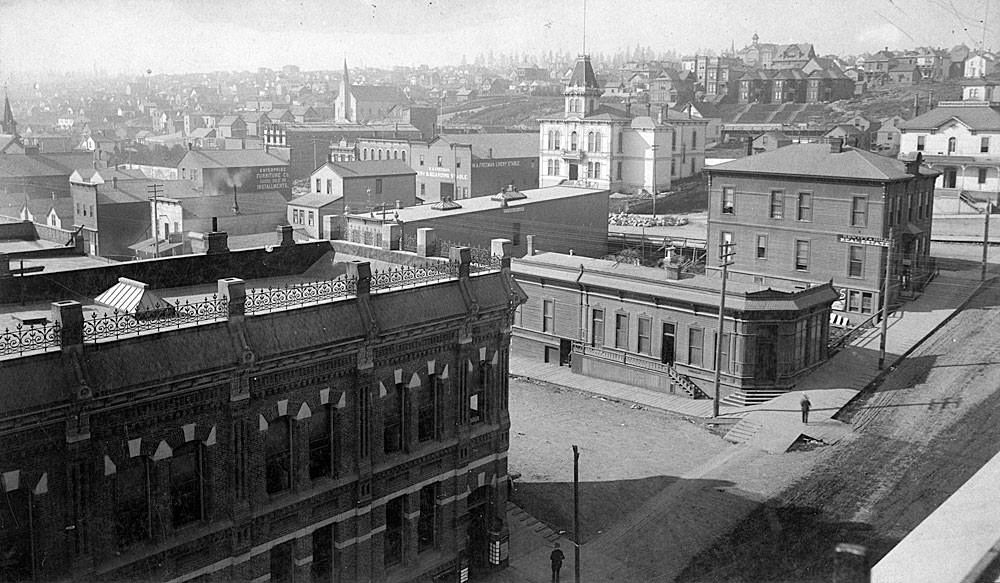
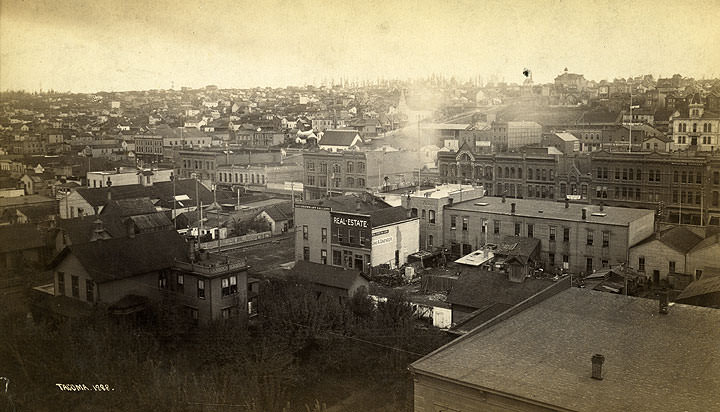
The elevated view looks west toward the first County Courthouse (1881–1893), the large white structure just right of center. To the left of the Courthouse is W.A. Freeman Livery Stable and the offices of the Tacoma Ledger. Just across the street from the Ledger is Enterprise Furniture Co. To the right of the Courthouse on the opposite side of the street is the office of Hewitt & Hill Real Estate. The streets are unpaved, and the sidewalks are wood planks.
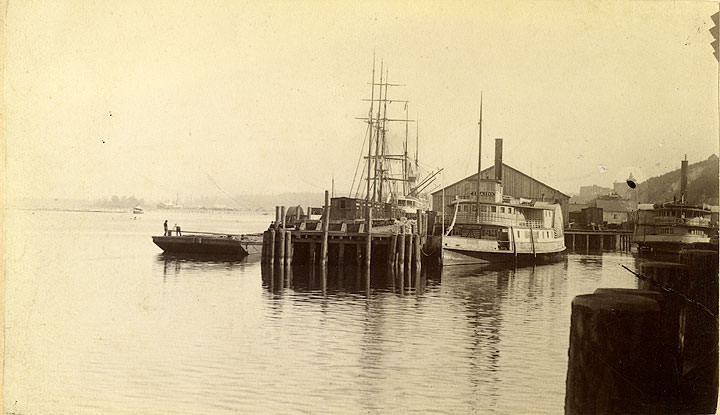
The end of the pier is visible in the center of the image. The end of a freight train is visible on the pier. A barge, with two men on it, is on the side of the pier on the left side of the image. The masts of possibly two sailing ships are visible in the center background. Another steamship is docked at the right edge of the image.
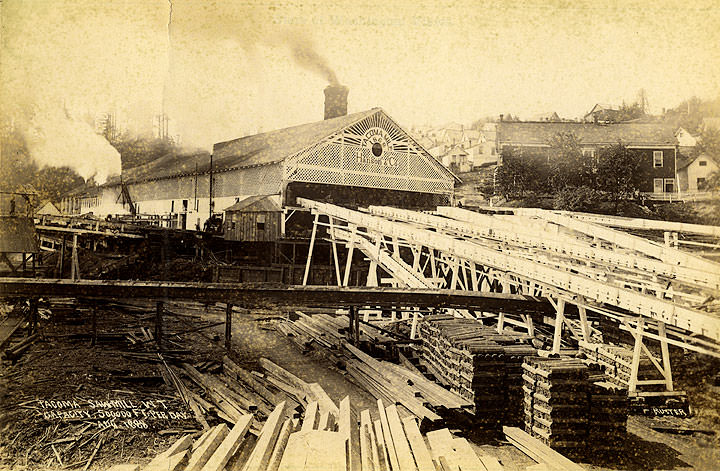
The company names are on the building. Trestles, with apparent pieces of lumber on top, descend from the open end of the building past the right edge of the image. Pieces of lumber lie on the ground in the foreground.
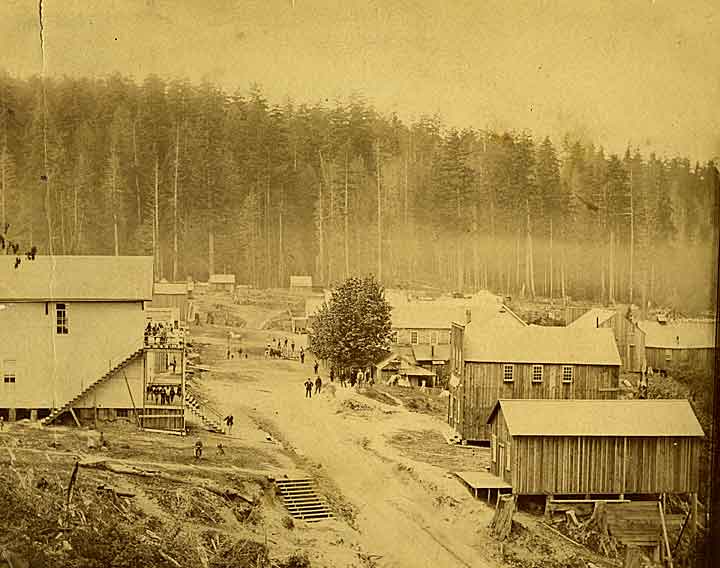
A two-story building, possibly a school, with children standing on the first- and second-floor exterior landings is on the left. Boys stand together on the lower level of the building, and girls stand together on the upper level. Other people, primarily men, and several horses are visible standing on the unpaved street.
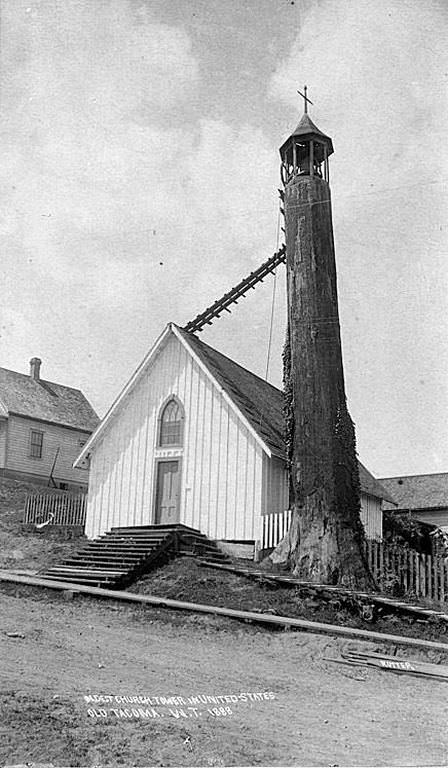
The church was built in 1873 and is the oldest building in Tacoma. The image shows a simple white wooden church building with a single door and a small arched window above. Wooden steps lead from the unpaved street to the church. The church’s bell tower is a tall tree stump topped with the housing for the bell.
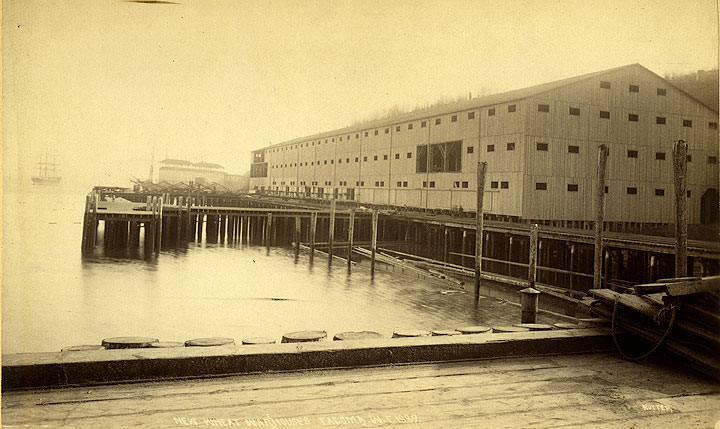
The image is taken from a dock in the foreground. The warehouse, apparently under construction, is visible in the upper center and right of the image. A loading dock extends from the building into the water in the center-left of the image.
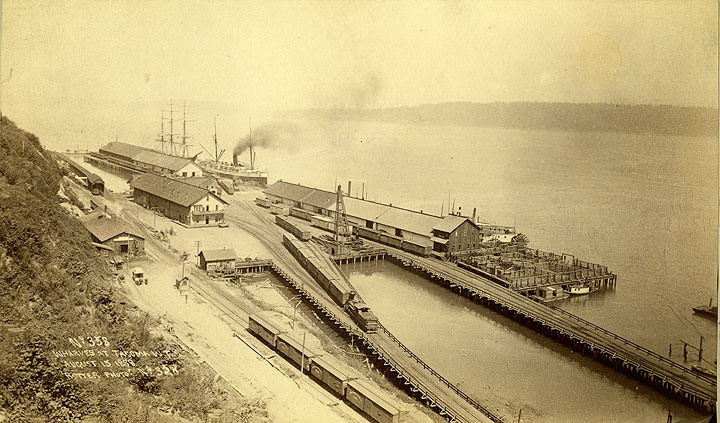
Part of the hillside is visible at the lower left corner of the image. The old Northern Pacific Railroad depot is the two-story building to the left of the center, near the wharves extending in the center of the image. Four freight cars are above the lower center edge. More freight cars are adjacent to the piers in the center. A sternwheeler is partially hidden behind a wharf at center-right.
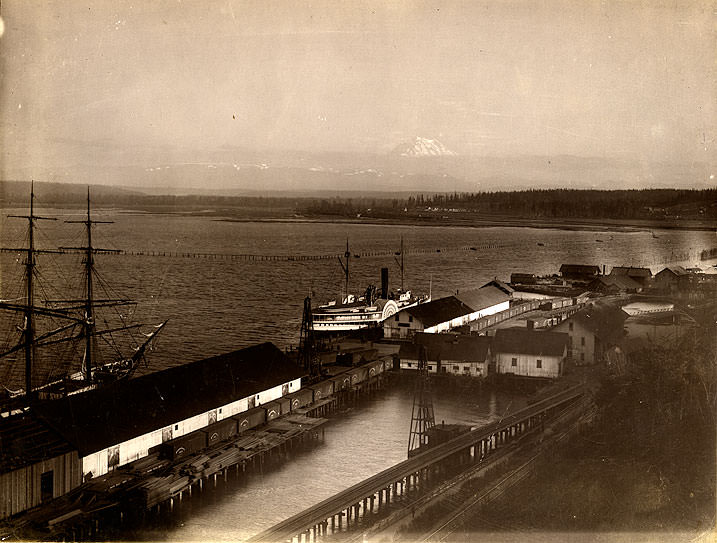
A sidewheeler steamship is moored on the far side, running diagonally from the lower-left corner of the image toward the center-right, with warehouses along the wharf.
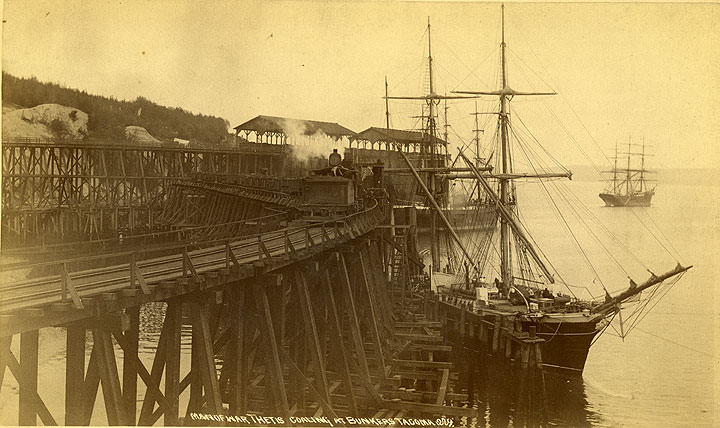
The Thetis is tied up next to an elevated track. A small train with many cars filled with coal is on the tracks above the ship, preparing to load onto the Thetis.
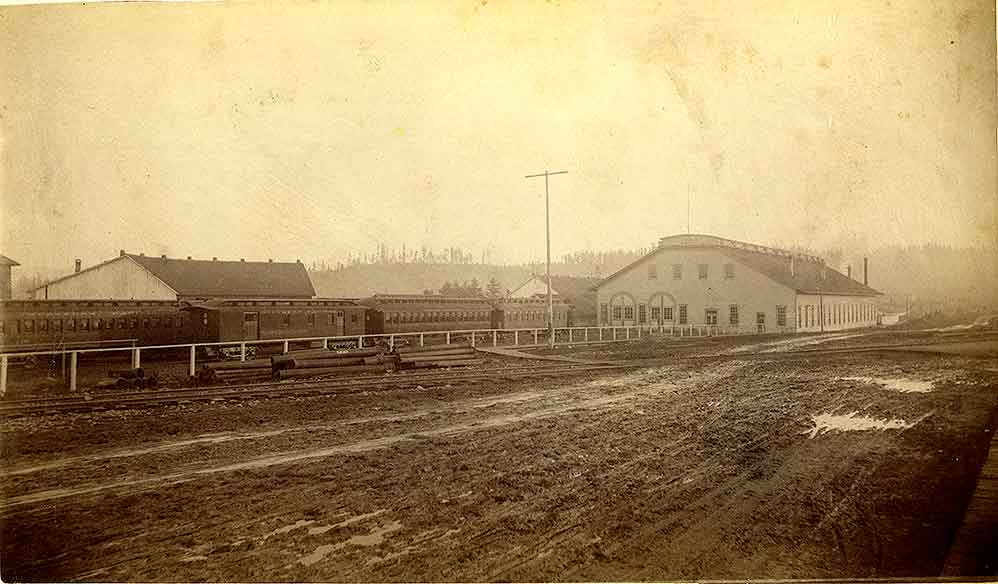
The muddy ground is in the foreground, and long pipes are piled near a fence across the center of the photo. Passenger railroad cars, another type of railroad car, and buildings are behind the fence.
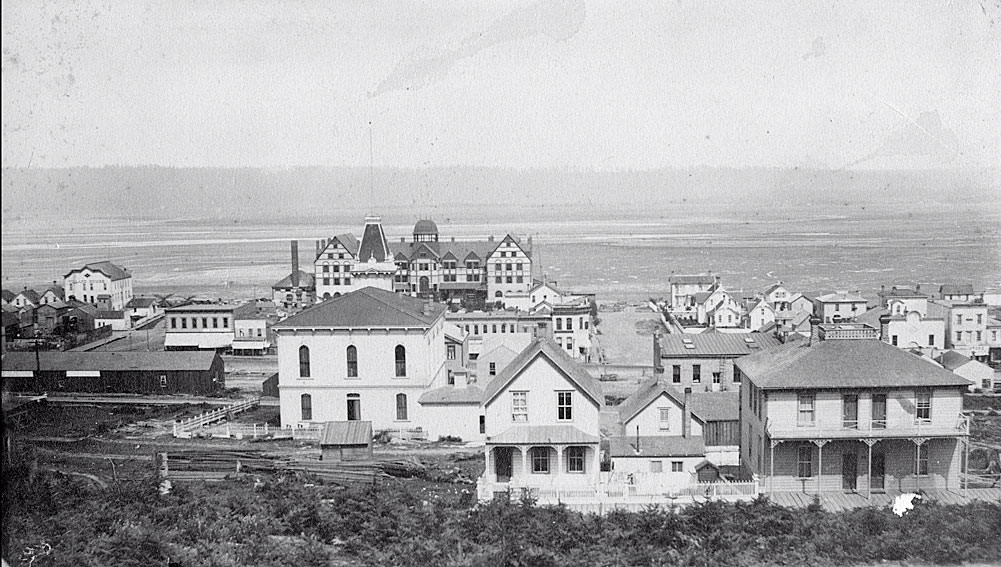
Several wooden barns and houses sit in the foreground while a few brick buildings are behind them. A sign on the roof of one of the wooden buildings reads Livery Board & Sale Stable. A church is visible on the far left. Railroad tracks cut diagonally across the tideflats just to the right of the church.
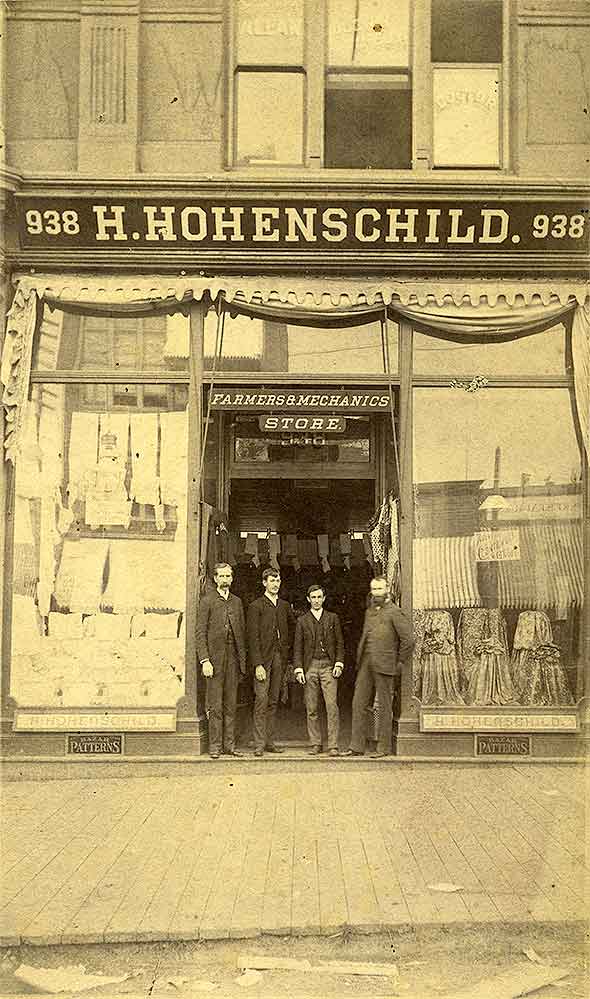
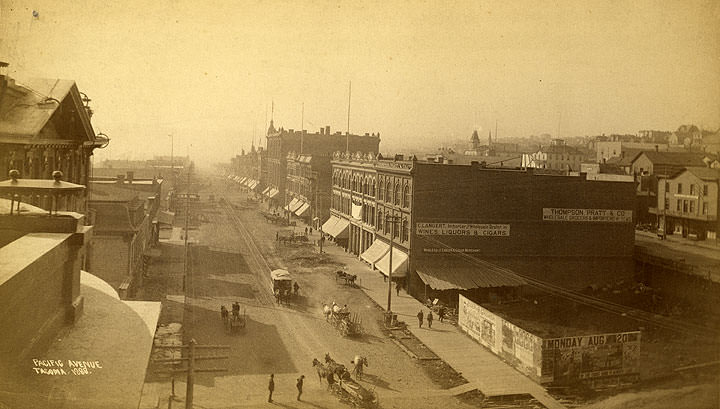
A roof ornament and roof edge are in the lower left foreground. A horse-team-drawn streetcar is in the center of the image. In the foreground, three horse-drawn wagons and two pedestrians are on the street. Commercial buildings appear to line both sides of Pacific Avenue.
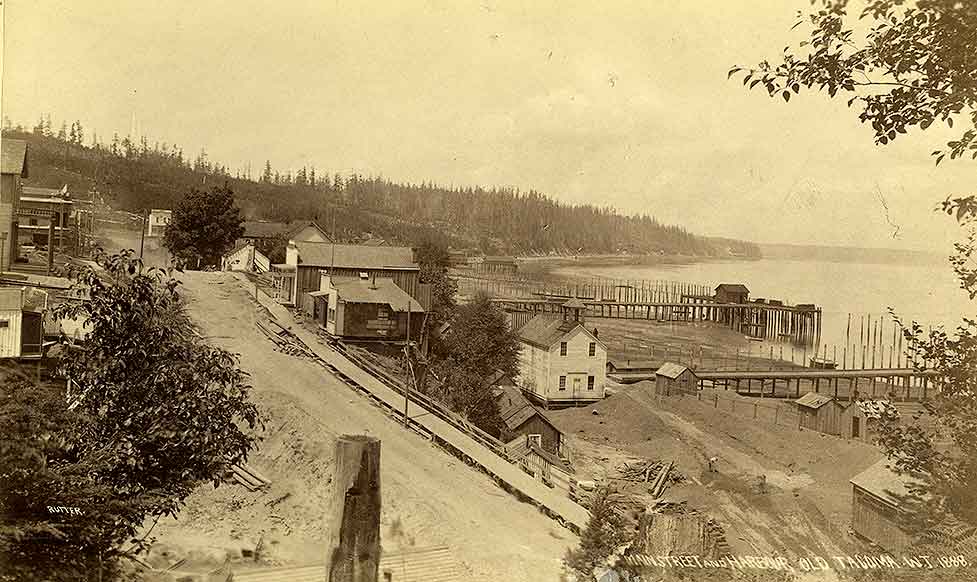
Main Street is now Thirtieth Street. Buildings are scattered along both sides of the street. The Commencement Bay waterfront and part of the bay are on the right side of the photo. Long piers extend across the beach to the water’s edge.
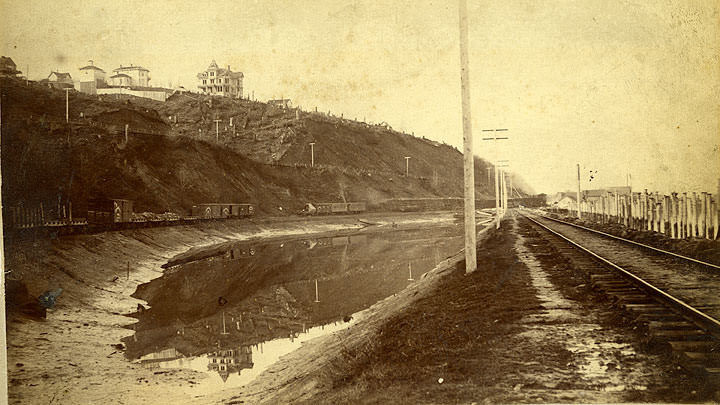
At the base of the bluff, railroad freight cars are visible across the center and left of center of the image. The Tacoma Hotel is at the top of the bluff, to the left of the image center. Another cluster of buildings is on the bluff to the left of the hotel. A road or walkway may extend parallel to the railroad cars, halfway up the bluff, where four telephone poles extend along a fence line. The reflection of the hotel, hillside, and railroad cars is visible in a large pool of water in the center of the image.
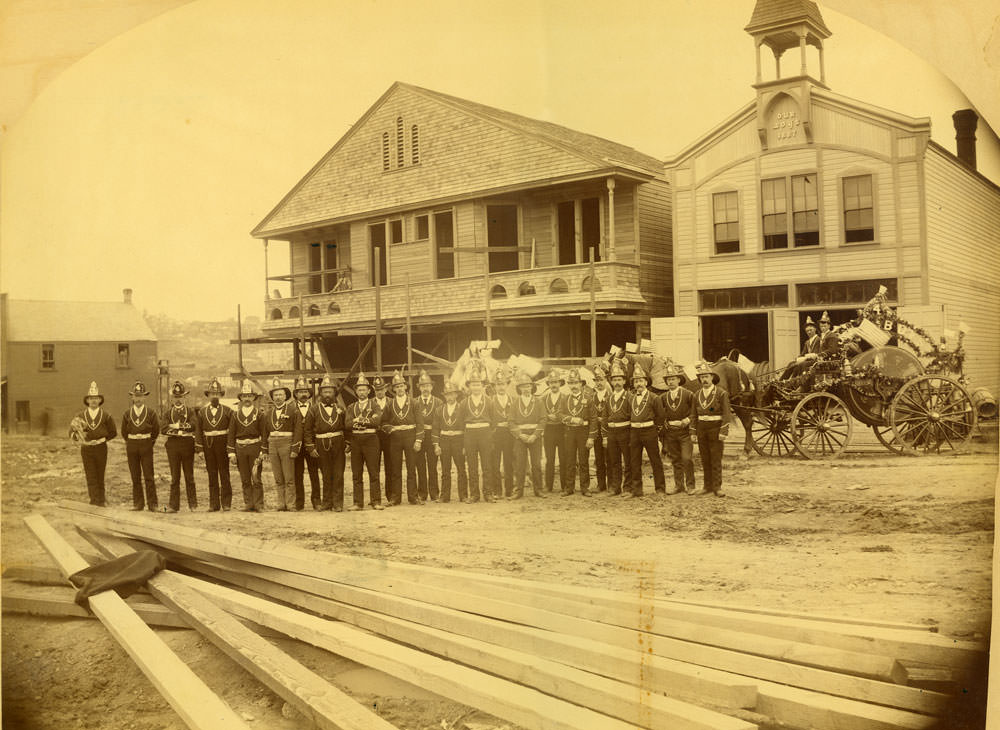
On the right side of the photo is a horse-drawn firehose cart decorated with garlands. The horses are partially visible behind the row of firefighters. Behind the firefighters, a building is under construction next to the firehouse.
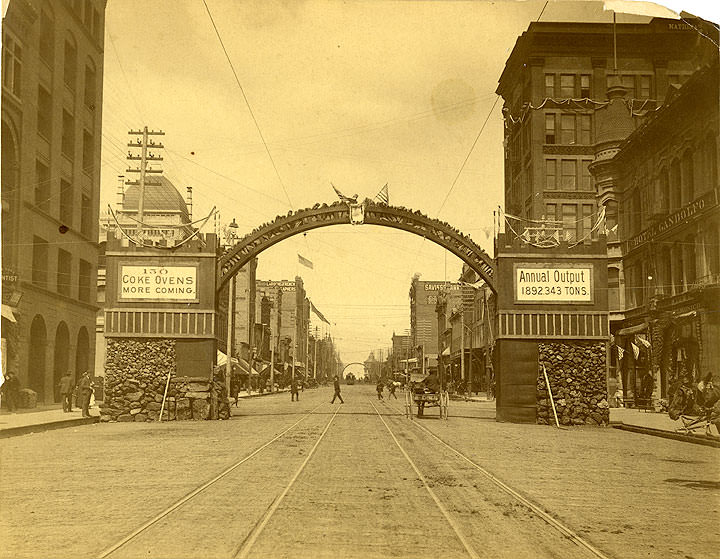
An arch is over the street in the foreground, ending in large constructed bases on either side of the street. Rock is being placed on the base of both structures.
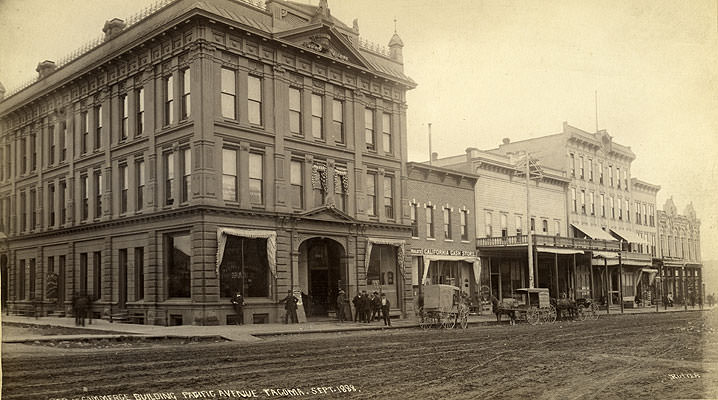
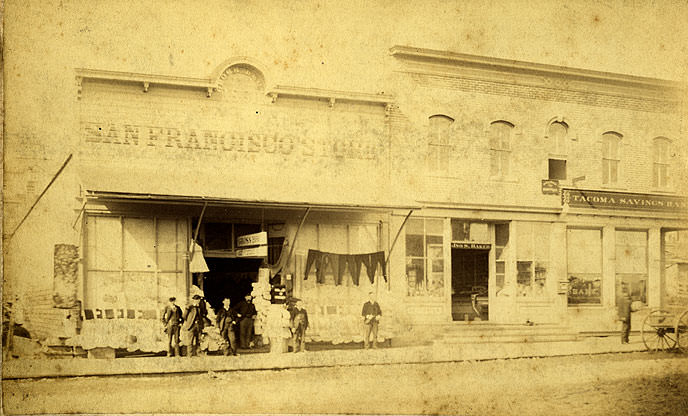
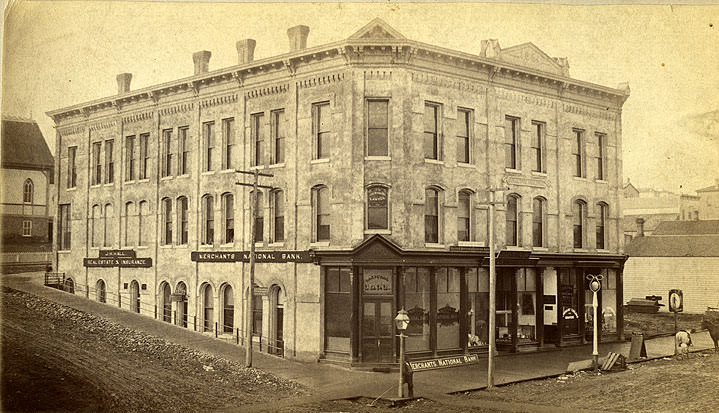
A few men stand in front of the bank. In the center of the image, a sign on an adjacent building reads: Hale’s California Cash Store. Two horse-drawn delivery wagons and a buggy are in front of the store.
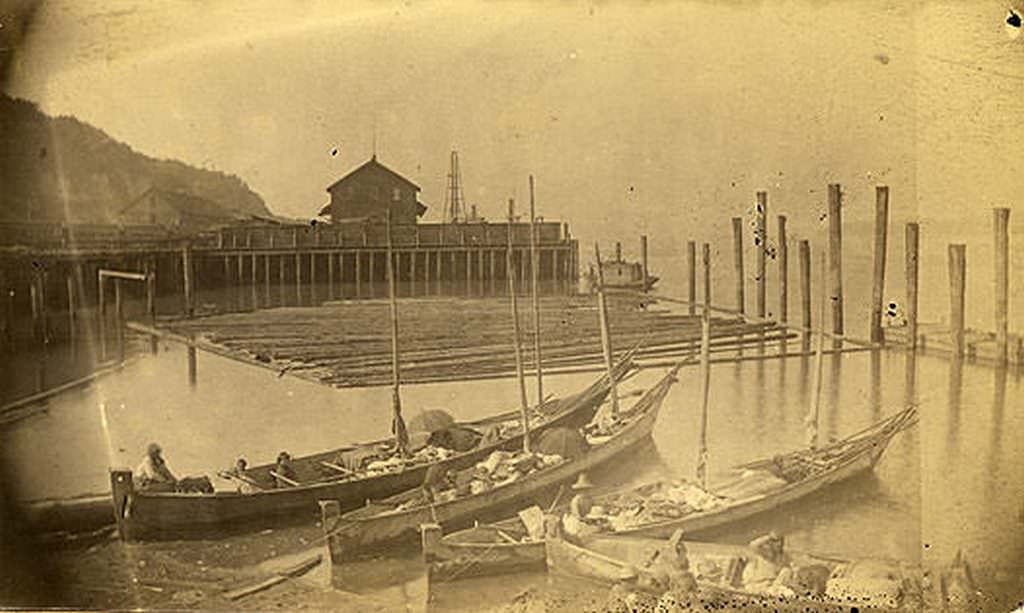
A wolf’s head is visible on the prow of one canoe. A few women and children are in the canoes along with several bundles. An open umbrella sits near the center of two of the canoes. A person wearing a basketry hat is in one canoe. A log pond protected by pilings is beyond the canoes, and a pier with a building is in the center background. A small steamship is near the pier.
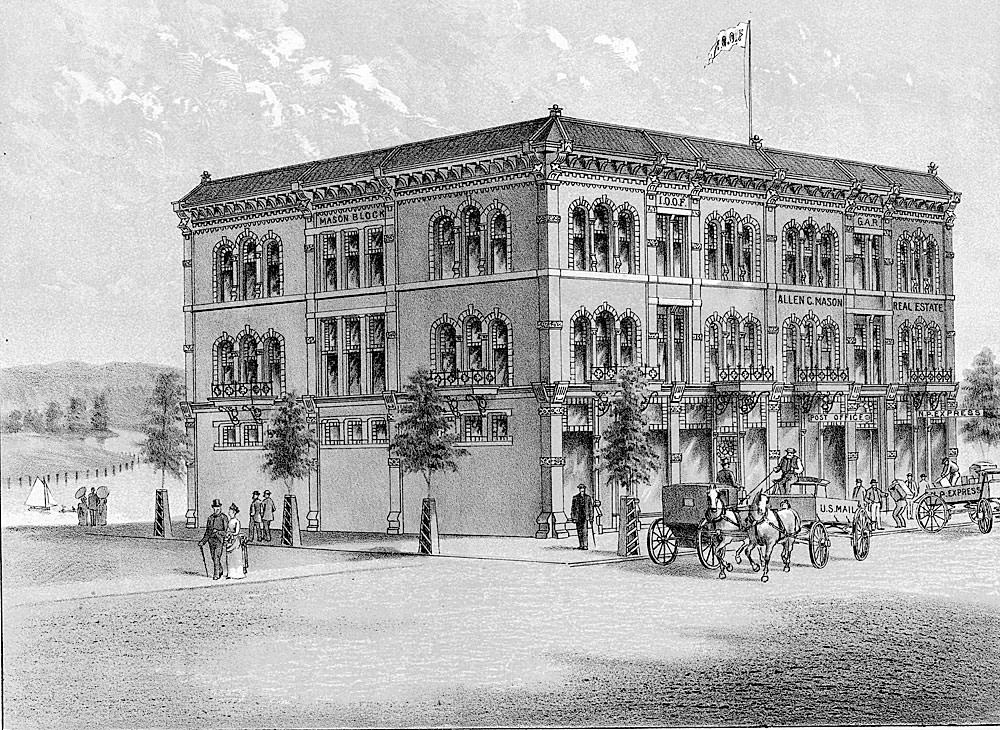
The three-story building contains several offices, including the office for Allen C. Mason Real Estate on the second floor. A flag with I.O.O.F. is flying from the roof. Three horse-drawn wagons and several people are on the streets around the building.
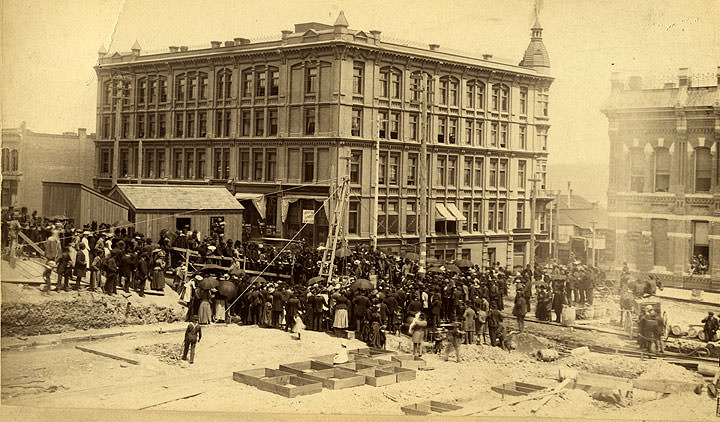
Many men and women, some women with umbrellas, and a few children face the site, which is hidden from view below the center of the image. A dragline appears to be in place for placing the stone. Small construction forms are on the construction site in the foreground, with a girl standing inside one of them.
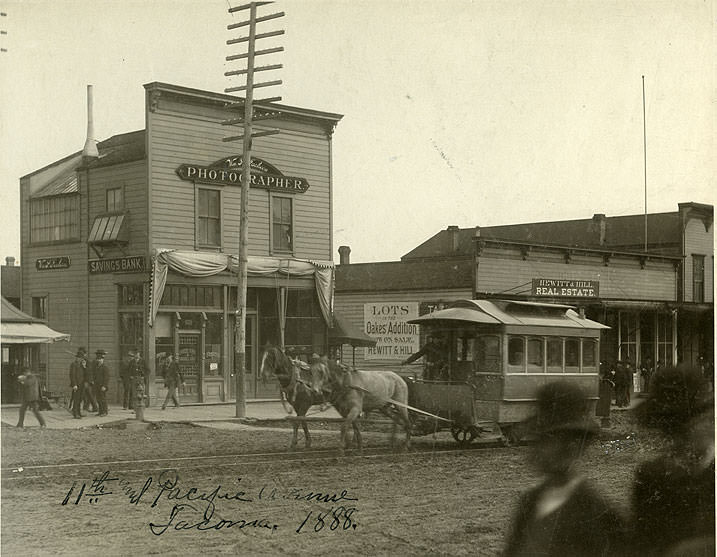
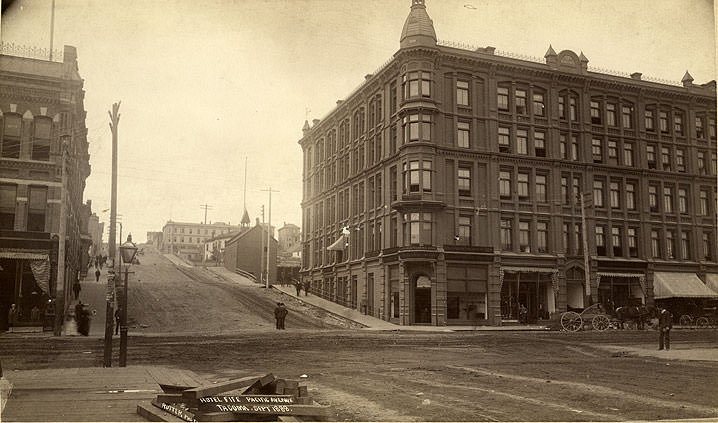
The view is taken from across the street. The studio is on the second story, above a savings bank, and its large multi-paned glass windows are visible on the side of the building. A business in a nearby building is listed as Hewitt & Hill, Real Estate. A sign on the side of the building reads: Lots in the Oakes Addition Now on Sale. A horse-team-drawn streetcar on Pacific Avenue, a dirt road, is in the center of the image.
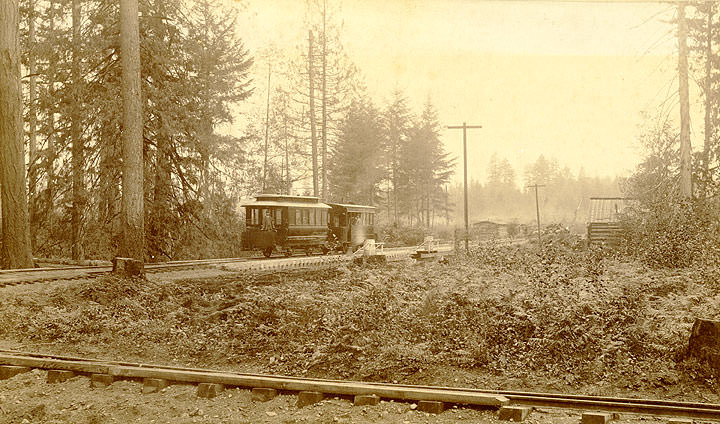
The engineer is looking out of the motor, and a man, possibly the conductor, stands on the steps at the end of the streetcar. Another railroad track runs parallel to the lower edge of the image. Three small buildings built from logs are in the right background. Wild foliage, including ferns, is in the right foreground.
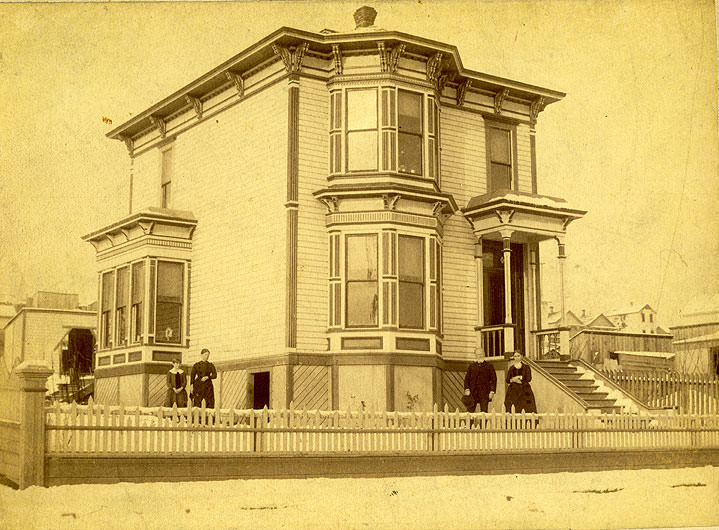
He was a partner in Orchard & Opie, Real Estate. Snow covers the ground and the top of the picket fence in front of the house. Snow is pushed to one side of the steps to the house.
![M[iles] F. Hatch Mill, Old Town, Tacoma, 1885](https://www.bygonely.com/wp-content/uploads/2022/01/Tacoma_historical_photos_681.jpg)
Looking south, Northern Pacific Railroad tracks are visible in the foreground. To the left of the tracks, there is a lumber shed and a sawmill. Stacks of lumber are visible on the far left. To the right are an additional lumber shed and a boarding house.
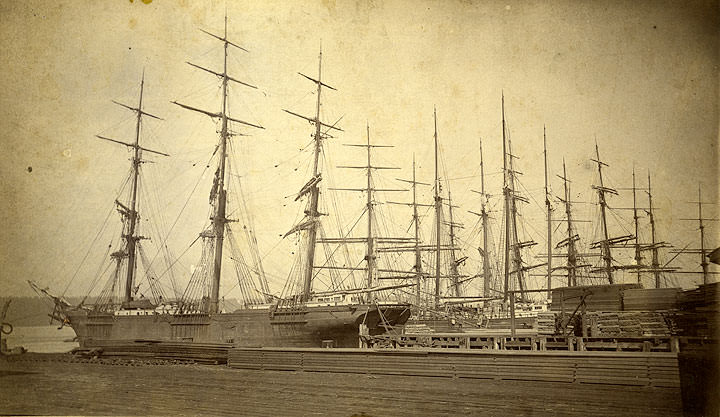
A wharf is in the foreground. On the far side of the wharf, the closest sailing ship — showing the port side from the stern end — is the Dashing Wave. Stacks of lumber waiting to be loaded are on the right side of the image.
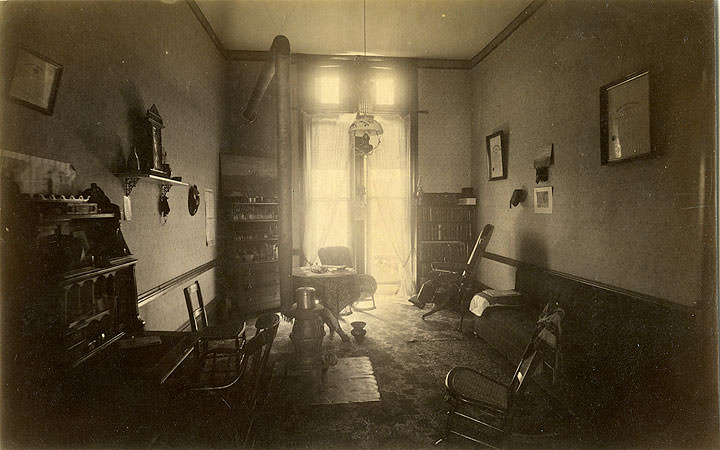
The view is from one end of a narrow room toward windows at the far end in the center background of the image. A dentist’s chair is in the right background, with a bookcase behind it on the wall adjacent to the window. An open cupboard with objects on the shelves is on the other side of the window.
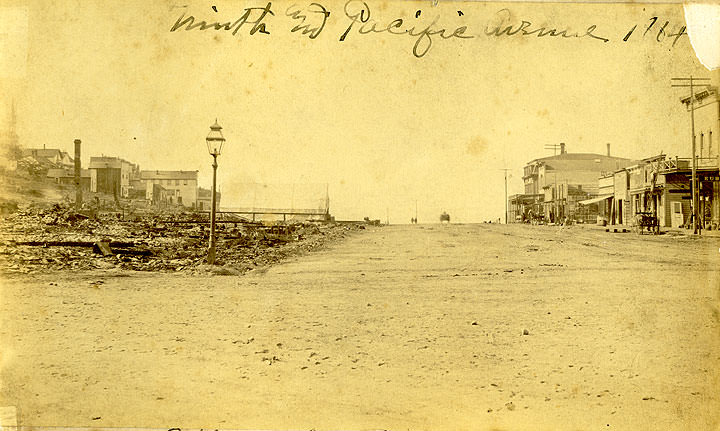
Ninth Street extends across the lower third of the image, and Pacific Avenue recedes into the center background. Fire leveled several buildings on the left side of the image, with only a street lamp left standing at the corner. Some intact buildings are in the background.
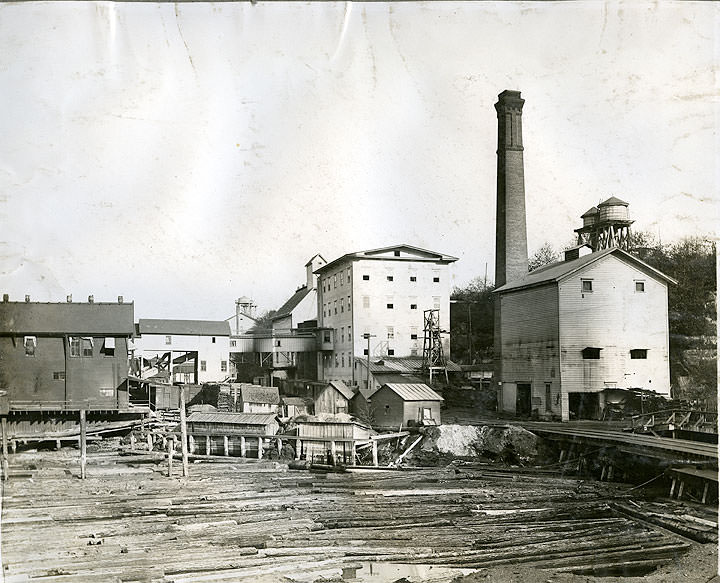
There is no name on either of the two large buildings in the center and right of the image. Railroad tracks are visible near the right edge in front of the building. Two water towers are on the hill behind the building. The mills were built in 1889, with A. Bradford as architect. Logs are crowded in a log pond in the foreground. In the lower center, a few small wooden buildings are clustered at and above the water’s edge.
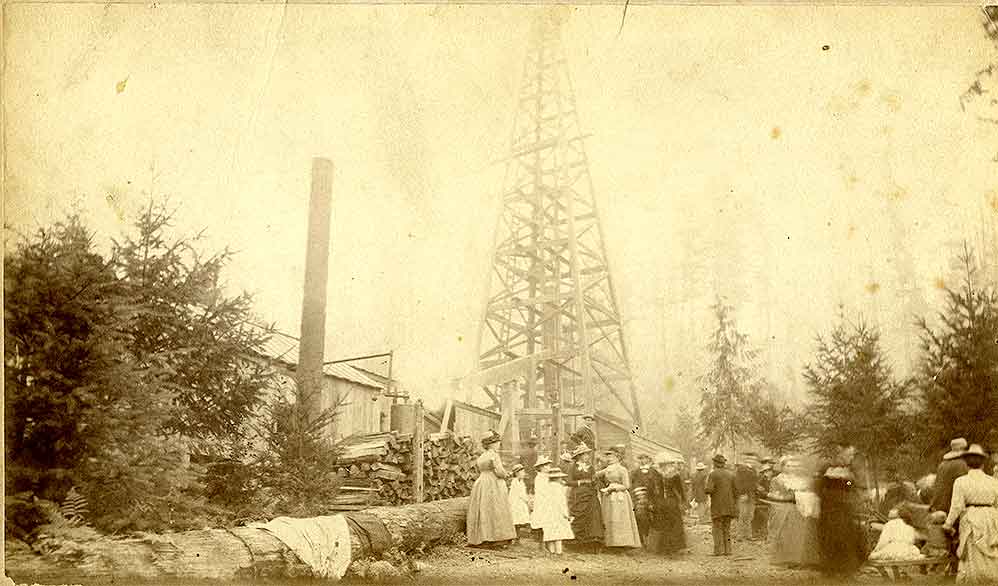
A black and white photograph shows groups of women and children and a few men near a Tacoma Oil Company oil well base. The oil well in the center of the image is behind them, and a large woodpile and frame buildings are partially visible on the left side of the image.
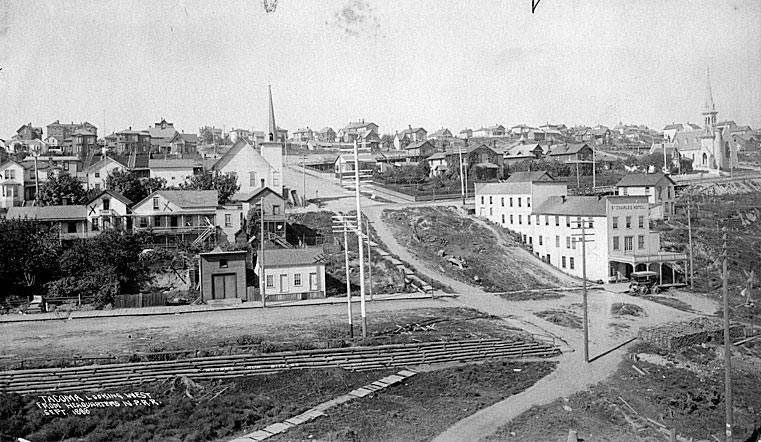
The image shows the view of the city looking west from the headquarters of the Northern Pacific Railroad. There are several houses, two churches, and a hotel. The church on the left is First Methodist, located at 602 Broadway. The church on the right is St. Luke’s Memorial Episcopal, located at 702 Broadway. The St. Charles Hotel is on the lower right. A wagon sits outside the hotel’s covered porch. The current City Hall is on the site of the St. Charles Hotel.
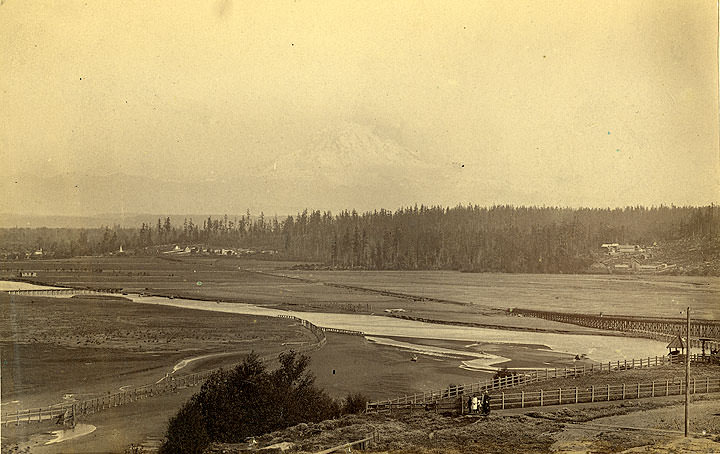
The Puyallup Indian Reservation is in the background. There are two clusters of buildings in the background: one in the center-left and one near the right edge of the image. A group of five people, including children, stand by a fence on the slope in the foreground, looking out at the tideflats.
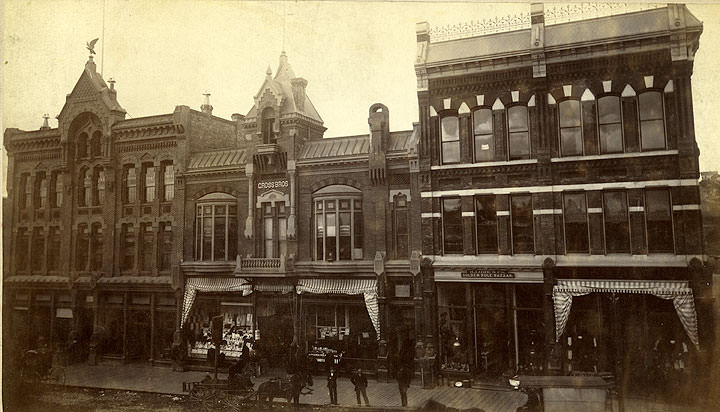
A two-story building with “Gross Bros.” on its front is in the center of the image. Merchandise is in the store windows on the first floor, although the details are not visible. Three-story buildings are adjacent on both sides.
Pacific Avenue is in the lower right corner of the image. A sign for Dr. James Brown is on the building on Pacific Avenue. Eleventh Street is in the lower left corner of the image.
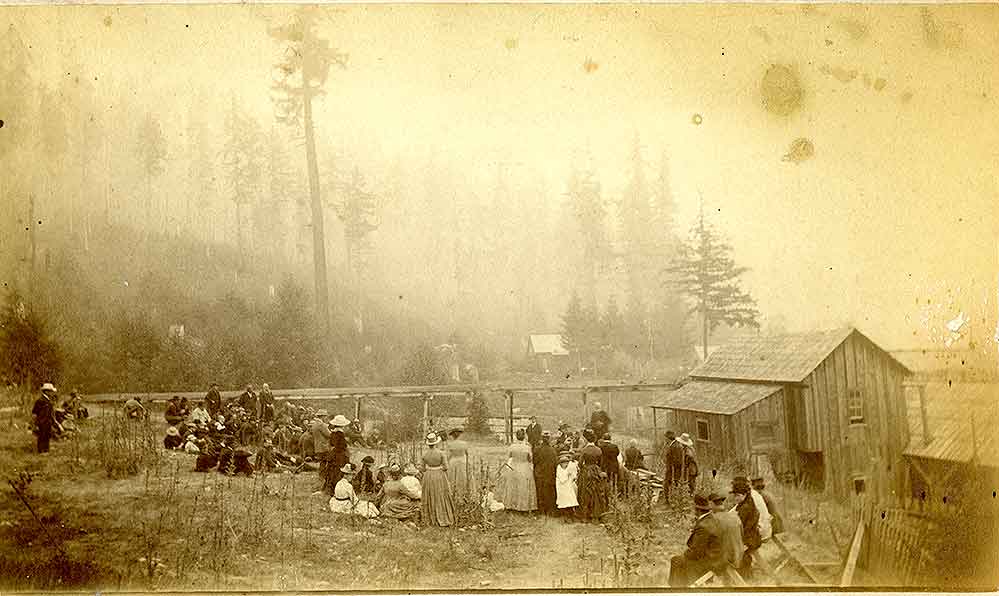
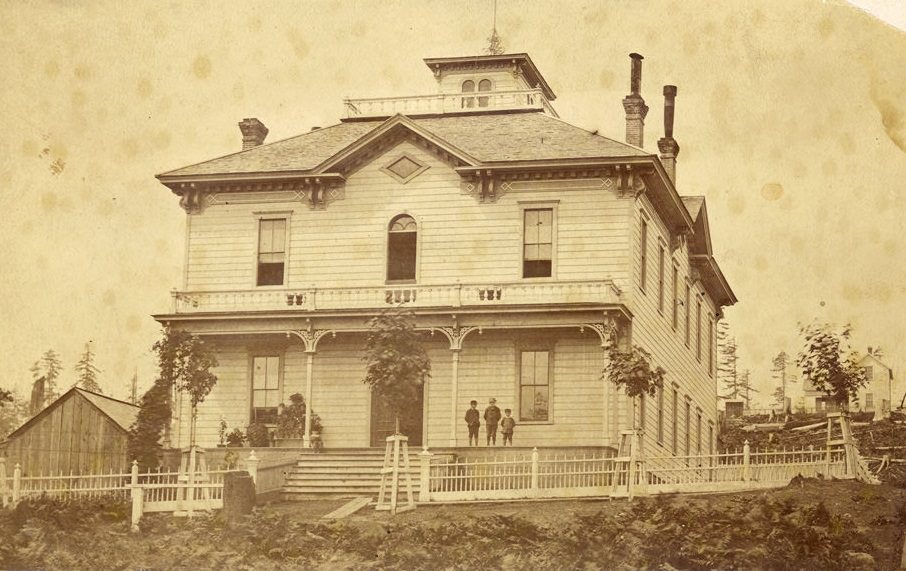
The old Northern Pacific Railroad Headquarters Building in Tacoma, located at 9th and C Streets, was built by the Tacoma Land Company in the mid-1870s and was in use until a building on Stadium Way replaced it. When the Tacoma Theater was built, the building was moved to 7th and St. Helen’s. It later became the Sylvan Hotel.
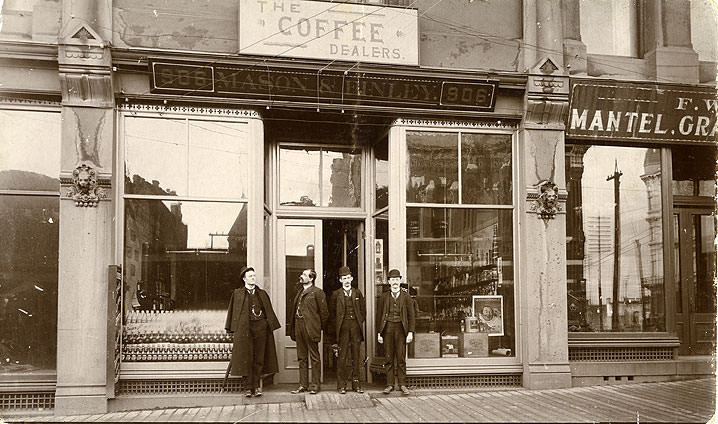
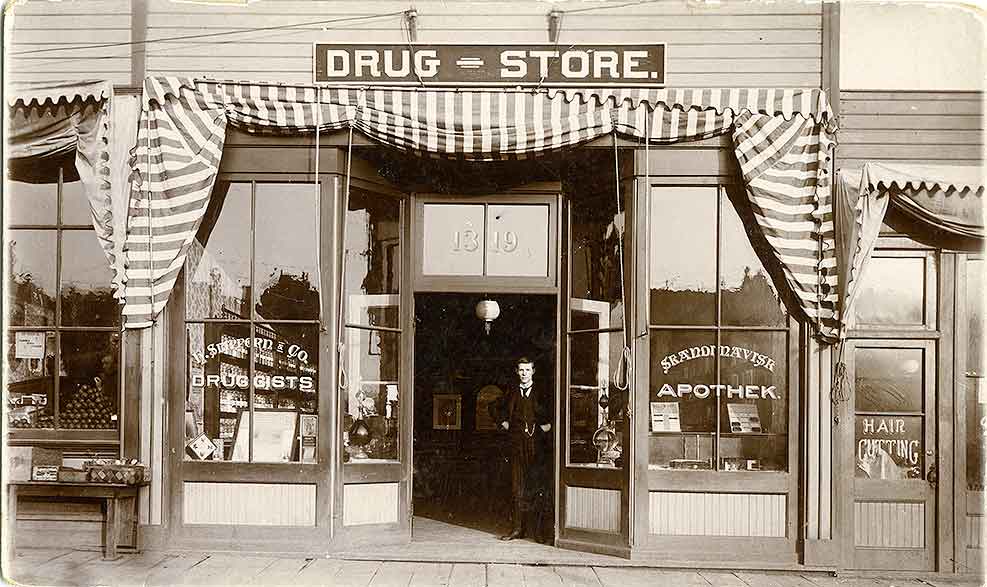
Byron L. Finley was one of the proprietors. Rows of bottles are in the storefront window on one side. Two boxes and a picture of a smiling, heavyset man’s head with a large napkin tied around his neck are in the other window.
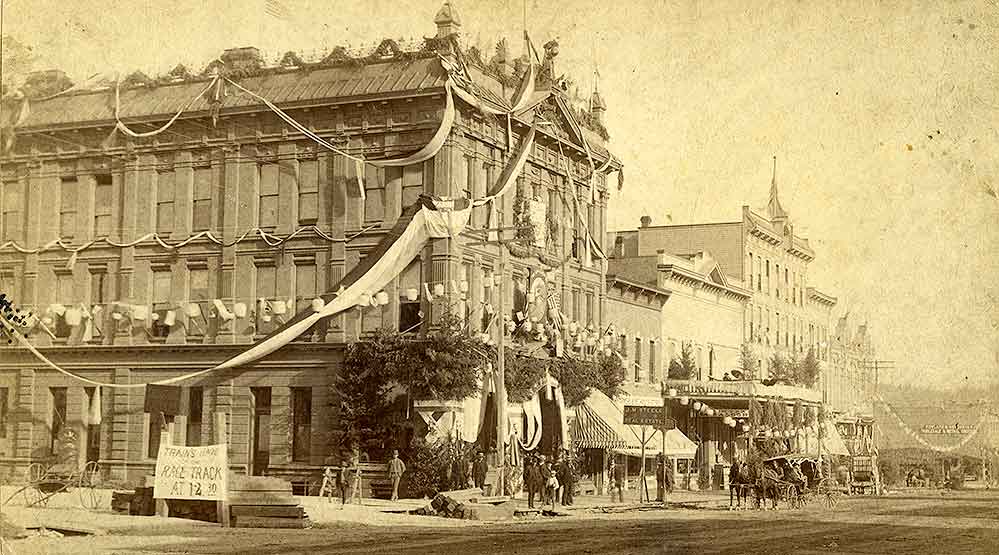
A statue of the Goddess of Commerce stands atop the building. The building is decorated with streams of bunting and paper lanterns, and the lanterns continue down the street hung on utility poles. Swags of greenery decorate the roof and the building entrance.
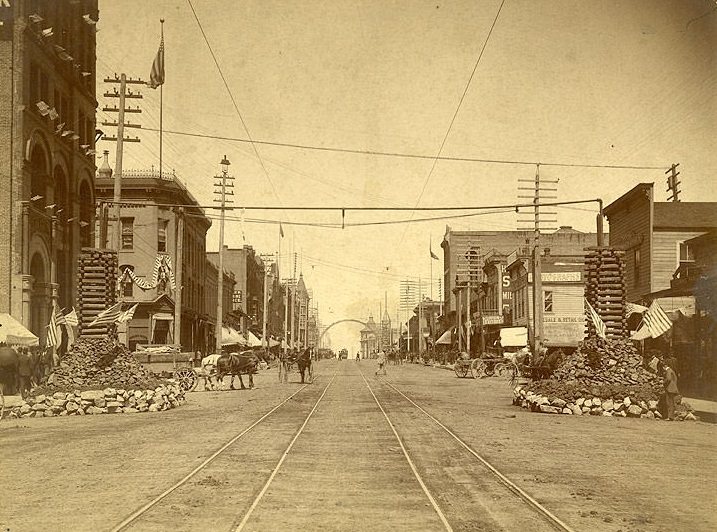
In the foreground, a pile of stones is at each side of the street, with a wooden structure rising from each one. U.S. flags are flying from the base of the structures. Four horse-drawn wagons are visible on the street.
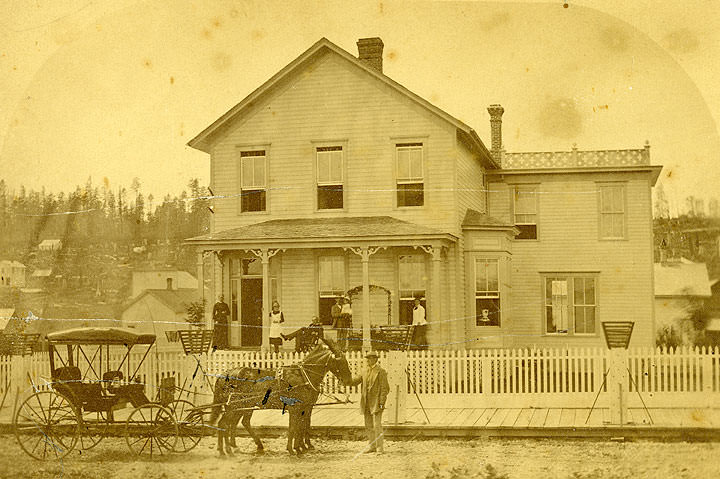
A man stands by a horse team and buggy on the dirt road in front of the house. A picket fence encloses the front yard beyond a plank sidewalk. Three women, one wearing an apron, and two men holding a small child, pose on the front porch. General J.W. Sprague later occupied the house.
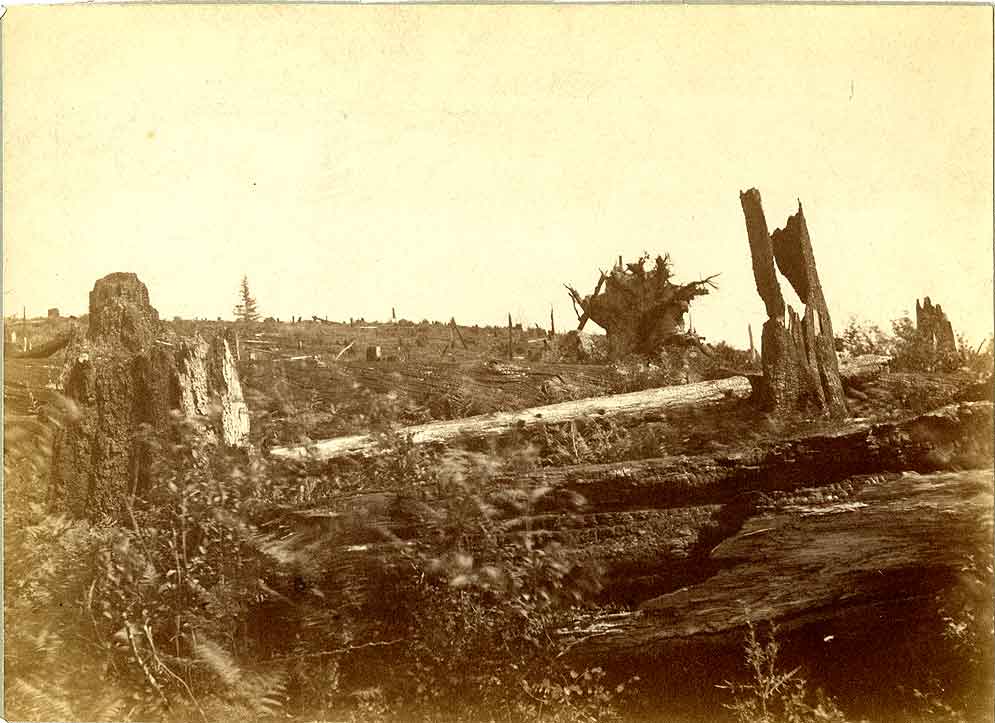
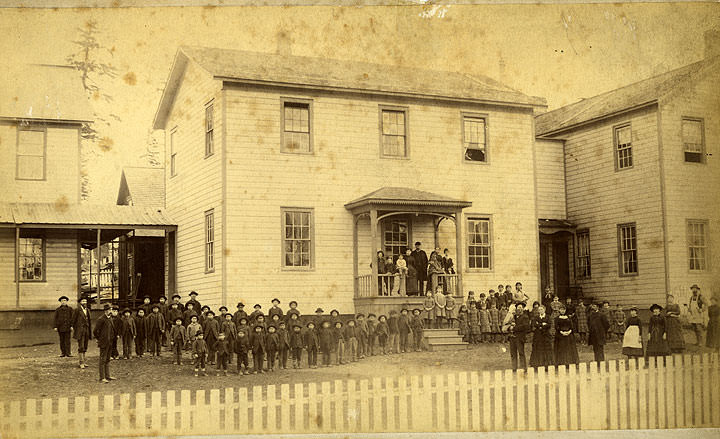
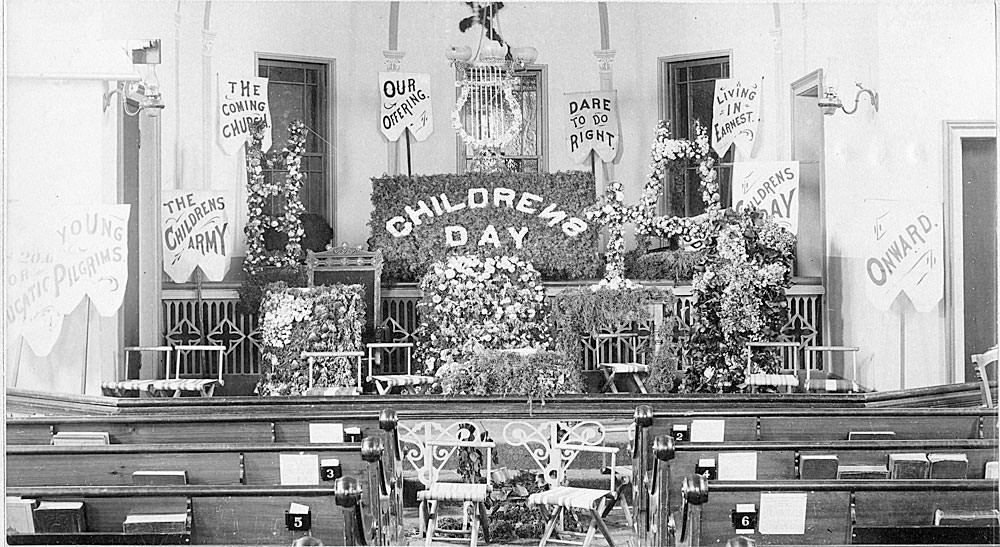
The altar is decorated with several large floral displays. One, in the center, reads “Children’s Day,” although the letters “N” and “S” are backward. Several banners are visible.
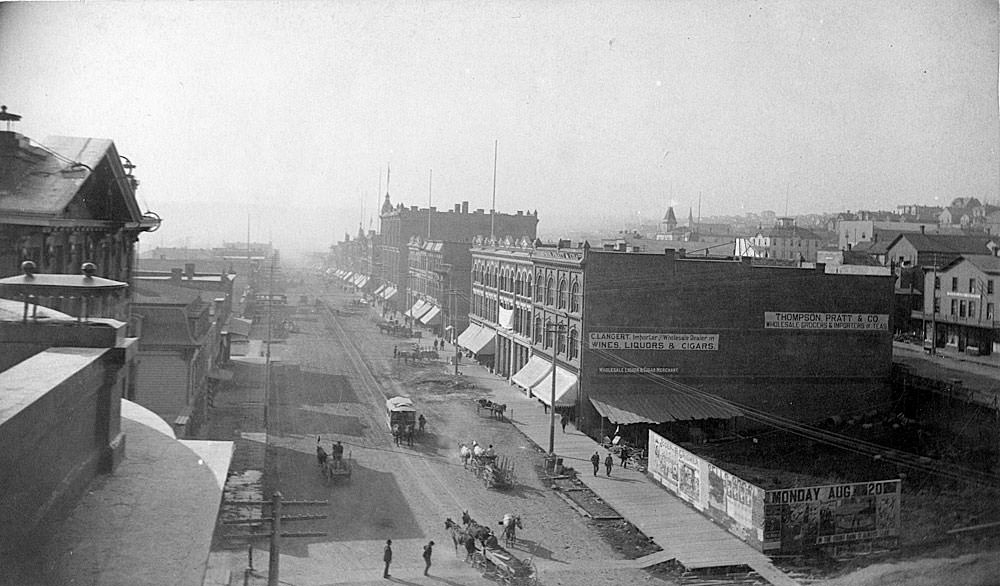
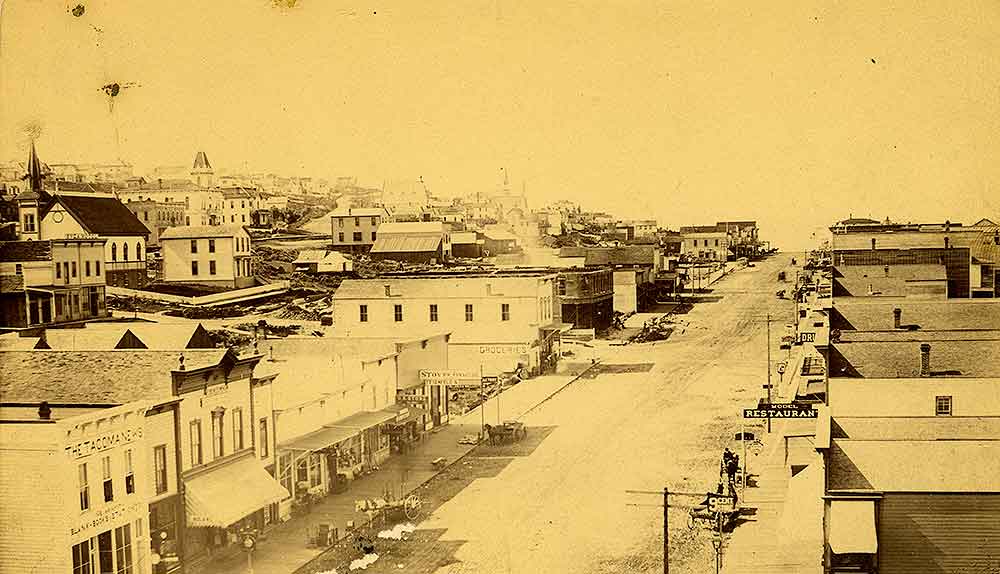
Pacific Avenue is a wide dirt road flanked on either side by brick buildings. A horse-drawn trolley and horse-drawn wagons are visible on the street. Pedestrians cross the street and walk along the wood plank sidewalk.
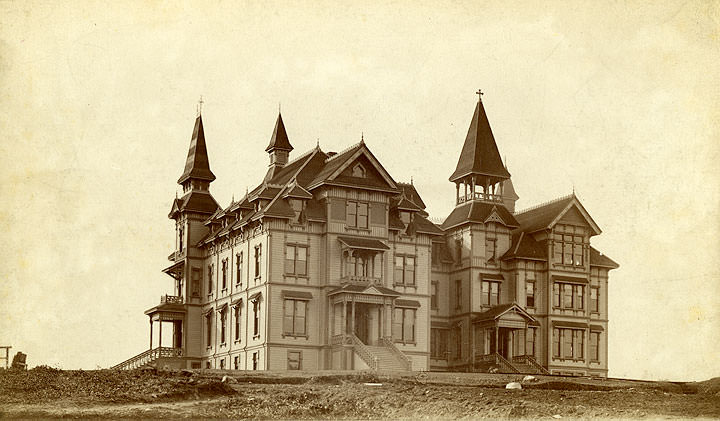
The school building was built in 1883, with Boone & Wheeler as architects, and opened in 1884. It was demolished in 1924.





Well that’s some stunning photos. Thank you.