

Dorothea Lange did not photograph landscapes or portraits for galleries. She photographed suffering — and she did it with precision. Her lens found people at their lowest points: unemployed men drifting through San Francisco streets, families stranded on desert highways, children living in roadside tents. What she produced was not just art. It was evidence. Her work during the Great Depression stands as one of the most complete visual records of what economic collapse actually looked like for ordinary Americans.
Lange began her documentary work on the streets of San Francisco in the early 1930s, turning her camera toward the unemployed men who filled the city’s sidewalks. Those photographs caught the attention of the federal government. In 1935, the Resettlement Administration — later reorganized as the Farm Security Administration (FSA) — commissioned her to photograph rural poverty across the country. She accepted, and spent years on the road.

Her most recognized photograph came from a pea pickers’ camp in Nipomo, California in 1936. The woman in the frame — Florence Owens Thompson — was 32 years old and had seven children. Lange took six exposures in about ten minutes. The image ran in newspapers, and the federal government shipped 20,000 pounds of food to the camp shortly after. It became the defining image of the Great Depression.

Lange’s FSA work took her well beyond California. In the American South, she documented laborers doing backbreaking work in conditions that had barely changed since the previous century. Turpentine workers in Georgia forests, sharecroppers in the Carolinas, and tenant farmers across Oklahoma and Texas all appeared in her frame. These were not people anyone else was photographing.


The Dust Bowl drove hundreds of thousands of families off their land. Severe drought and failed crops left farmers in Oklahoma, Texas, Arkansas, and Missouri with nothing. Many loaded everything they owned onto trucks and cars and headed west, chasing rumors of farm work in California. Lange documented them every step of the way — stalled in deserts, camped beside highways, waiting in lines.

After the attack on Pearl Harbor in December 1941, anti-Japanese sentiment spread rapidly across the West Coast. Lange documented the climate it created — including moments like a store owner’s public declaration of loyalty — before the forced removals began. In 1941, she had been awarded a Guggenheim Fellowship for achievement in photography, but she was soon assigned work of a different, more urgent kind.

The War Relocation Authority assigned Lange to document the forced removal of Japanese Americans from the West Coast following Executive Order 9066. The order required over 110,000 people of Japanese descent — the majority of them American citizens — to leave their homes and report to internment camps. Lange photographed the process from beginning to end, including families like the Mochidas waiting with their luggage and identification tags.

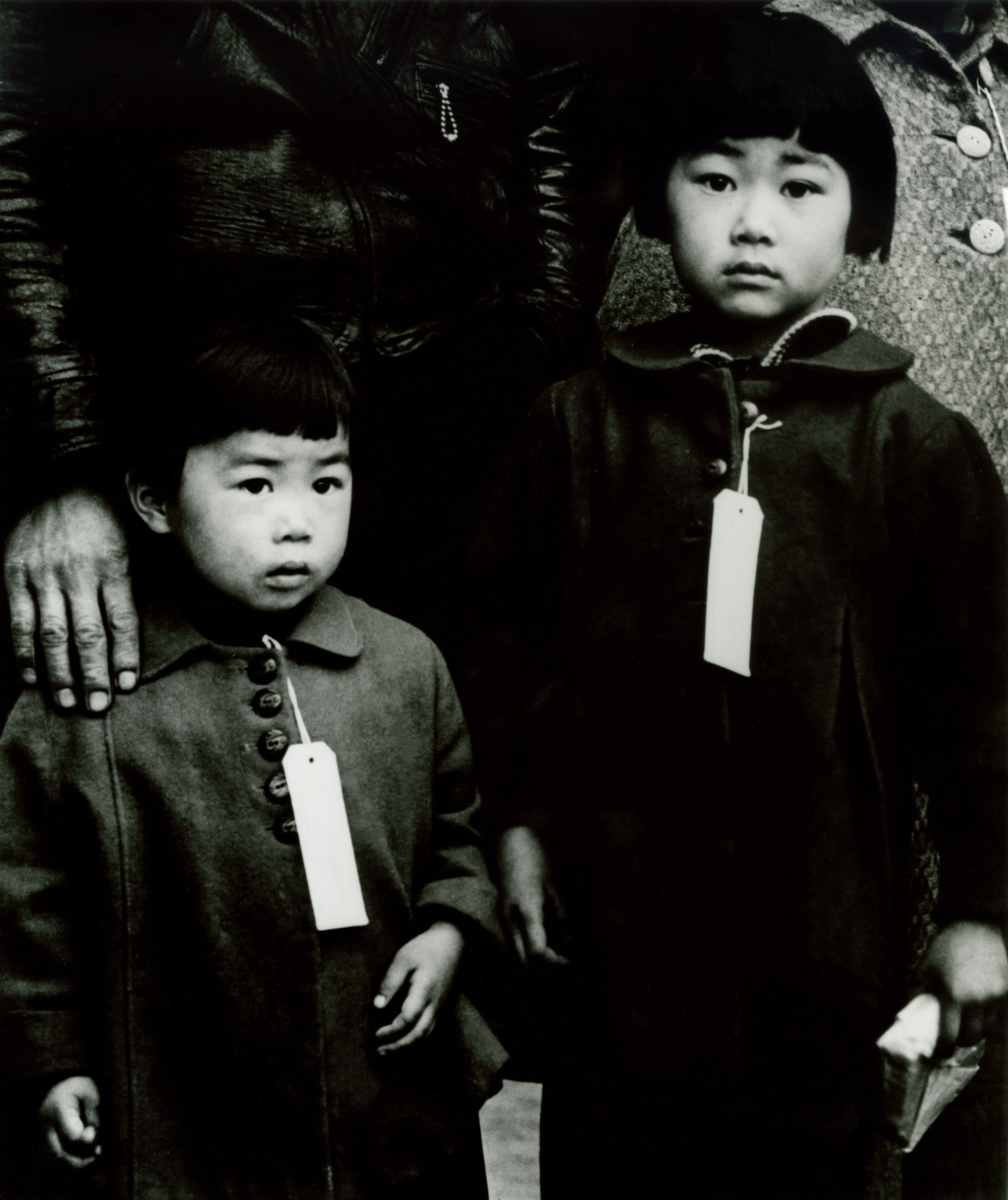
Children were not exempt from the removal order. Lange photographed Japanese American children in Hayward, California wearing identification tags — numbered and labeled like luggage — as they prepared to be sent to camps. The Army later suppressed many of Lange’s internment photographs, deeming them too critical of the government’s actions. They were not widely seen until decades later.


Before the FSA commission, Lange had already produced one of her most striking early images — a San Francisco breadline in 1933. Known as the White Angel Breadline, it shows a man with his back turned to the crowd, his hands resting on a railing, his hat pulled low. He is surrounded by other men waiting for food, but he is the one Lange chose to isolate. It was that kind of compositional instinct that set her work apart.


Lange’s work was not confined to the United States. She traveled internationally in her later years, photographing people in Asia, South America, and the Middle East. Her eye for the relationship between people and their environments carried over into every setting. A woman and child in a Nile village received the same serious attention she gave to a migrant mother in California.


The Dust Bowl farms Lange photographed across Texas and Oklahoma were often abandoned shells. Fences buried in sand, buildings half-swallowed by drifts, fields that had simply ceased to exist as farmland. For the families still on them, there was rarely a decision to make. The land had already made it for them.


Highways became a defining feature of Depression-era migration. Families who could not afford fuel walked. Lange photographed a family of seven — two adults, five children — on foot beside the road in 1936. The image carries no dramatic staging. It is simply what was happening on American roads at the time.


The contrast between advertising and reality was sharp enough that Lange photographed it directly. Families camped behind billboards promoting prosperity they could not access. In Kern County, three destitute families set up shelter in the shadow of a roadside advertisement on U.S. 99. Lange framed both in the same shot.


The FSA set up migratory labor camps to give workers a more stable base than roadside squatter camps. Lange photographed life inside these camps extensively — their layout, their residents, their conditions. The camps provided running water and some shelter, but they were still crowded and far from comfortable. Workers moved between them depending on what crops were being harvested and where.


Not everyone on the road was a family. Lange also photographed solo workers — men who had spent decades moving from harvest to harvest, with no permanent home and no fixed employer. Some were former tenant farmers who had lost their land years before the Depression made that story common. Others had been migrant laborers their entire working lives.


California’s Imperial Valley was one of the country’s most productive agricultural regions, and it ran on migrant labor. Workers came from Texas, Oklahoma, Arkansas, Missouri, and Mexico to pull carrots, pick peas, cut cabbage, and harvest lettuce. The pay was low and the work was seasonal. When one crop ended, workers moved to wherever the next one was ready.


Children appeared constantly in Lange’s FSA photographs. They lived in tents, in cars, and under tarps stretched between trees. Many had no access to school. In the squatter camps, they played in the dirt beside open drainage ditches that served as the water supply. Lange photographed them without sentimentality — straightforwardly, as they were.


The American River camp near Sacramento was one of the informal settlements that sprang up along waterways where families could access water. It had no infrastructure beyond what residents built themselves. Lange photographed the people living there — including the son of a destitute migrant — with the same composed directness she brought to every subject.


Lange’s FSA work extended north into Washington State’s Yakima Valley, where hop and fruit harvests drew migrant families each year. Some children had been coming to the same camps since they were toddlers, following the same harvest circuit year after year. A sick child in Toppenish, a boy picking hops for the third consecutive year — Lange recorded both.


Not all migrants traveled by car. Some rode freight trains, hopping cars to get from one region to the next without paying for a ticket. It was illegal and dangerous, but for families with no money for fuel or bus fare, it was the only option. Lange photographed one such family in Toppenish, Washington — they had made it to the Yakima Valley by rail.


Some families did not stay permanently mobile. Near Klamath Falls, Oregon, Lange photographed a family that had begun building a permanent house while still living in a tent inside the unfinished structure. It was a practical solution to having nowhere else to go while construction was underway — shelter built around them as they slept.


Water was a constant problem in the squatter camps. In California near Calipatria, an open settling basin fed by an irrigation ditch served as the water supply for an entire camp. Lange photographed these conditions as part of the public health case for better-managed FSA facilities. The photographs were used in government reports to document what unregulated camps actually looked like.


Relief checks — issued twice a month — were a lifeline for thousands of families in the Imperial Valley. Lange photographed the lines that formed at Calipatria on distribution days. People waited for hours. The checks were small, but they were often the only guaranteed income a family had. Everything else depended on whether there was work available and whether the harvest was good.


Access to schooling for migrant children was inconsistent at best. When families moved every few weeks to follow harvests, children were pulled in and out of schools constantly — if they could get into a school at all. Some FSA camps worked to provide schooling on-site. Lange photographed children in Oregon who were enrolled in local schools near FSA units, a rarer situation than most migrant families experienced.


Lange also taught fine art photography at the California School of Fine Arts, and in 1952 she co-founded Aperture, a photography magazine that would become one of the most respected publications in the field. Her attention never drifted far from the people she had spent the Depression years photographing. Farmers trying to hold on to their land in Colorado, millworkers in North Carolina, and cooperative farm communities all appeared in her work through the late 1930s.


Lange died of esophageal cancer at the age of 70. Three months after her death, the Museum of Modern Art in New York opened a full retrospective of her work — an exhibition she had personally helped to curate before she died. The show displayed the breadth of what she had documented: not just one crisis, but decades of American life captured in black and white with unflinching honesty.

From textile mill workers in the South to sharecroppers displaced by the collapse of cotton farming, Lange’s camera reached people who existed at the margins of the American economy. The white sharecropper family she photographed in 1937 had previously worked in the Gastonia textile mills — one displacement following another. In Lange’s photographs, their faces are not symbols. They are individuals, caught in a specific moment, in a specific place, during one of the hardest periods in American history.
