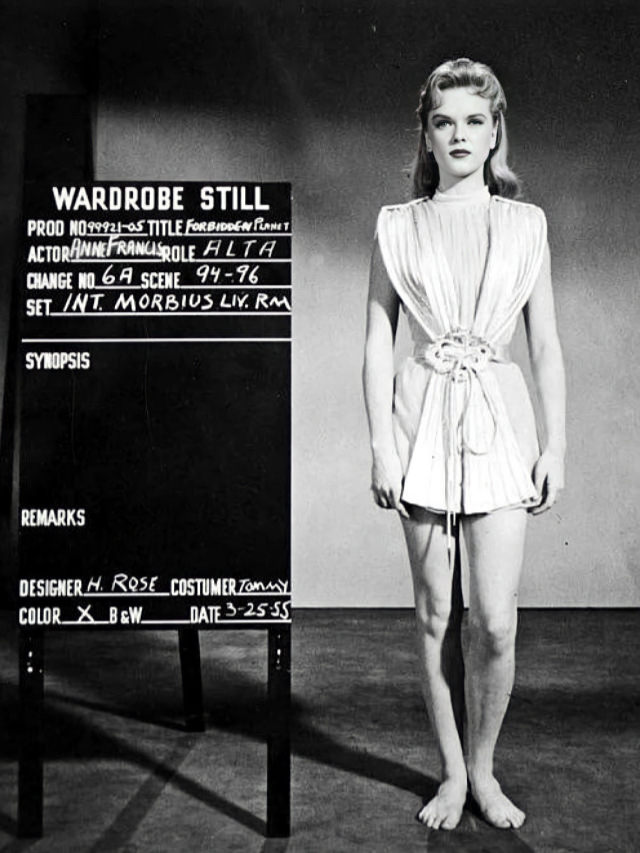
In the 1956 MGM science fiction film Forbidden Planet, Anne Francis played Altaira ‘Alta’ Morbius — the daughter of a reclusive scientist living on the distant planet Altair IV. Alta had grown up in near-total isolation, raised alongside robots and alien wildlife, with no knowledge of the outside world. That unusual backstory gave the costume designers a distinctive creative challenge: dress a character who was simultaneously naive and otherworldly, human yet alien in her own right.
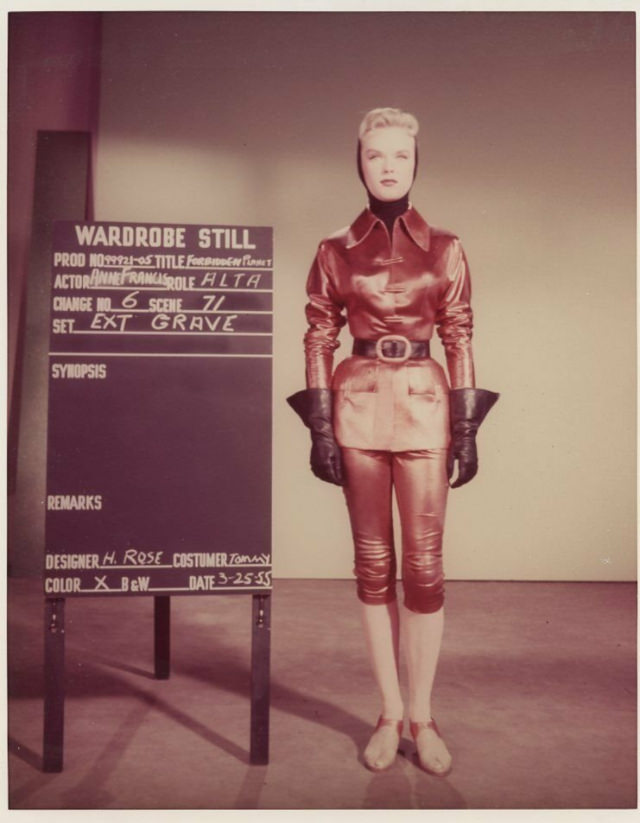
The most talked-about piece in Alta’s wardrobe is her sparkling white mini-dress. Short hemlines were not yet a mainstream fashion staple in 1956, making the dress visually ahead of its time. Paired with Anne Francis’s platinum blonde hair, the outfit gave her an almost luminous quality on screen — a deliberate contrast against the cold, metallic surfaces of the Krell planet set. The simplicity of the design kept the focus on the character rather than the costume.
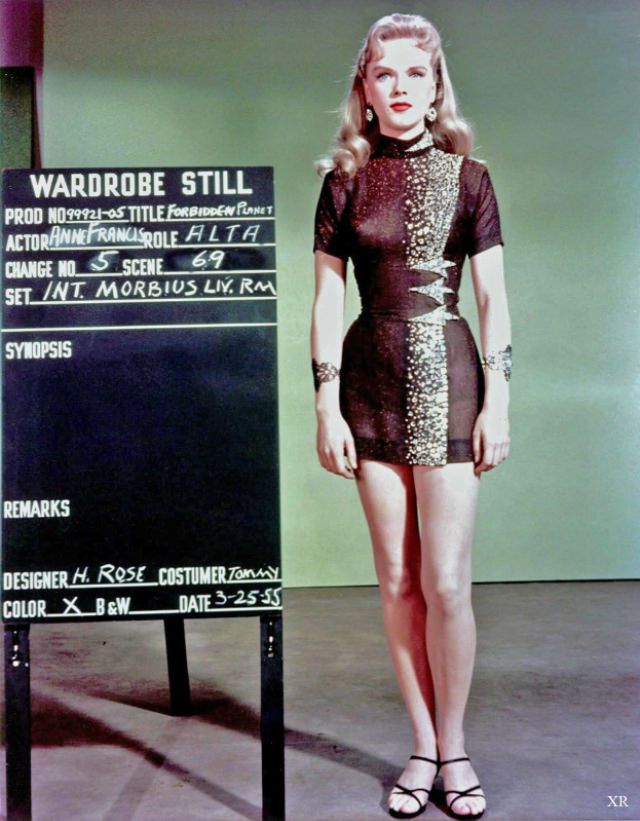
The white dress appeared in several key scenes and quickly became the defining look associated with Francis’s role. Wardrobe stills from the production capture just how carefully the outfit was constructed — clean lines, a fitted silhouette, and a fabric that caught studio lighting in a way that emphasized Alta’s separation from the uniformed, utilitarian world of the United Planets crew.
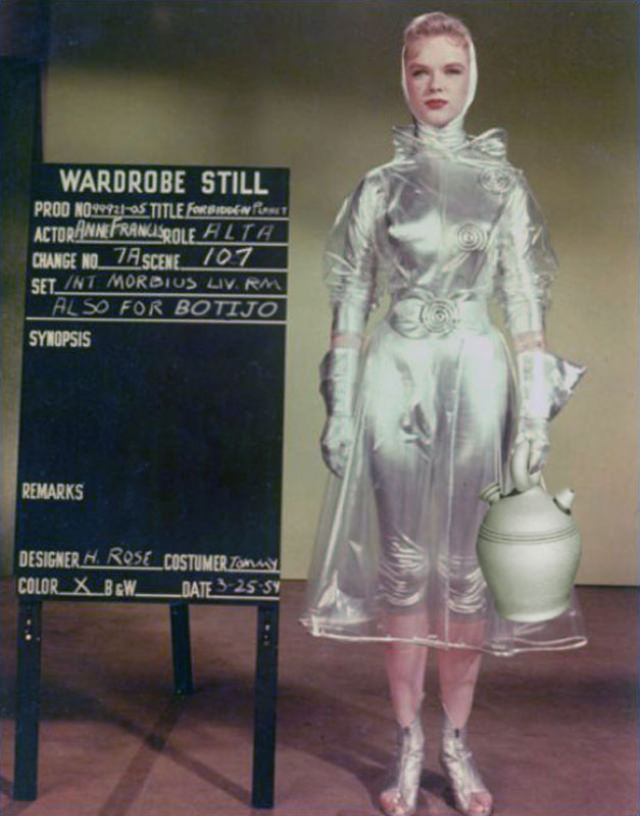
Alta’s green tunic dress offered a striking contrast to the white look. Where the white dress projected purity and detachment, the green tunic connected her visually to the lush outdoor sequences filmed on the studio’s painted alien landscape. The color choice was deliberate — Alta spent much of her time outdoors among the planet’s wildlife, and the earthy green tone grounded her character in that environment.
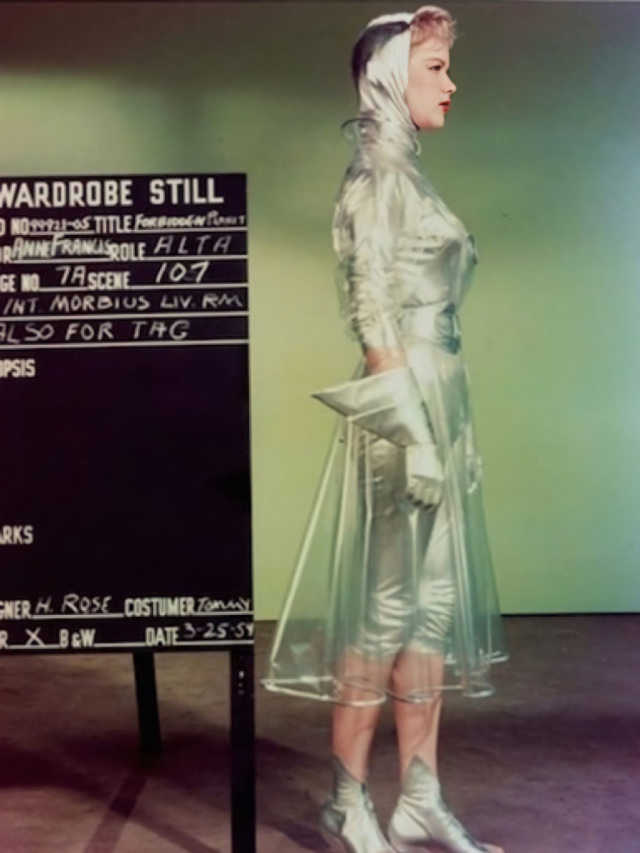
Across the film, Alta’s wardrobe shifts subtly as her character’s awareness grows. She begins the story completely sheltered, and her interactions with Commander Adams and the United Planets crew expose her to human society for the first time. The costume changes track that progression — each outfit marks a different stage in her understanding of the world beyond Altair IV.
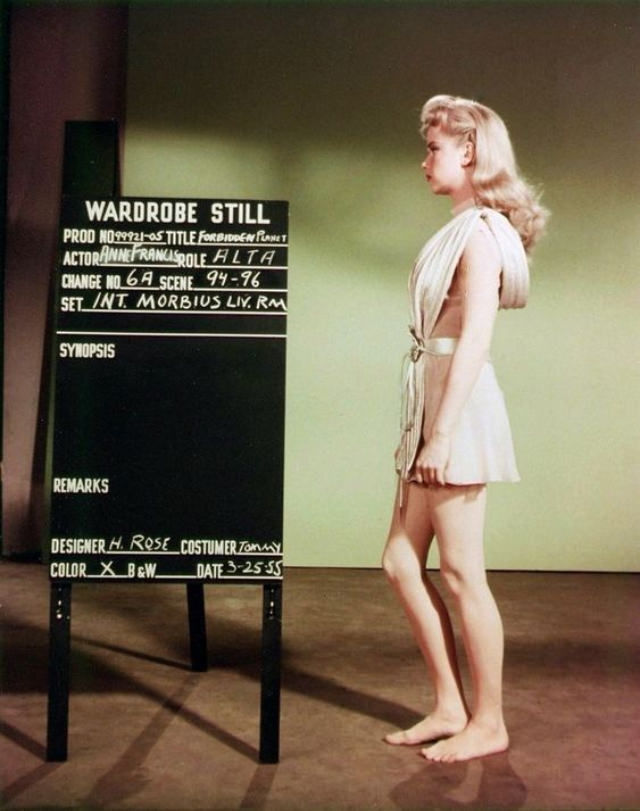
The production’s wardrobe stills are a valuable record of mid-1950s Hollywood costume design at its most experimental. Forbidden Planet had a budget of roughly $1.9 million — large for its era — and the costume department used that budget to craft looks that felt genuinely futuristic without relying on the clunky, armor-like spacesuits common in B-movie science fiction of the time. Alta’s clothes were soft, wearable, and human in shape, which made them far more unsettling in an alien setting.
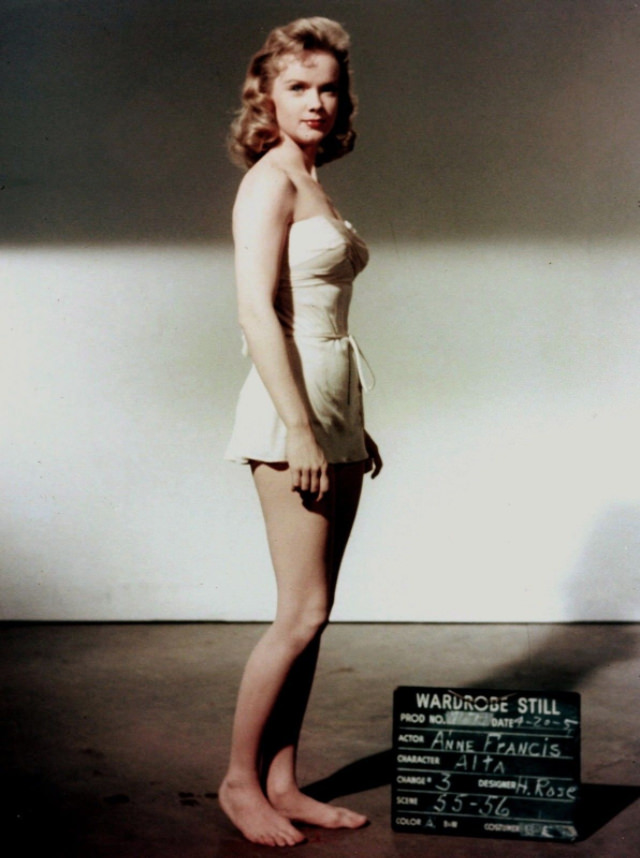
Anne Francis brought a natural ease to the character that made each costume feel lived-in rather than theatrical. She moved through the sets with confidence, and the wardrobe worked with her physicality rather than against it. That balance between the actress and her costumes is visible in every production still from the film.
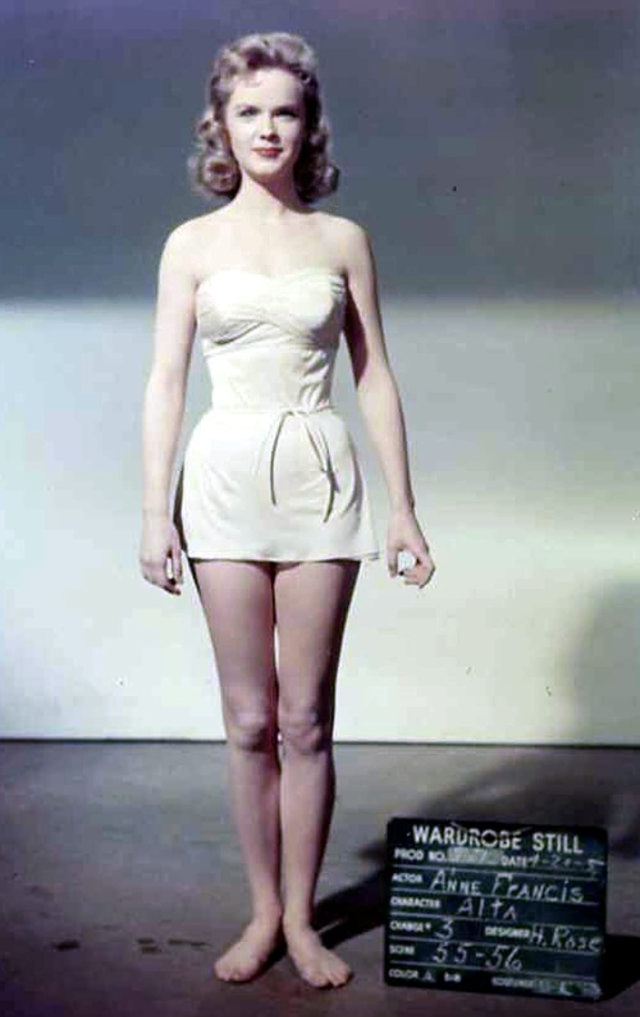
Looking at these wardrobe stills today, the designs hold up as precise expressions of 1950s optimism about the future. Space exploration was a growing national obsession in the years following World War II, and Forbidden Planet channeled that excitement into every frame — including what its central character wore. Alta’s outfits weren’t accidental. They were carefully constructed visual statements about what it meant to be human in an alien universe.