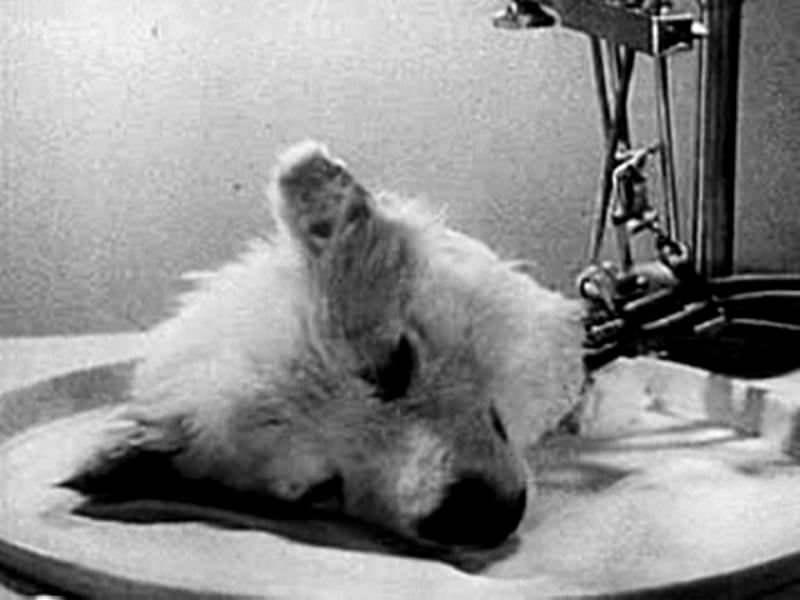

Of all the experiments ever performed on animals, few are as disturbing or as scientifically significant as what happened in a Soviet laboratory in 1928. A Russian scientist named Sergei Brukhonenko managed to keep a dog’s severed head alive — completely separated from its body — using a machine he built himself. The experiment was not a secret. It was presented to the world at an international scientific conference, where the machine and its results were demonstrated in front of an audience of scientists.

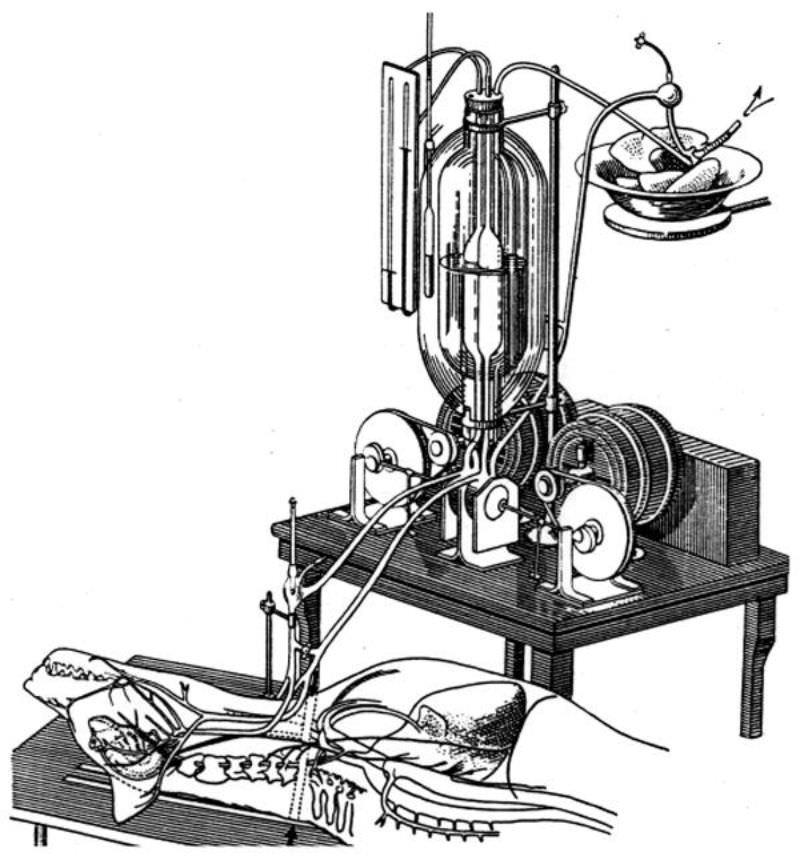
The device Brukhonenko created was called the autojector — a heart-lung machine that circulated and oxygenated blood artificially. It took over the functions that a living body would normally perform, pumping blood through the dog’s severed head to keep the brain and tissues supplied. Without the autojector doing the work of the heart and lungs, the head would have died within minutes of separation from the body. With it, the head showed measurable signs of life.

A film was made documenting the experiments, and it drew widespread attention from the scientific community. However, several scientists who claimed to have witnessed the filmed experiments raised doubts about one key detail: the duration of survival. The film suggested the severed head remained alive for hours, but eyewitness scientists said the head survived for only a few minutes, not the extended period the film implied. The discrepancy sparked debate about how much of the footage was staged or exaggerated for dramatic effect.

The experiment caught the attention of people far beyond the scientific world. The playwright George Bernard Shaw made one of the most memorable public responses, commenting directly on Brukhonenko’s decapitation work. Shaw wrote that he was tempted to have his own head cut off so he could continue to write plays and books without being bothered by illness, without having to dress and undress, without having to eat — doing nothing else but producing masterpieces of dramatic art and literature. It was a darkly humorous reaction to a deeply unsettling experiment.

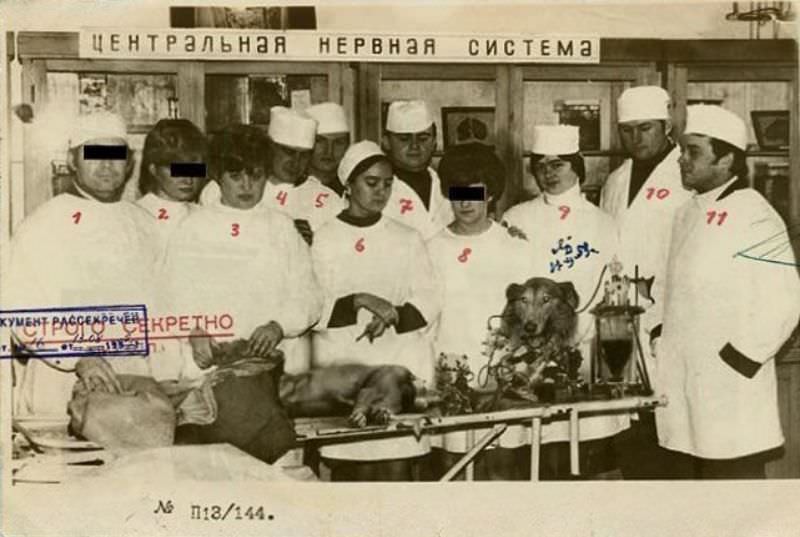
Brukhonenko did not stop after the initial demonstration. He continued refining his work and developed an updated version of the autojector. That improved machine is preserved today at the Museum of Cardiovascular Surgery at the Bakulev Scientific Center of Cardiovascular Surgery in Russia. Brukhonenko was posthumously awarded the Lenin Prize, one of the Soviet Union’s highest honors, recognizing the significance of his contributions to science. His work on artificial blood circulation laid important groundwork for later developments in open-heart surgery. The experiments did not end with Brukhonenko. In 1959, another Soviet scientist named Vladimir Demikhov carried out a related but different procedure. Demikhov surgically attached the upper body of a small dog onto the neck of a larger dog, creating a two-headed living animal. The larger dog’s circulatory system kept both heads alive simultaneously. Demikhov’s experiment shocked the world and pushed the boundaries of what transplant science was considered capable of achieving at the time.