
Ecuador sits on the far western edge of South America, straddling the Equator — the imaginary line that divides the Earth into the Northern and Southern Hemispheres. The country takes its name from that line. Its capital, Quito, rests between the Pacific coast and the towering Andes mountain range, sitting at an elevation of over 9,000 feet above sea level. In 1959, Ecuador was a country shaped by deep contrasts — ancient traditions alongside colonial architecture, barefoot farmers alongside cobblestone city streets, and lush tropical lowlands alongside freezing Andean nights.
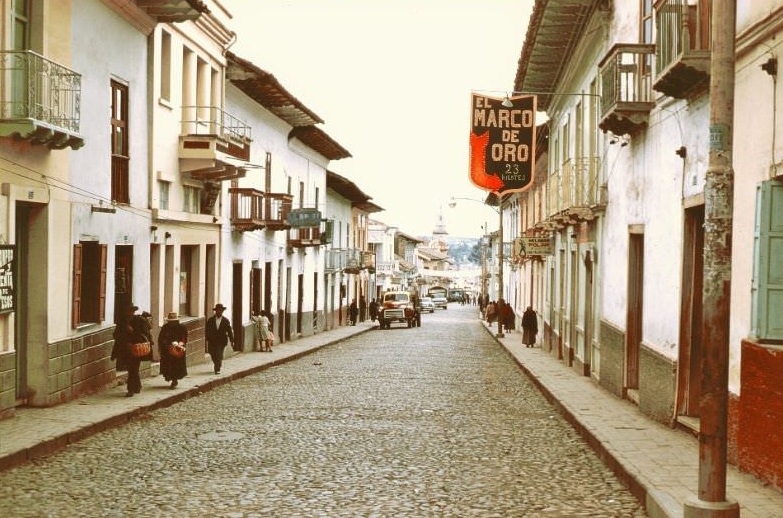
The population in the late 1950s was a mix of backgrounds. About 25 percent of Ecuadorians belonged to indigenous or native cultures, roughly 10 percent were of European descent, and the rest were mostly of mixed heritage. For many indigenous communities, life revolved around subsistence farming — growing only what was needed to feed the family. Photographer Bob McCleskey captured this world in remarkable detail during his 1959 travels across the country, from the northern border town of Tulcán to the southern coastal town of Pasaje. His photos offer a rare, unfiltered look at Ecuador during that era. The town of Tulcán, near the Colombian border, served as a northern gateway into the country. Its main street in 1959 reflected a modest but organized urban life.
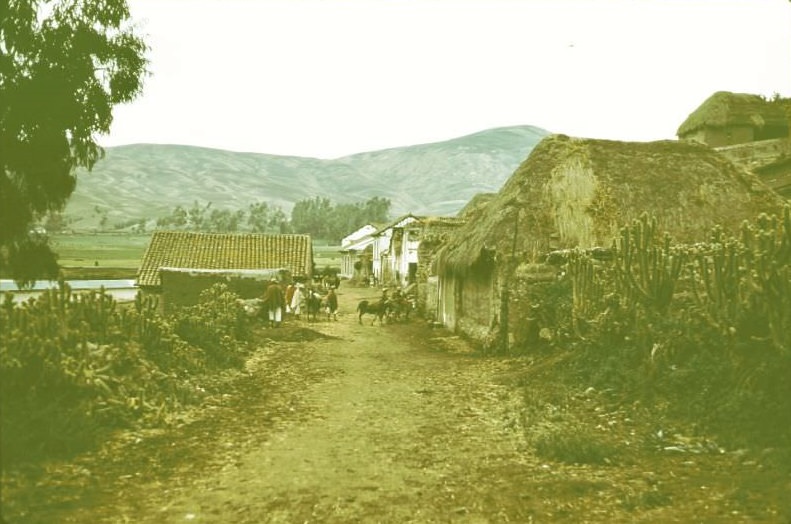
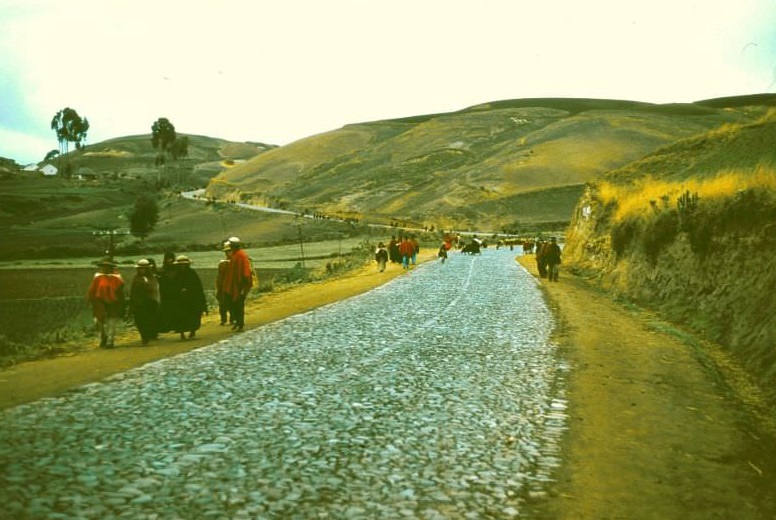
Traveling between towns meant navigating the rugged Andean landscape. Roads wound through valleys and highlands, connecting communities that were often separated by dramatic changes in elevation and terrain. The region between Ibarra and San Antonio de Ibarra was one such stretch, defined by rolling hills and small farming settlements.
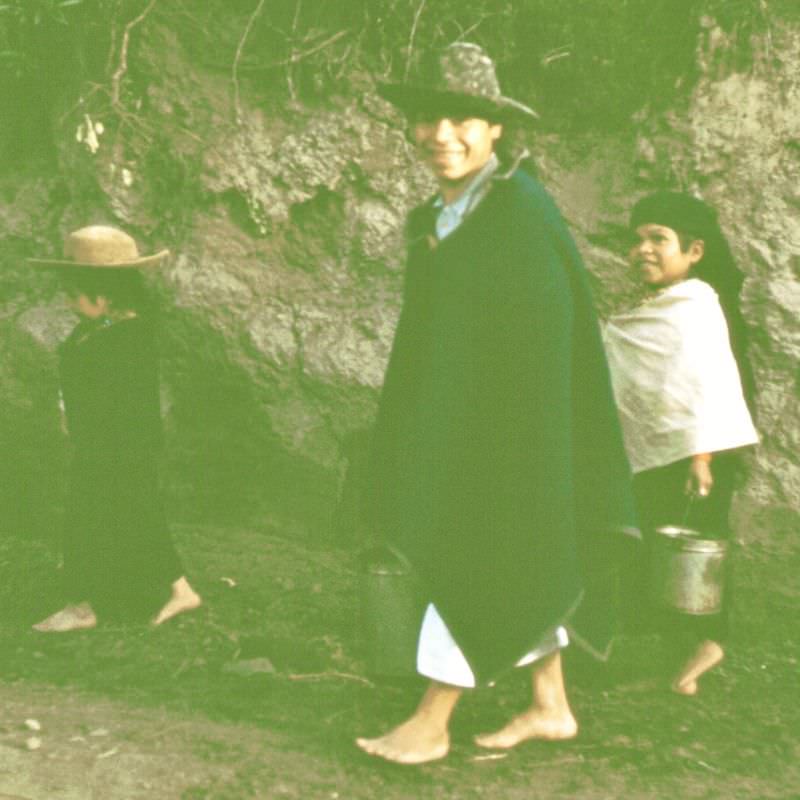
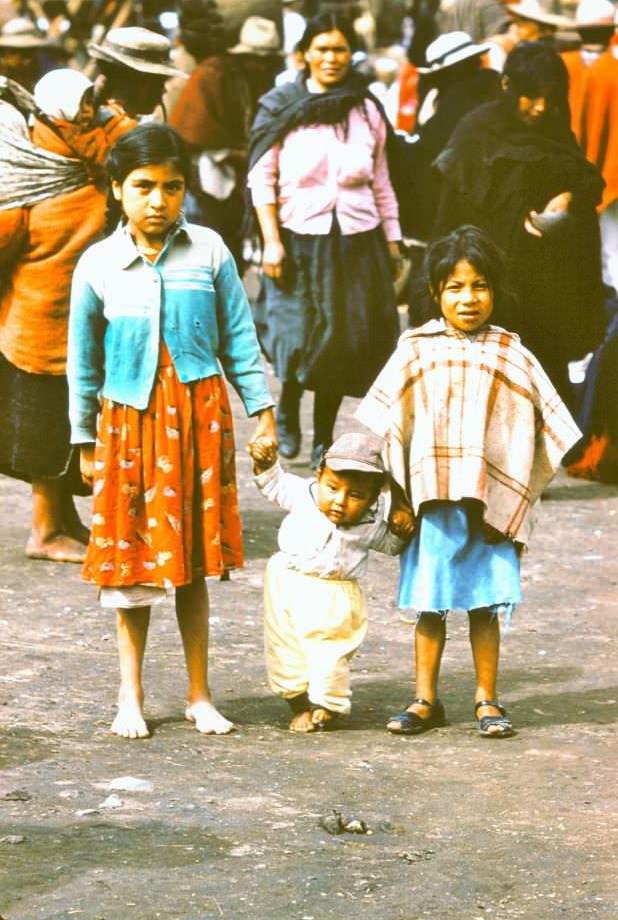
Despite frigid temperatures at high elevations after dark, many people throughout the Andes went barefoot. The cold was a daily reality for highland communities, yet footwear remained a luxury for a large portion of the population.
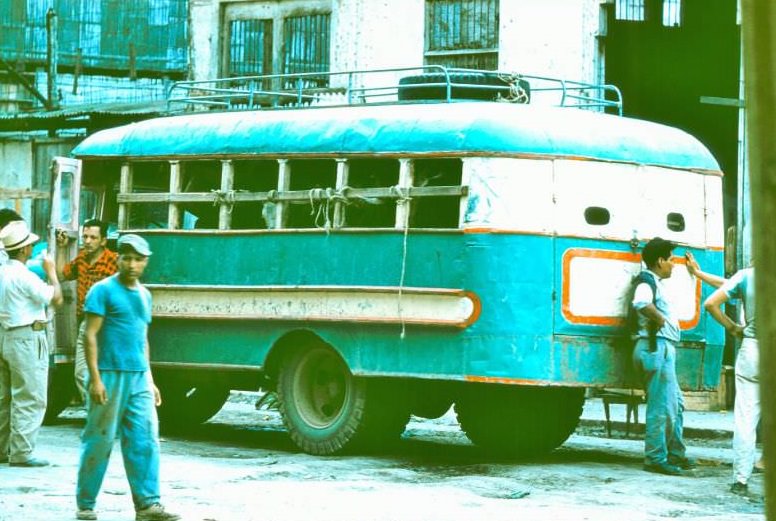
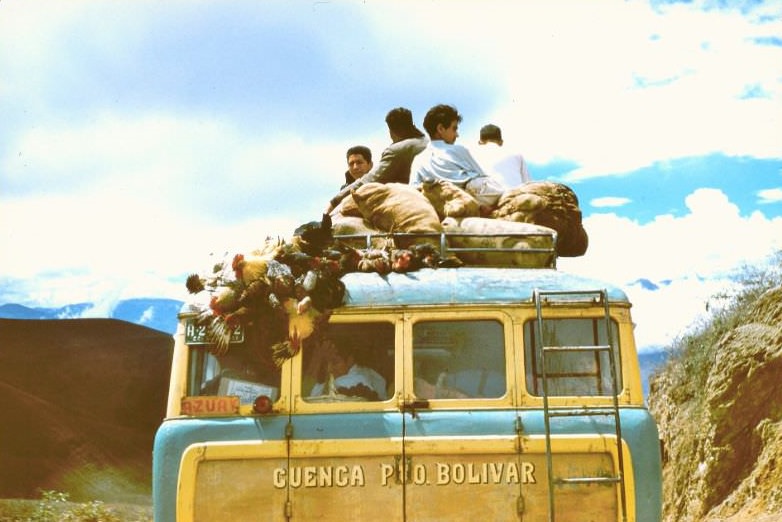
Public transportation in 1959 Ecuador operated on its own terms. The bus route between Cuenca and Pasaje carried an assortment of passengers and cargo — people rode in front, cattle were loaded into the rear, and chickens were secured on top. This was not unusual. Buses were the main link between distant towns, and they carried whatever needed moving.
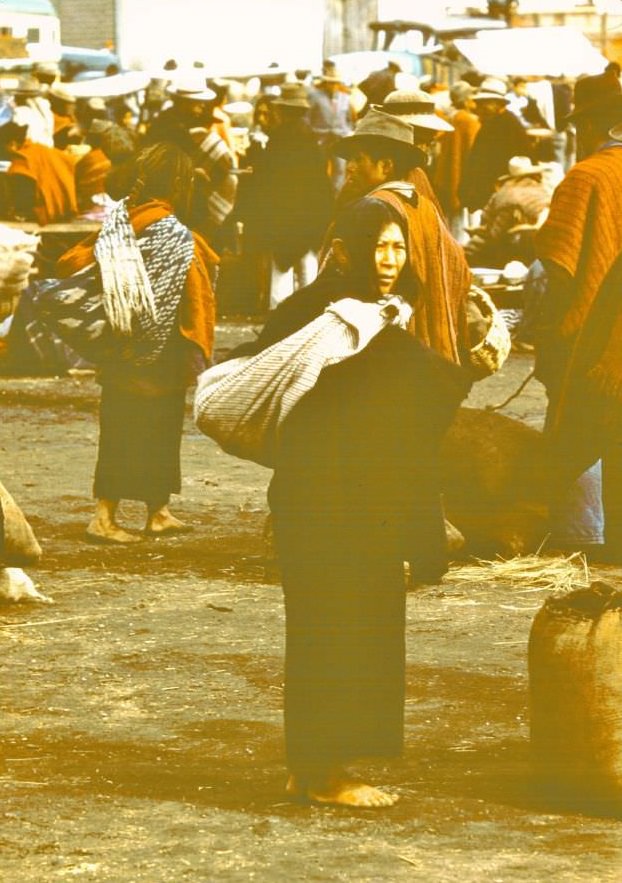
Ecuadorian cuisine relied heavily on bold flavors. Hot peppers were a staple of the local diet, and food was typically highly seasoned. In Cajabamba, a small Andean town, peppers were grown and sold locally, forming a key part of both the diet and the market economy.
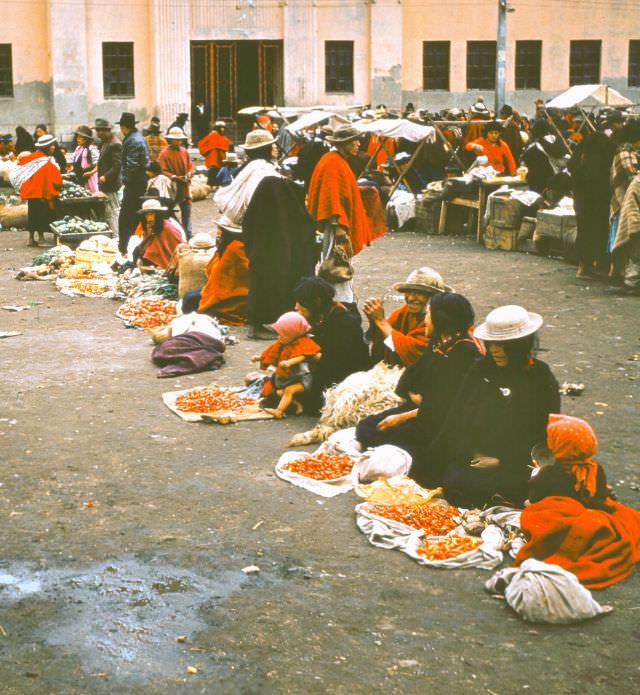
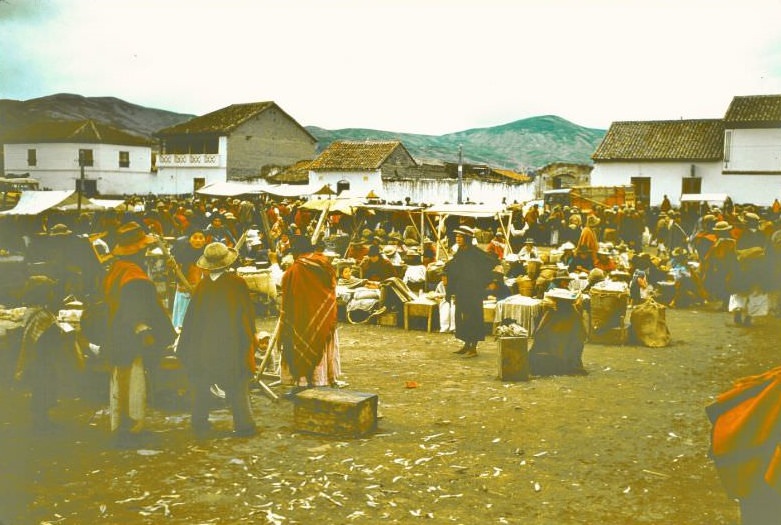
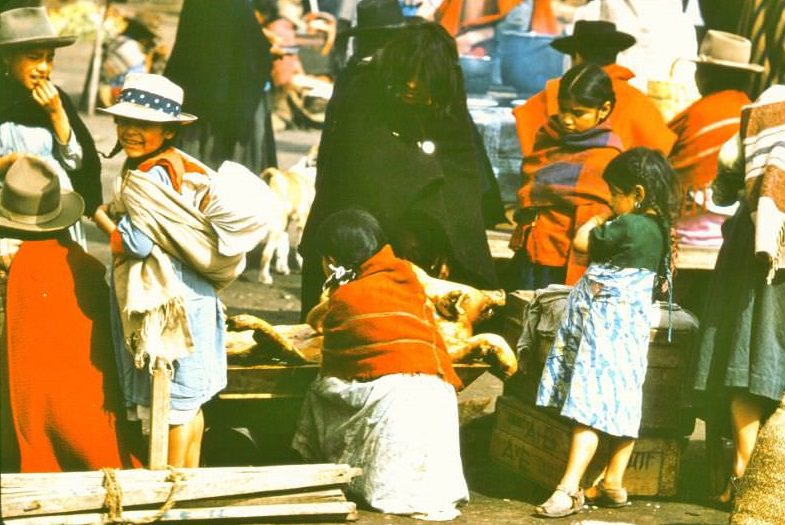
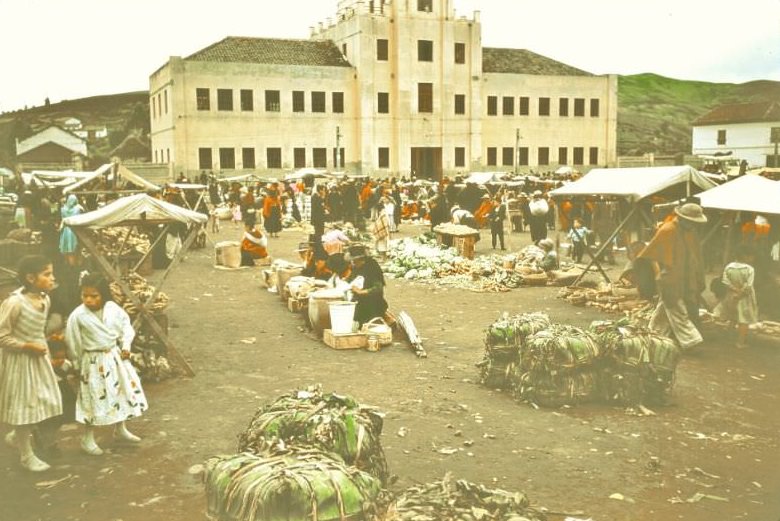
Market days were the heartbeat of rural Ecuadorian life. Towns like Cajabamba held weekly markets where vendors, farmers, and buyers gathered to trade goods. These markets were organized and lively, drawing people from surrounding villages who arrived on foot, often having walked miles before dawn.
Live animals were a common sight at these markets. Chickens destined for sale were tied by their feet in large bundles and carried to market — alive. This was the standard method of transport, keeping the birds fresh until the moment of sale.
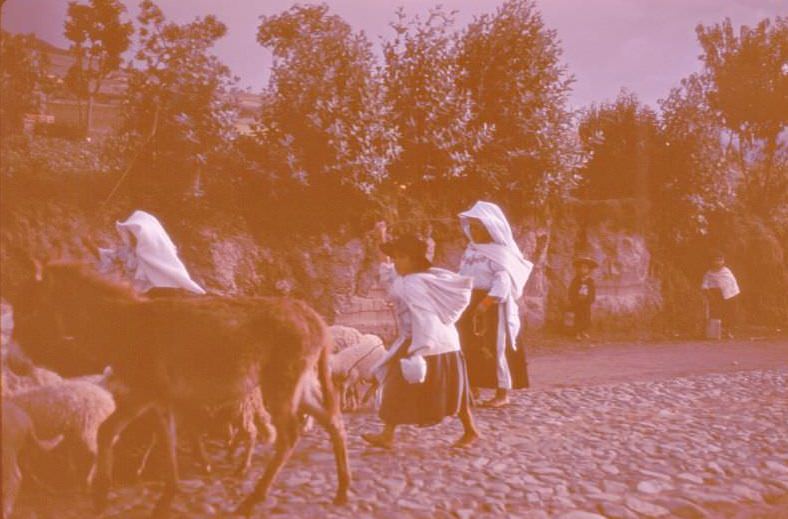
Near Ibarra, young women herded sheep across open land. A donkey served as the lead animal for the flock, guiding the sheep along the path. This practice made herding easier and was common across the Andean highlands, where donkeys and mules played essential roles in daily agricultural work.
Firewood was a critical resource in highland Ecuador, and gathering it was physical, demanding work. Indigenous men carried heavy loads of cut wood on their backs, using straps across their foreheads to distribute the weight. This method of carrying loads — known throughout the Andes — allowed people to transport far more than they could carry by hand.
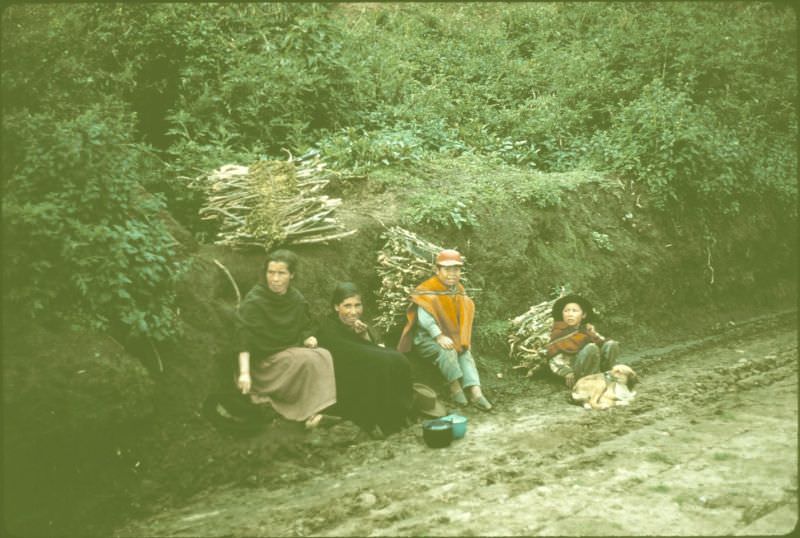
Roads in Ecuador ranged from the Pan-American Highway — the major north-south route running through the country — to rough dirt tracks leading out of small towns. Access to the Pan-American Highway was a significant factor in how connected a community was to the wider economy.
At the markets, every person carried their share. An elderly woman, dressed in black, had just finished unloading a smoked pig she had carried on her stooped back. Children nearby helped ease the load to the ground. Scenes like this were common — labor was distributed across all ages, and market days demanded everyone’s effort.
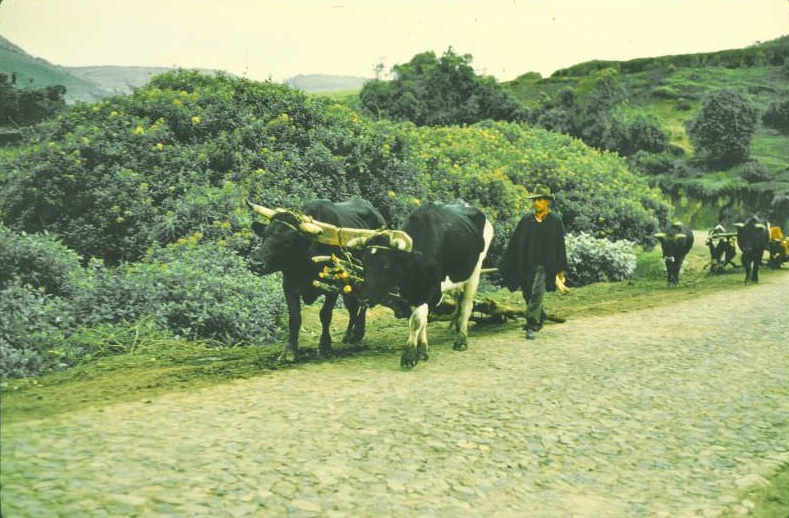
Even along the Pan-American Highway, one of the most important roads in the Western Hemisphere, the pace of life moved slowly. Just above Tulcán, oxen pulled heavy loads of wood along the highway’s edge. Modern motor traffic and ox-drawn carts shared the same road without much conflict — each was simply part of everyday Ecuadorian life.
In the coastal town of Pasaje, old leather saddles were on display and for sale. Horses and mules remained essential for travel and farm work in many parts of the country, and a good saddle was a practical necessity. Pasaje itself, sitting in the southern lowlands, had a warmer and more tropical character than the highland towns.
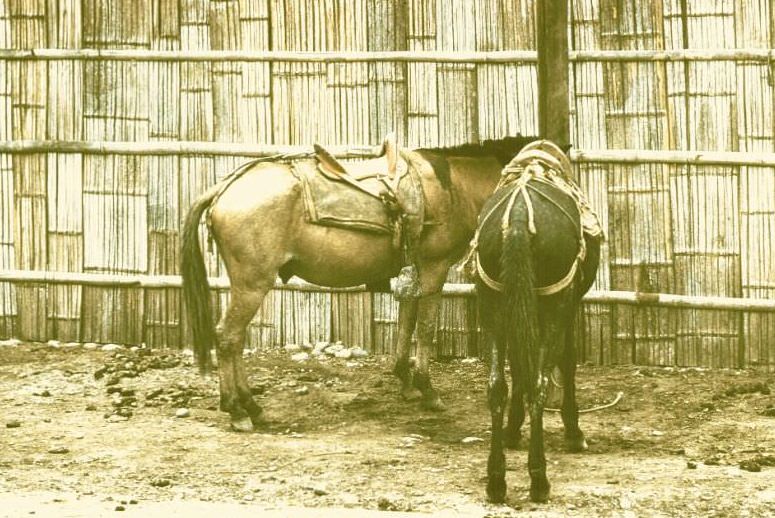
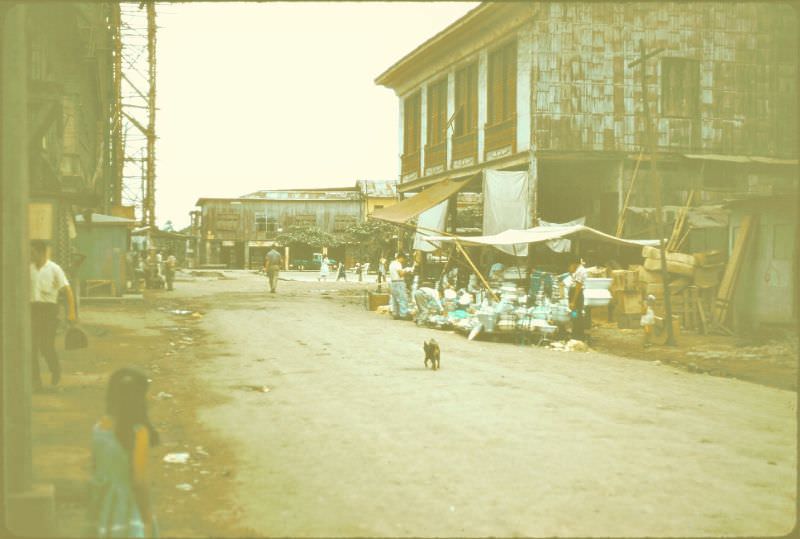
Market mornings were a striking spectacle. People streamed into town from surrounding countryside in the early hours, many of them trotting for miles with heavy loads strapped to their backs. The markets opened at dawn, and arriving early meant better prices and better positioning for both sellers and buyers.
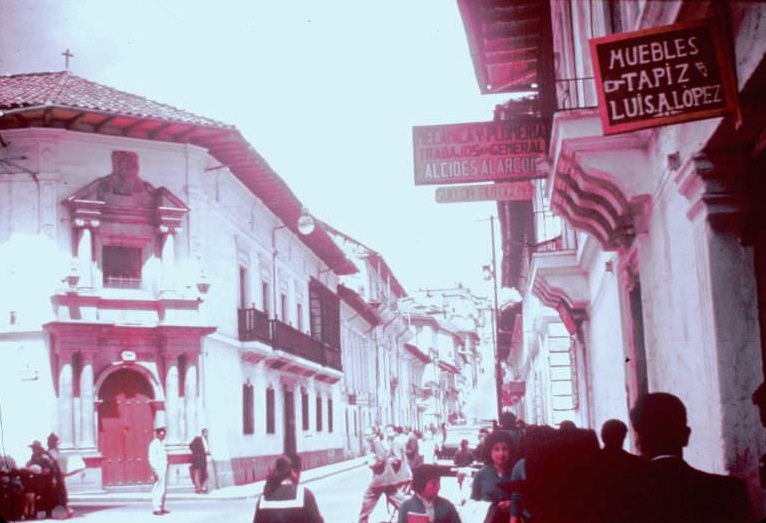
Quito in 1959 was still a compact and visually striking city. Its skyline was defined by colonial-era cathedrals and churches built during Spanish rule, many of which still dominate the historic center today. McCleskey noted that the city had no slums at the time — it remained a small, well-kept capital with a distinct old-world character.
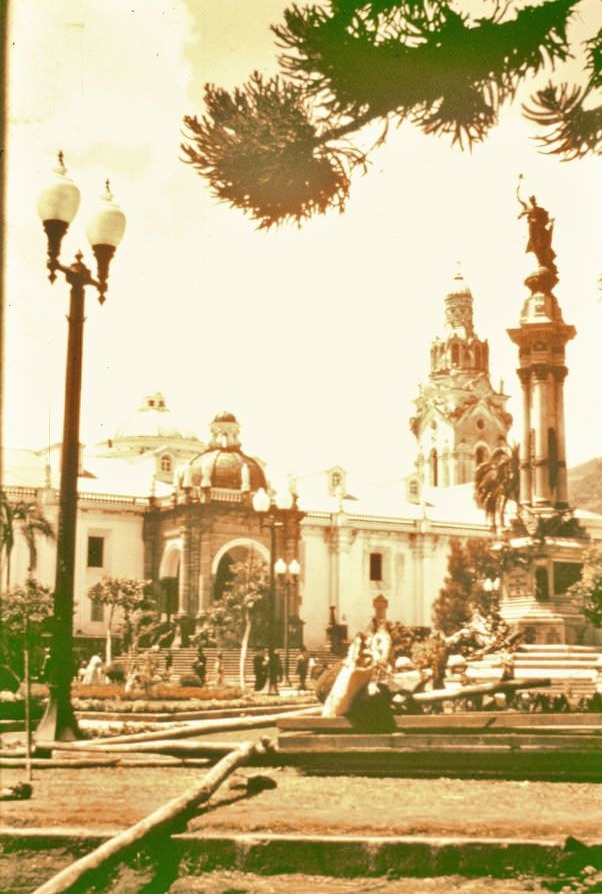
Government institutions in Quito occupied grand colonial buildings at the heart of the city. The government building stood as a symbol of Ecuador’s formal political structure, even as much of the country’s rural population lived by patterns unchanged for generations.
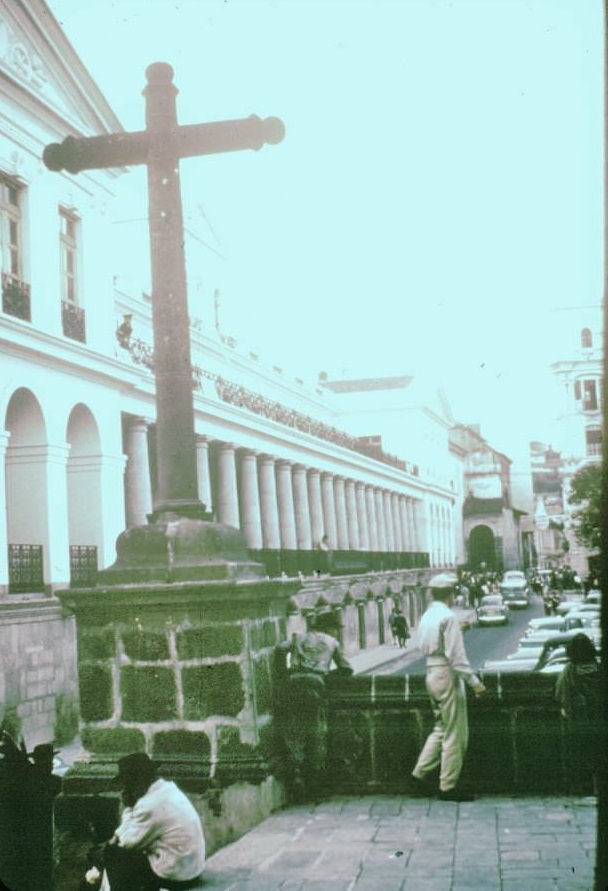
Street life in Quito had a calm, unhurried quality. Pedestrians moved along narrow stone streets lined with colonial architecture, and the city’s modest size meant that most of it was accessible on foot. The mix of indigenous dress and Western clothing visible in the streets reflected the country’s diverse population.
The markets were tightly organized by product type. Each category of goods — tobacco, vegetables, meat, grains — was assigned its own dedicated zone within the market space. Vendors paid a city tax to set up in their designated area, giving local governments a small but consistent source of revenue from the weekly trade.
Across every town and region McCleskey photographed, children were a constant presence — in the markets, on the roads, and at the sides of working adults. Ecuador’s population was young, and children were woven into the fabric of daily work and community life from an early age.





Thank you very much, it’ nice to see this pictures of my country.
12 Ecuador. Cajabamba hot peppers, food highly seasoned, 1959
What happened? Lol.
Nada realmente; Chimborazo sigue siendo a día de hoy una de las provincias que más cosecha más ají.
Still looks the same in so many ways