
Amsterdam in the 1940s and 1950s was a city still finding its footing after World War II. Streets were crowded with trams, trucks, early automobiles, and cyclists all sharing the same narrow roads. Traffic rules were loosely enforced, road markings were minimal, and vehicles were often poorly maintained. The result was a steady stream of accidents — some minor, many serious, and a few deadly. The photographs collected here document those crashes, collisions, and disasters across the city and its surroundings, preserving moments that would otherwise be lost to time.
Heavy municipal vehicles were a common sight on Amsterdam’s streets. Trucks used for city cleaning, waste removal, and road maintenance moved through residential and commercial areas daily. When accidents involved these large vehicles, the damage was significant. The collision on Stadhouderskade in 1952 involving a gully suction truck was one of several incidents that highlighted how dangerous large service vehicles could be in tight urban spaces.
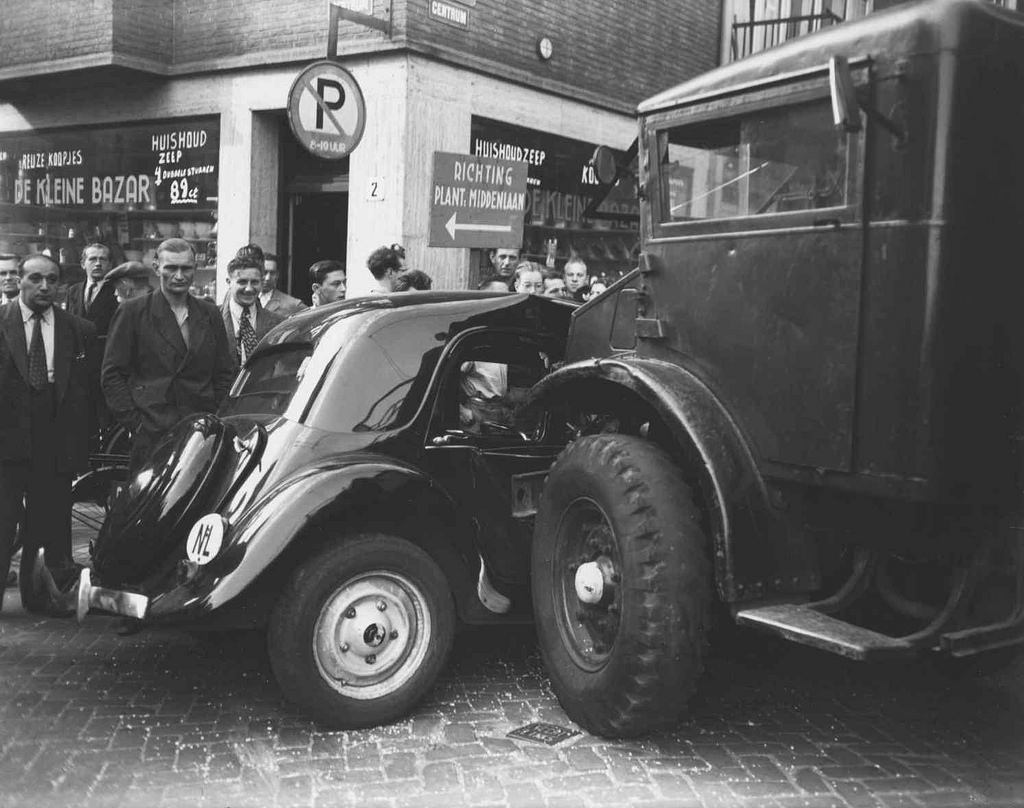
Canal-side streets and sharp intersections made many parts of Amsterdam particularly accident-prone. The junction of Nieuwe Herengracht and Weesperstraat was one such spot. A collision there in September 1949 caused damage to both vehicles and the nearby De Kleine Bazar storefront. Intersections without traffic lights forced drivers to rely entirely on their own judgment — a system that failed often.
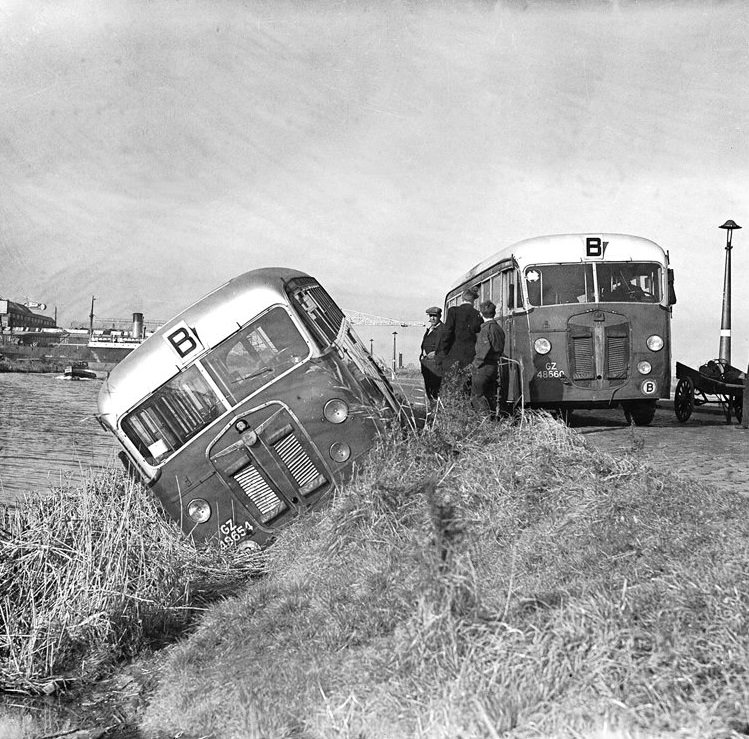
Flooding was a recurring threat in Amsterdam’s low-lying districts. When water levels rose quickly, vehicles caught in the wrong area had little chance of escape. A Line 35 bus was trapped and flooded in 1965, sustaining major structural damage. Passengers had to be evacuated, and the bus was rendered unusable. Events like this were a reminder that Amsterdam’s geography added an extra layer of danger to everyday travel.
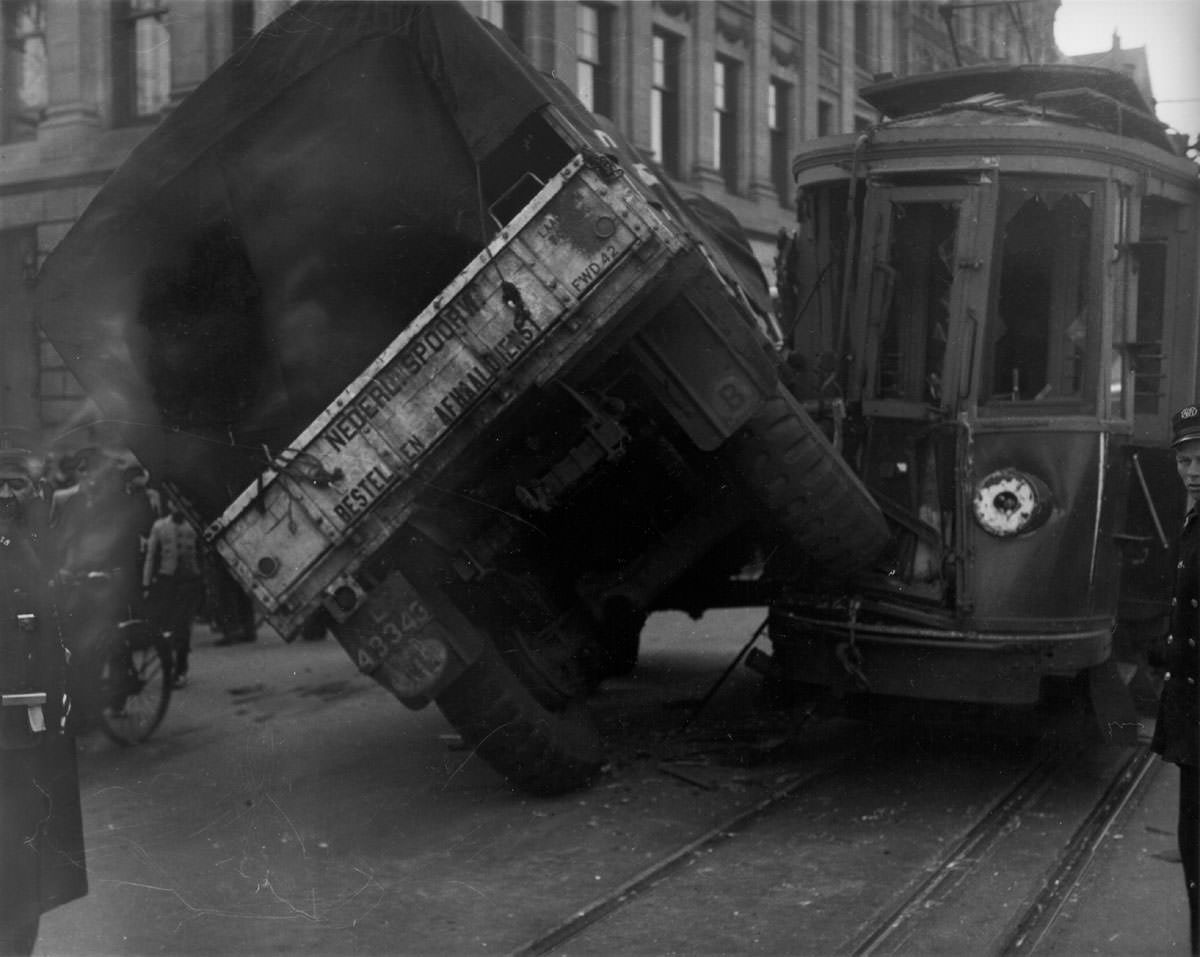
Trams were the backbone of Amsterdam’s public transportation in the post-war years. They ran on fixed tracks through the middle of streets, sharing space with trucks, cars, and horse-drawn carts. On April 14, 1947, a Dutch Railways truck struck a tram on Raadhuisstraat with enough force to knock it halfway onto its side. The image is a stark reminder of how vulnerable fixed-track vehicles were to collisions with heavier road traffic.
Train accidents in Amsterdam during the 1950s ranged from derailments to collisions at rail crossings. As rail traffic increased alongside road traffic, the risks multiplied. Several incidents in this period resulted in significant damage to rolling stock and, in some cases, injuries to crew and passengers. The rail network was still recovering and expanding after wartime disruption, and safety infrastructure had not always kept pace.
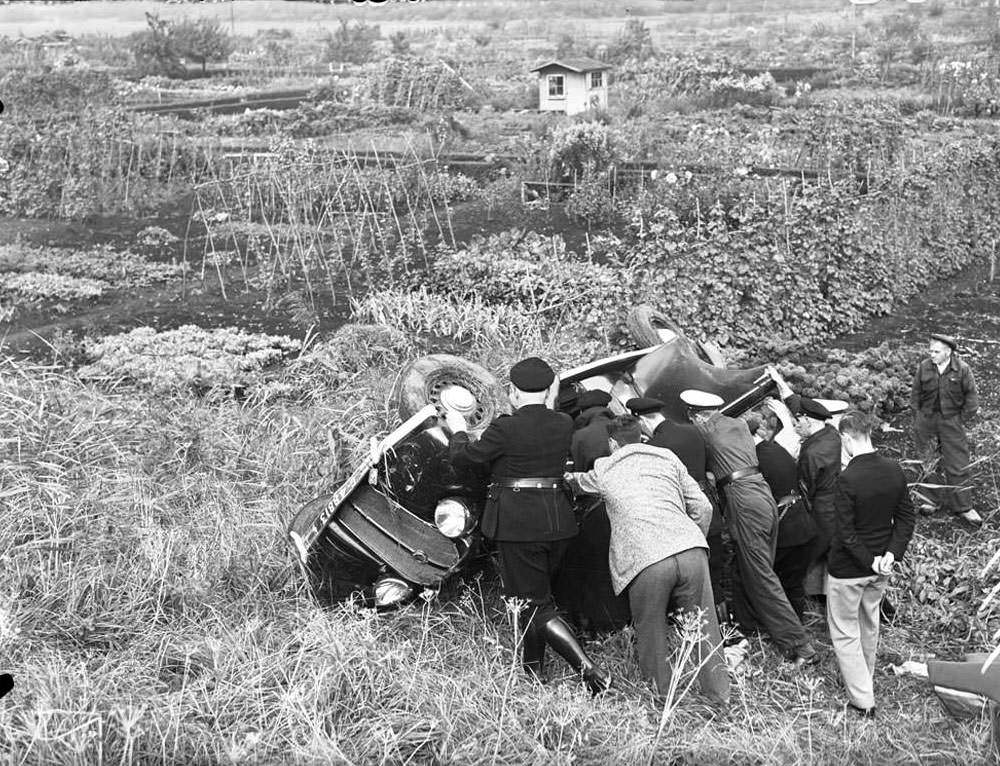
A Hotchkiss automobile flipped onto its back in 1949, a scene that captures just how quickly a crash could turn catastrophic. The Hotchkiss was a French-made vehicle, and like many cars of the era, it lacked the safety features that would become standard decades later — no seatbelts, no crumple zones, no reinforced roof structure. A rollover in a vehicle like this left occupants with very little protection.
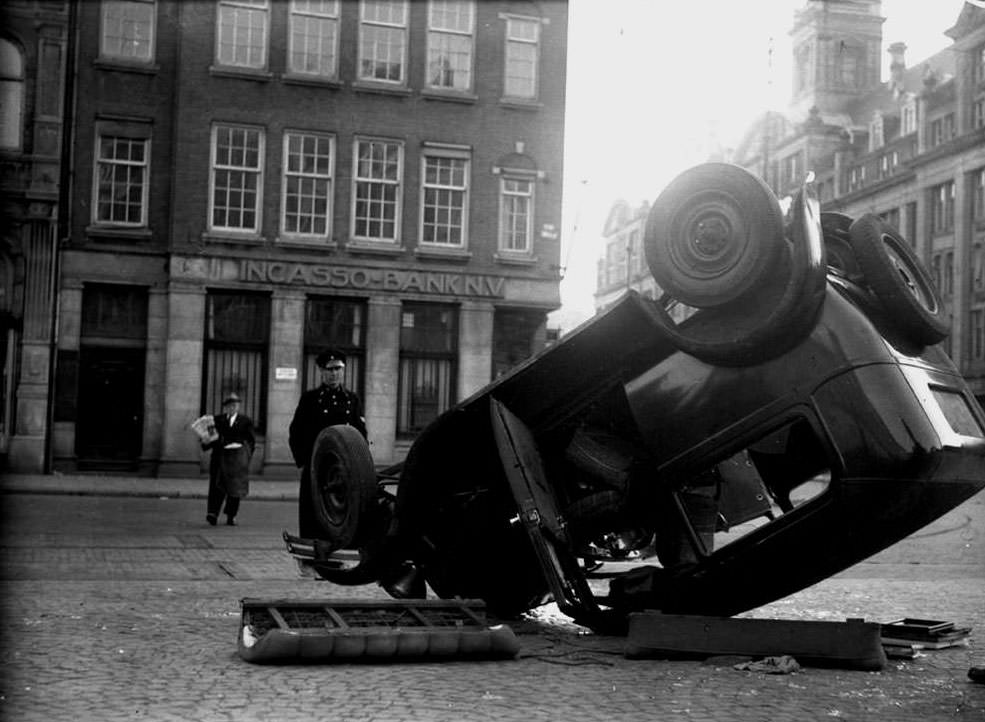
Throughout the 1950s, car ownership in Amsterdam grew rapidly. More vehicles on the road meant more accidents, and the city’s infrastructure was slow to adapt. Roads designed for horse-drawn traffic were now filled with motor vehicles traveling at speeds the original planners never anticipated. Crashes became a routine part of city life, and accident scenes often drew large crowds of onlookers.
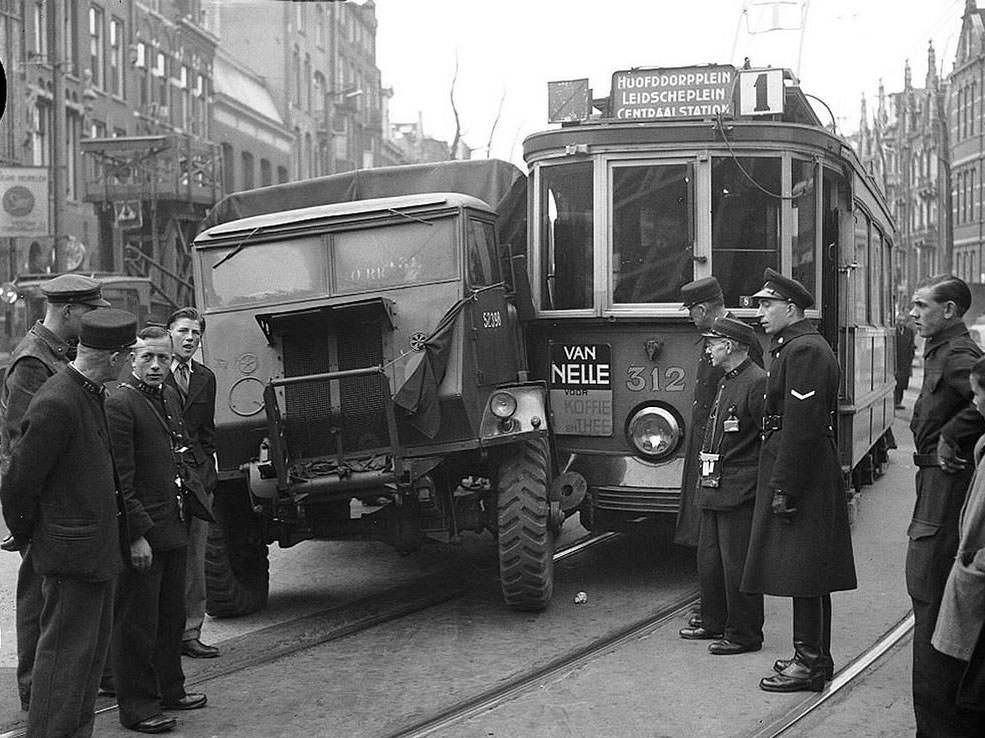
Just one year after liberation, Amsterdam’s streets were already seeing serious accidents. In April 1946, Tram 1 collided with a British-made Fordson truck at the corner of Overtoom and Nassaukade. The Fordson, widely used across Europe in the post-war period, was a heavy vehicle, and the impact on the tram was severe. The presence of British-made trucks in Amsterdam at this time reflects the ongoing movement of foreign military and aid vehicles through the city.
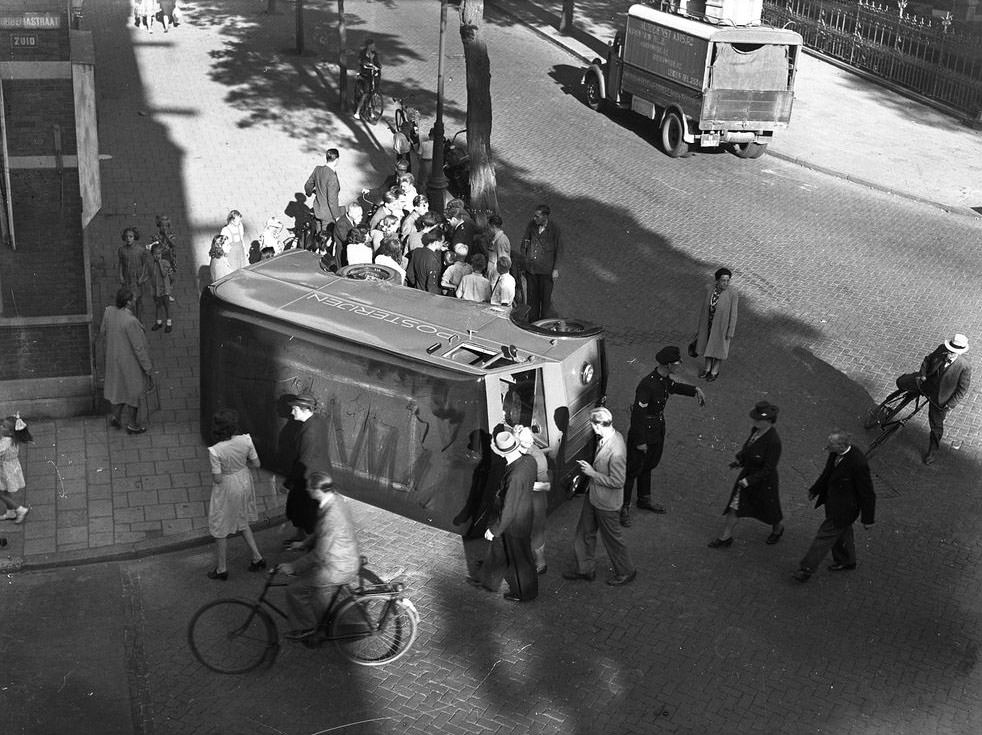
Government and postal vehicles were among the most active on Amsterdam’s streets in the late 1940s. Delivery schedules, tight routes, and pressure to move quickly all contributed to accidents. On September 4, 1947, a Post Office car overturned at the corner of Hobbemastraat and Jan Luijkenstraat — a well-trafficked residential area near the Rijksmuseum. The overturned vehicle blocked the street and required recovery crews to clear the scene.
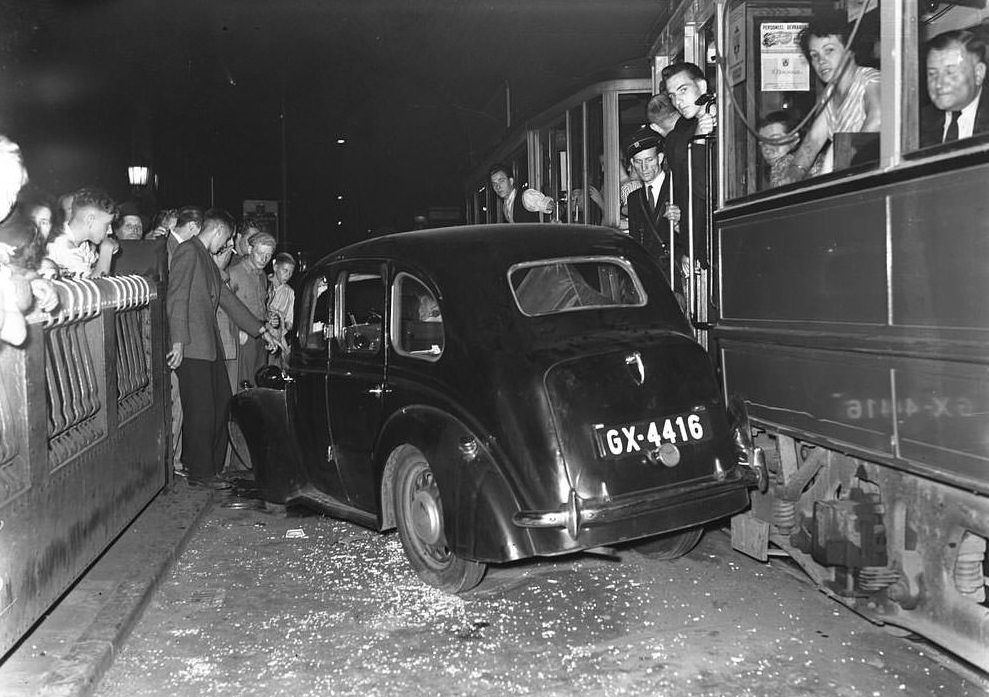
The 1940s were a particularly dangerous decade for road users in Amsterdam. Wartime damage to roads and infrastructure had not been fully repaired, and vehicle maintenance was often neglected due to shortages of parts and materials. Many of the cars on the road were pre-war models kept running well past their intended lifespan. Accidents in this environment were frequent and often serious.
Amsterdam’s canals were a constant hazard for motorists. The city has more than 100 kilometers of canals, and many roads run directly alongside them with little more than a low curb or railing as a barrier. Cars going into canals was not a rare event — it happened regularly, in daylight and at night, in dry conditions and wet ones. Recovering a submerged vehicle required cranes and diving crews, and not every occupant made it out alive.
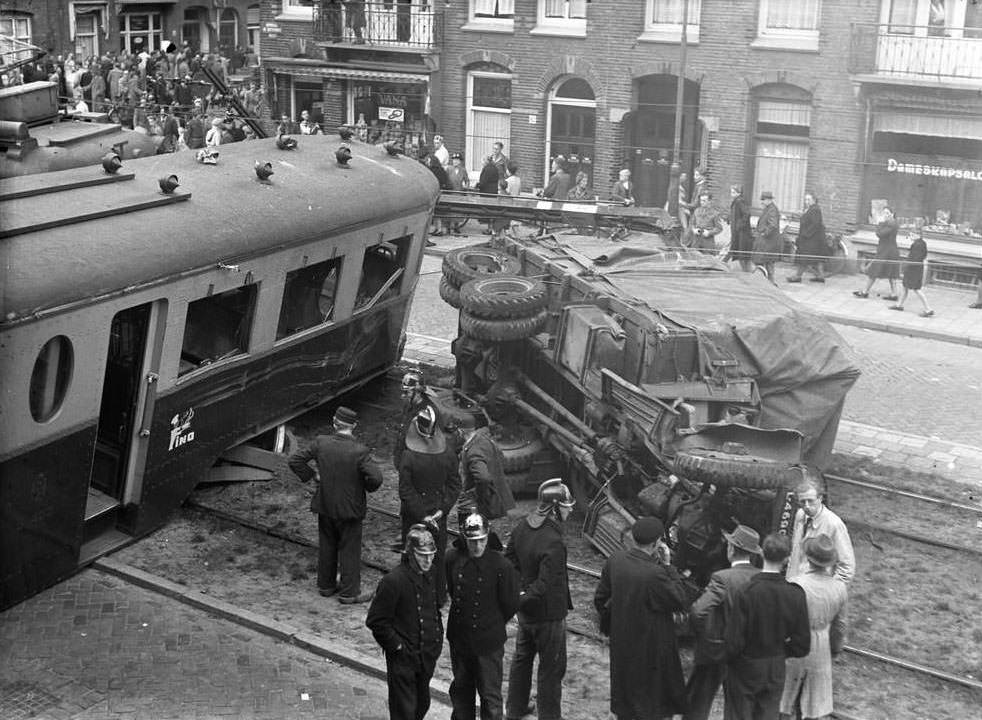
The Haarlem tram line connected Amsterdam to its neighboring city and ran through some of the busiest streets in the western part of the city. On October 7, 1946, a truck struck the tram broadside at the corner of Admiraal de Ruyterweg and Jan van Galenstraat. Side-impact collisions with trams were among the most dangerous types of accidents in post-war Amsterdam, as the tram’s metal body offered little lateral protection to passengers.
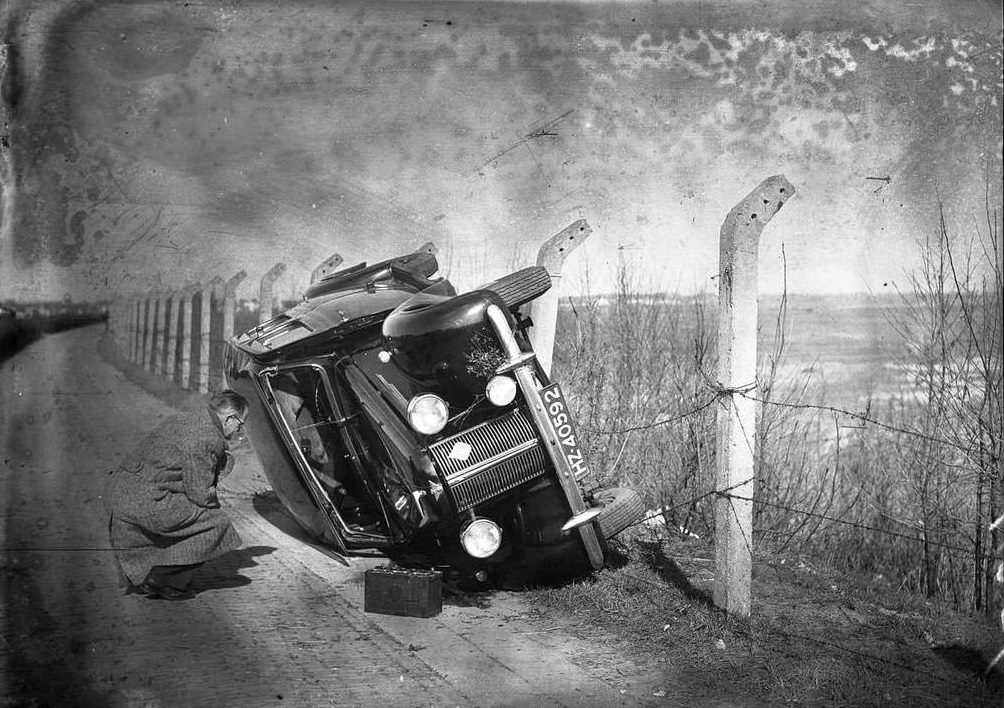
Police officers were regularly called to accident scenes to assess damage, take statements, and direct traffic. In the 1940s, accident investigation was a basic process — officers noted what they observed, spoke to witnesses, and filed reports. Forensic reconstruction of crashes was not yet standard practice. A single officer examining a damaged vehicle at the scene was often the extent of the official response.
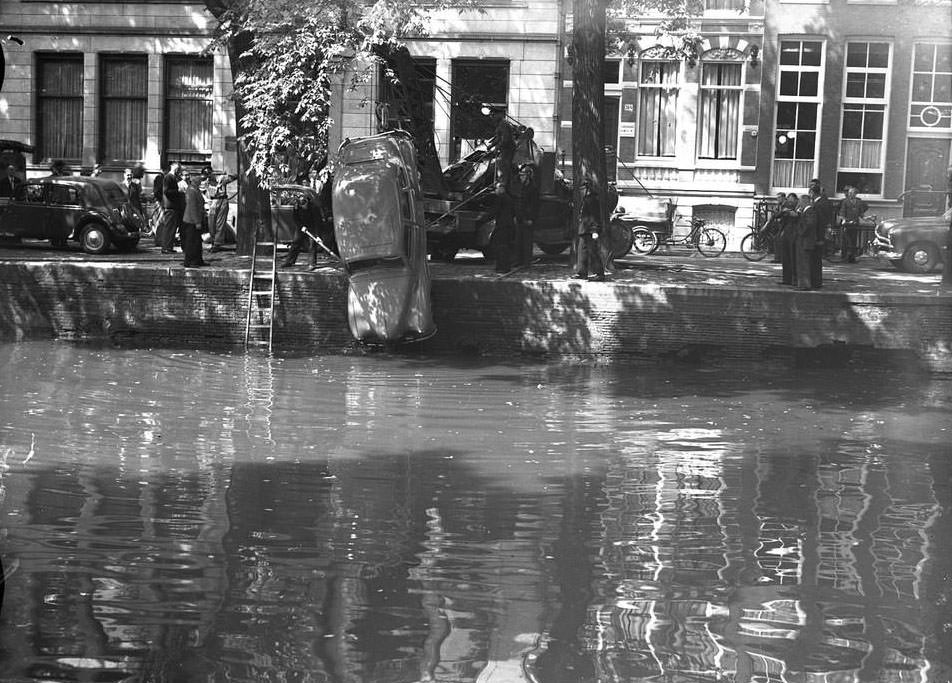
Canal recoveries required heavy equipment and a coordinated effort between police, fire services, and private salvage crews. Cranes and chains were used to drag vehicles from the water, sometimes hours or even days after they had gone in. The cars recovered were almost always beyond repair. The frequency of these recovery operations led to ongoing debates about better canal-side barriers, though improvements were slow to come.
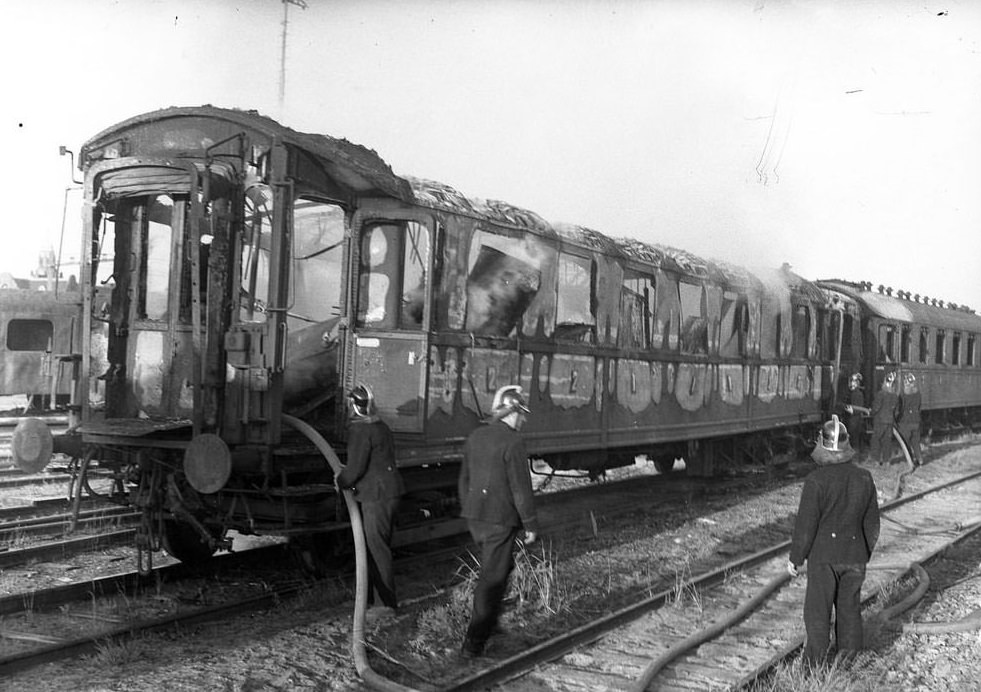
Rail accidents in and around Amsterdam drew significant public attention. A derailment or collision involving a passenger train disrupted not just the rail network, but also the roads around the affected area. Emergency crews, onlookers, and press photographers all converged on accident scenes, as documented in multiple photographs from this period. The train system was under pressure to modernize and expand, and accidents were a painful indicator of where the infrastructure was failing.
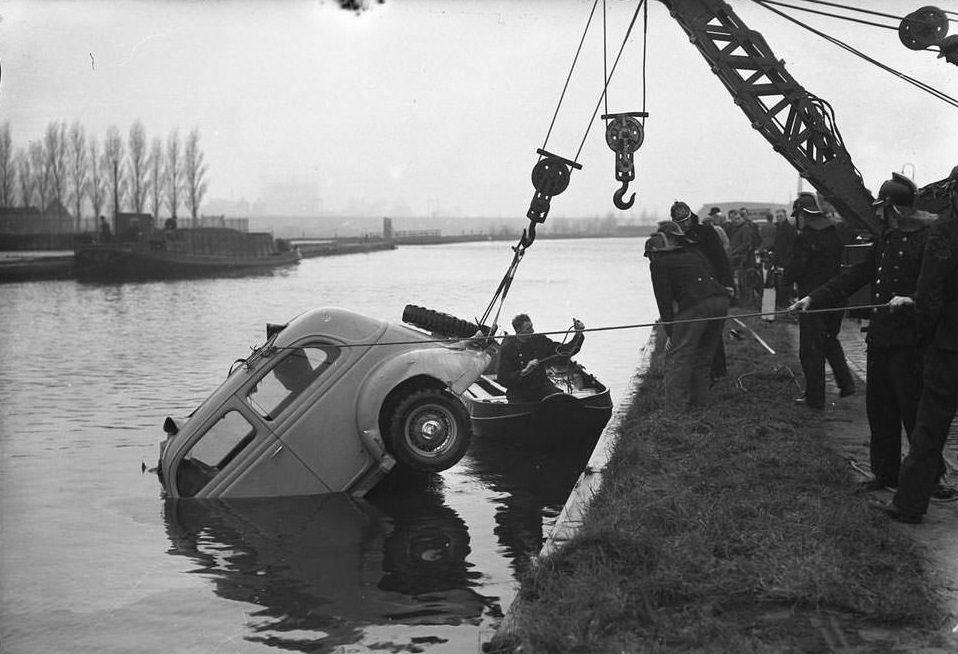
The 1945 canal recovery took place in the immediate aftermath of World War II, a period when Amsterdam was still rebuilding. Resources were stretched thin, and salvage operations competed with reconstruction efforts for equipment and manpower. Despite these challenges, canal recoveries were prioritized because submerged vehicles posed navigational hazards to the boats and barges that used Amsterdam’s waterways for commerce.
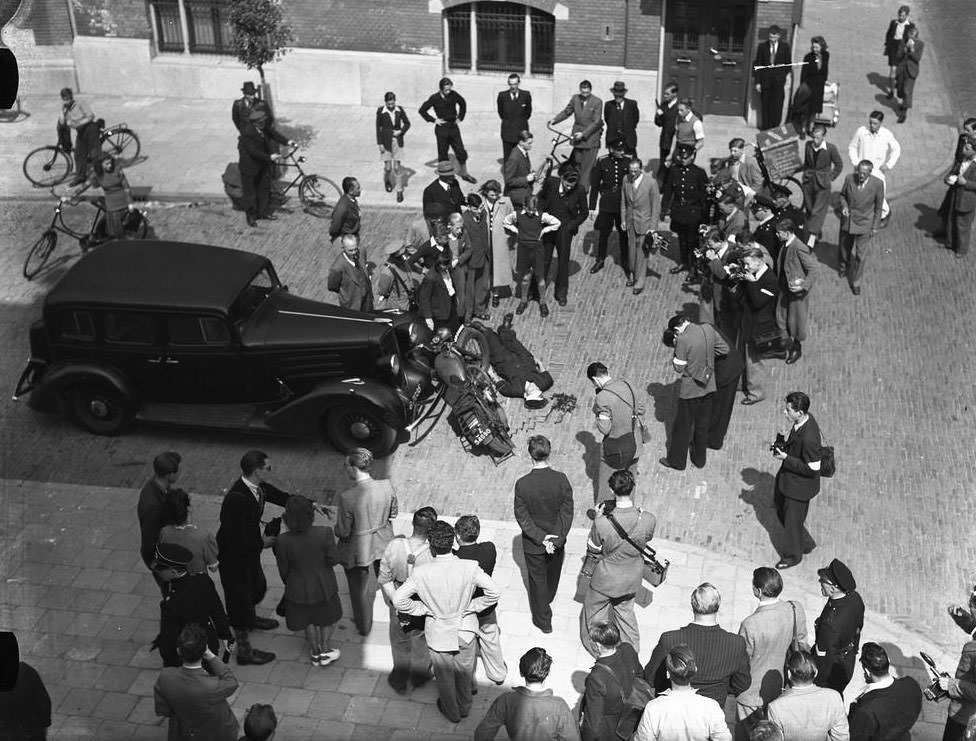
The documentation of accident scenes in this era was partly driven by the growing field of press photography. On May 10, 1948, trainee photojournalists from the Dutch Association of Photojournalists used an accident scene as a practical assignment. This underscores how accident photography was considered a core skill for working journalists of the time. The images produced by both professionals and trainees form much of the visual historical record we have today.
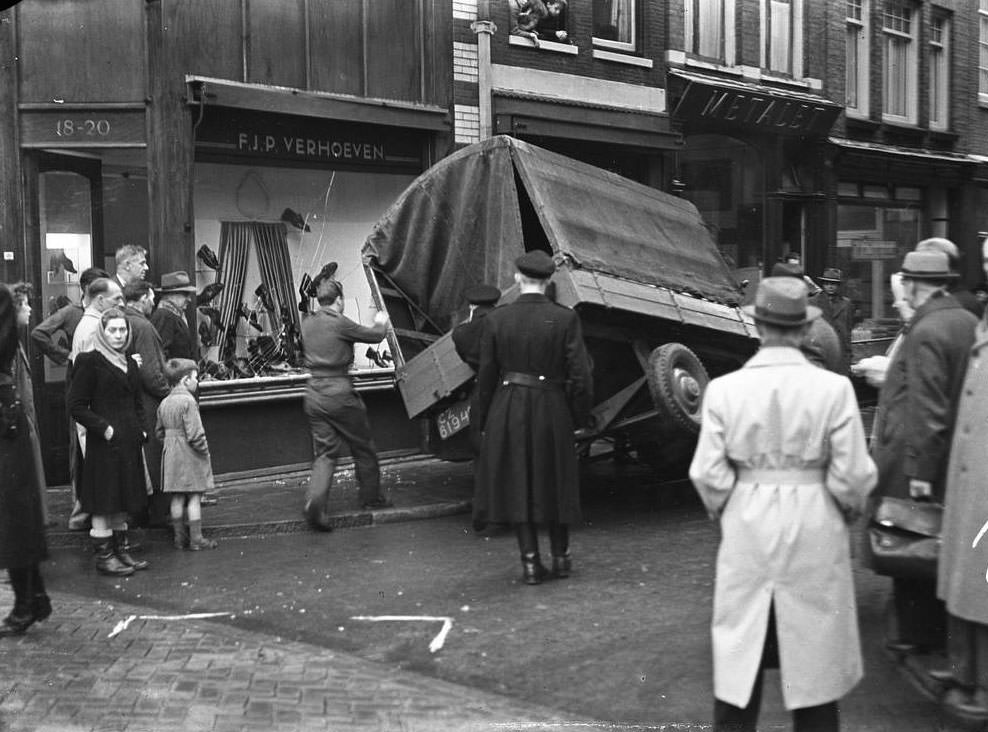
Delivery vehicles navigating Amsterdam’s narrow shopping streets regularly misjudged distances, striking buildings, storefronts, and parked vehicles. When a delivery vehicle hit a shop window, the damage extended beyond the vehicle itself — glass shattered into the street, merchandise was destroyed, and business was halted. These incidents were costly for shop owners and drivers alike, and they happened more often than official records suggest.
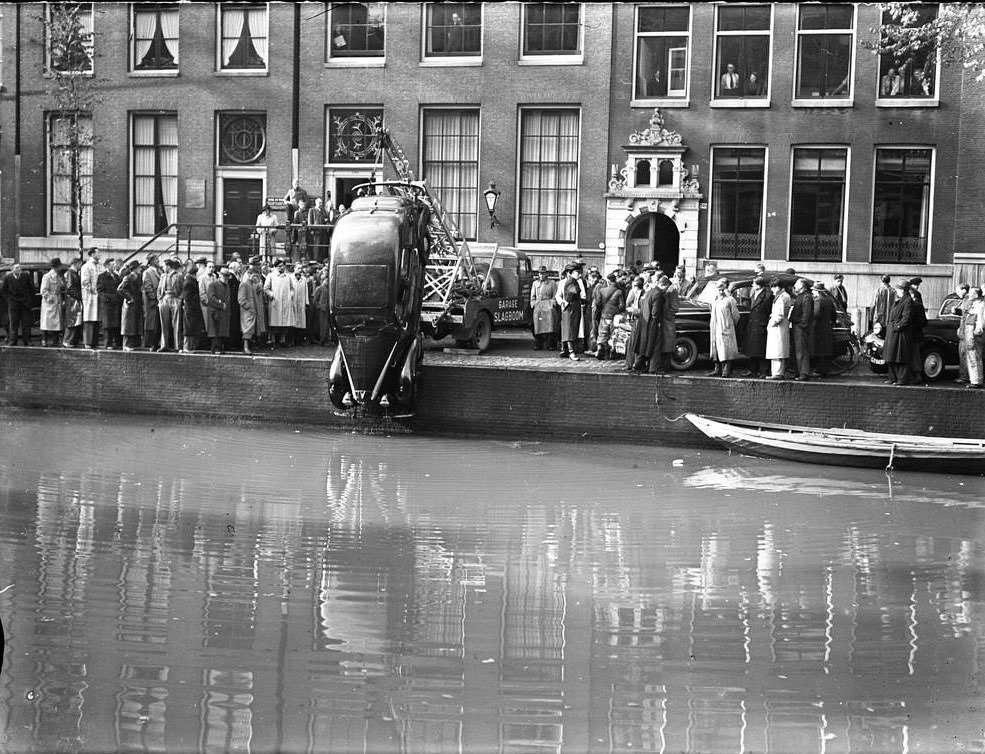
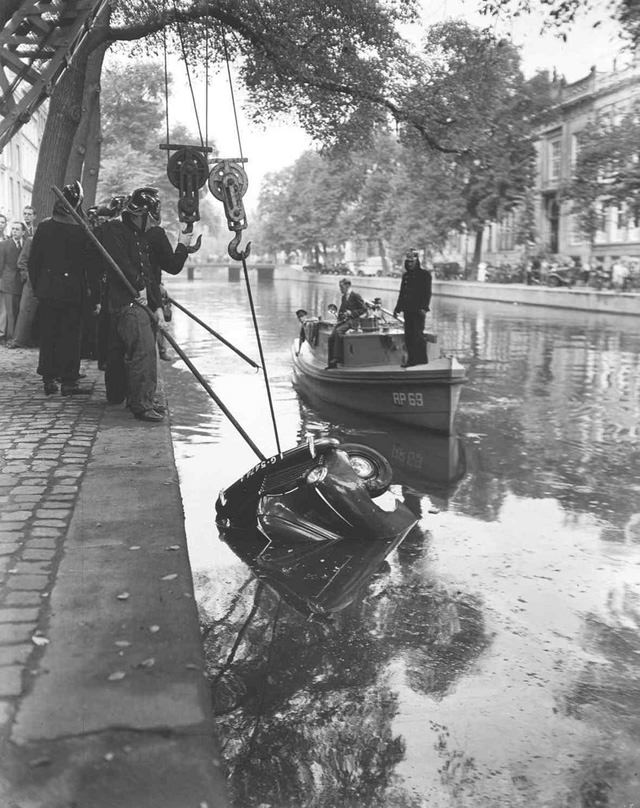
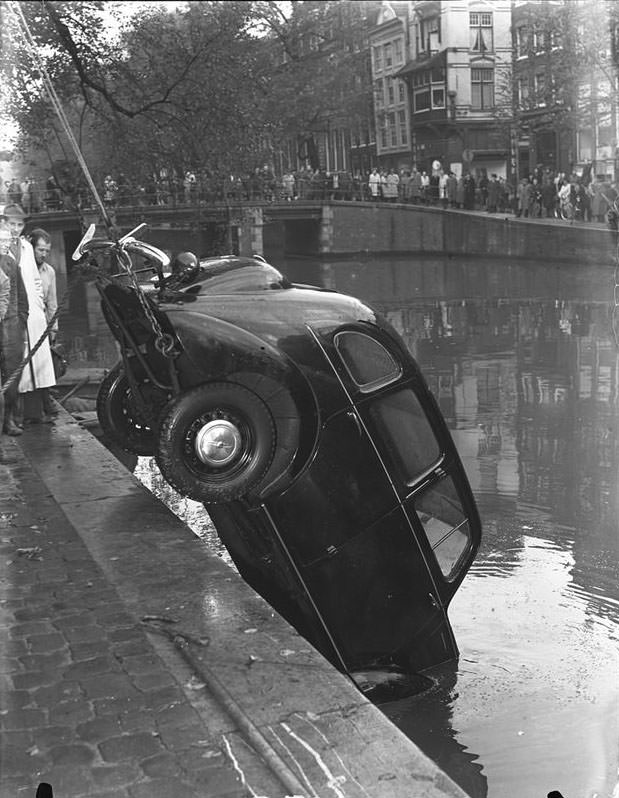
On November 7, 1949, a Vauxhall 14-6 was pulled from the Herengracht canal by Garage Slagboom, located at number 248. The Herengracht is one of Amsterdam’s most famous canals, lined with historic merchant houses. The involvement of a private garage in the recovery operation was common — the city did not always have dedicated salvage capacity, and local garages often provided the cranes and expertise needed to retrieve submerged vehicles.
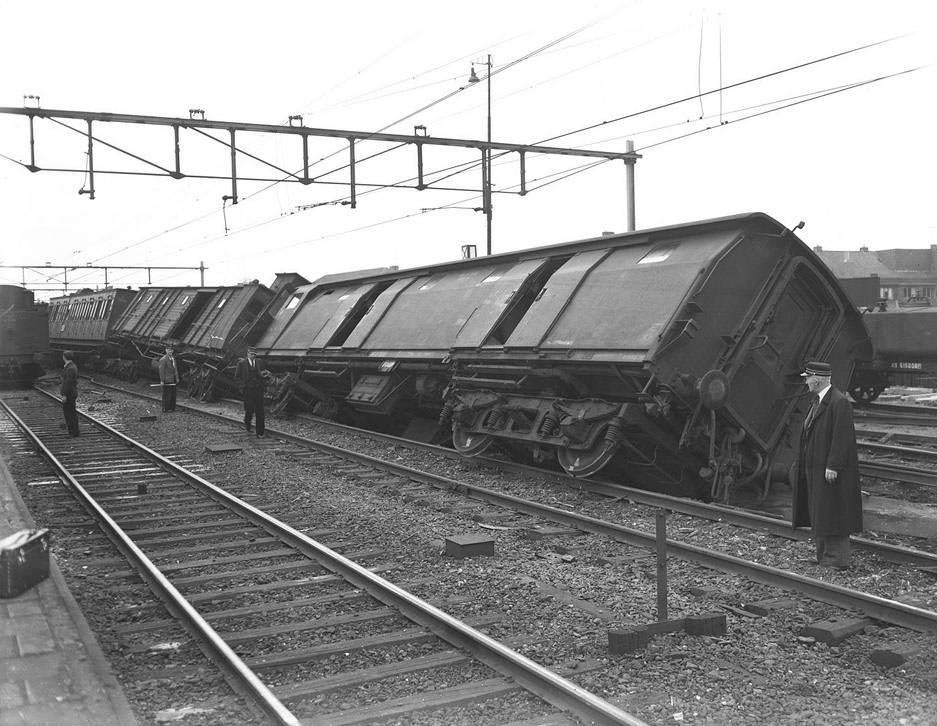
Just after midnight on June 13, 1949, an express train arriving from the North derailed at Hilversum station, a major rail hub southeast of Amsterdam. Nighttime derailments were especially dangerous because visibility was low, response times were slower, and passengers were often asleep when the crash occurred. The Hilversum derailment caused significant damage to the track and rolling stock, and disrupted rail service across the region.
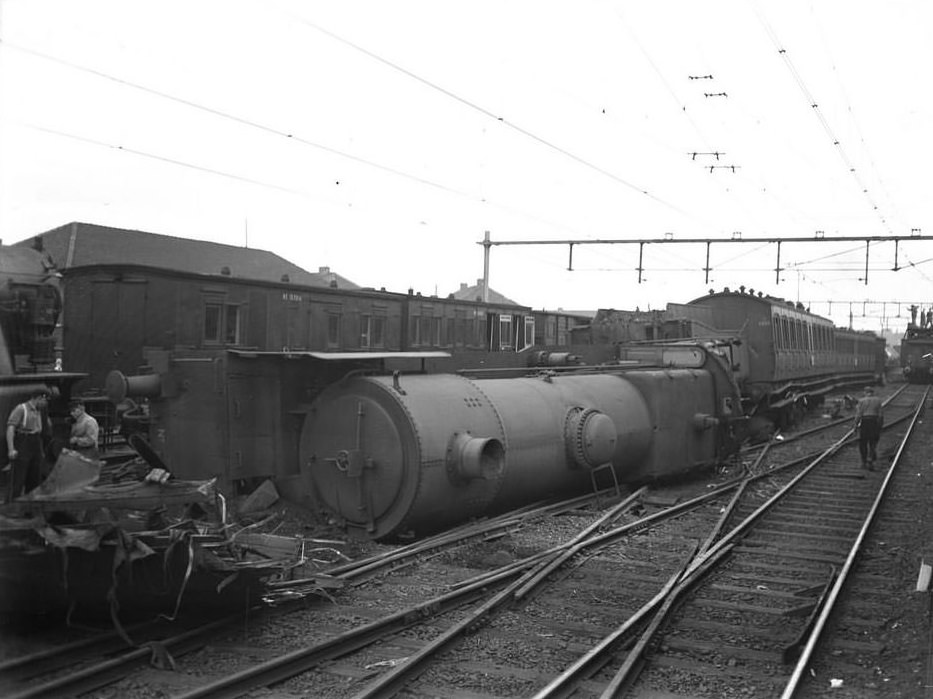
Train accidents continued to occur through the 1950s as the Dutch rail network expanded to meet post-war demand. Some incidents involved freight trains, others passenger services. In each case, the aftermath was the same — damaged track, derailed carriages, and the slow, difficult work of clearing the line and restoring service. Photographs from these scenes show the scale of disruption a single accident could cause.
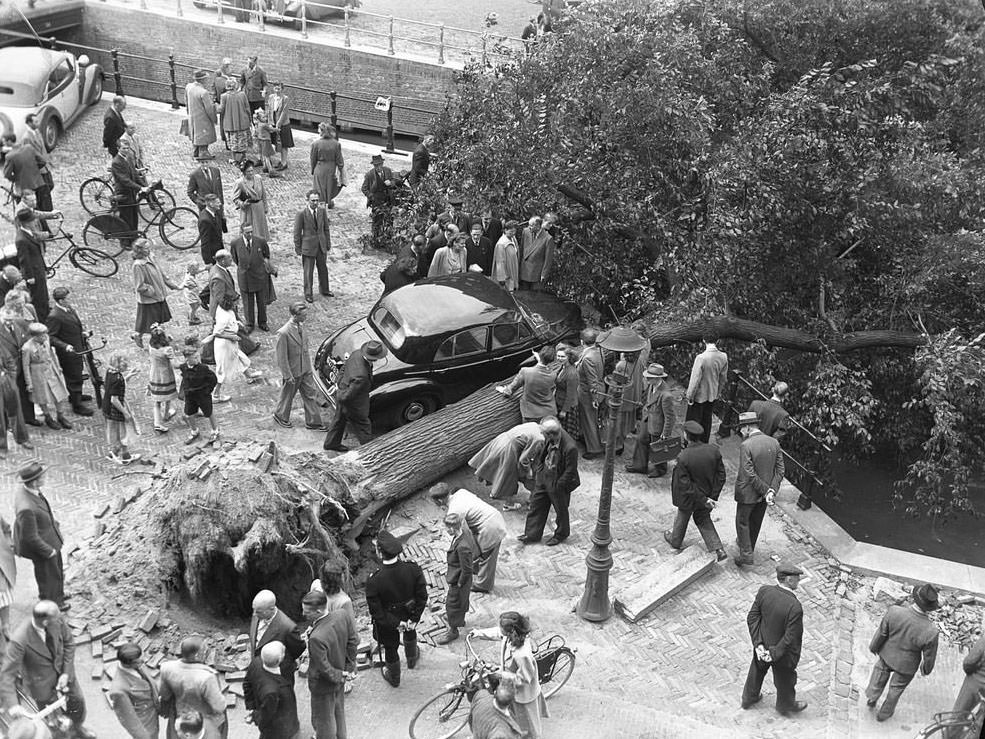
Not all accidents were caused by vehicles. On August 1, 1949, an elm tree fell at the corner of Herengracht and Utrechtsestraat, blocking the street and damaging whatever was beneath it. Amsterdam’s canalsides were lined with large, mature trees, and their root systems were often compromised by the saturated ground near the water. When a tree came down in a densely built part of the city, the consequences for vehicles, buildings, and pedestrians could be serious.
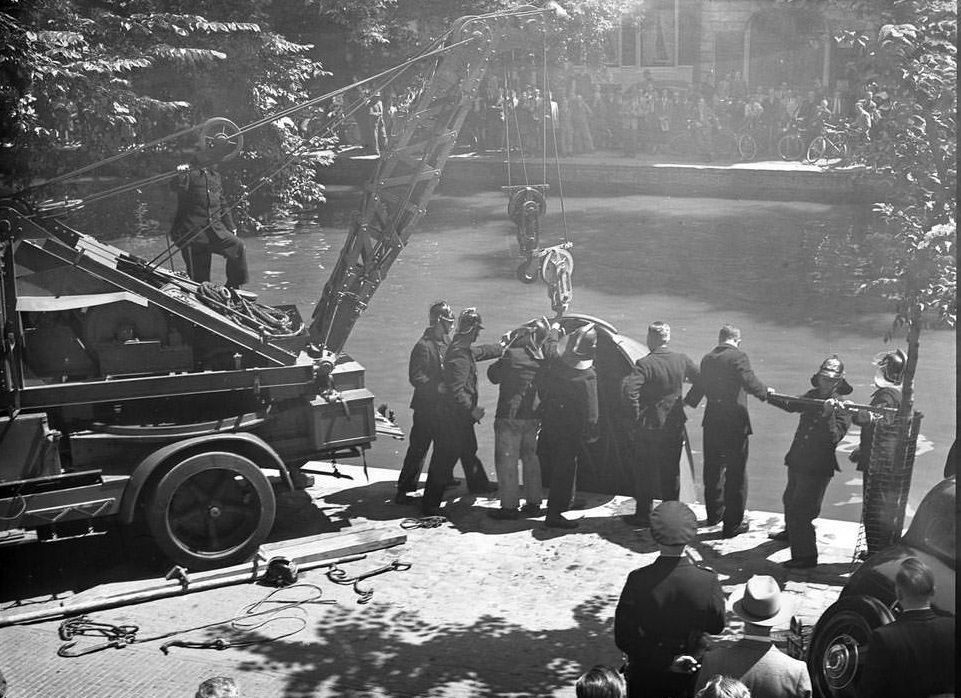
Cars entering Amsterdam’s canals was a problem that persisted through every decade. In the 1950s, as more private cars appeared on the roads, the frequency of canal incidents increased. Some vehicles went in due to driver error, others because of mechanical failure, and some after collisions that pushed them over the edge. The canal’s murky water made rescue operations difficult, and survival depended heavily on how quickly help arrived.
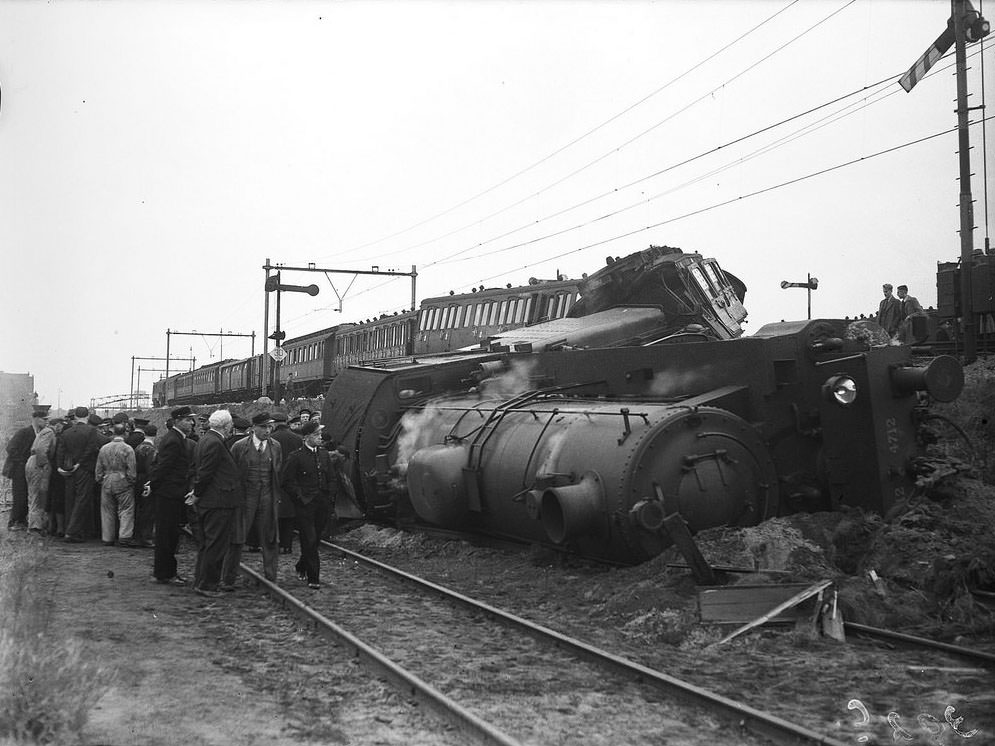
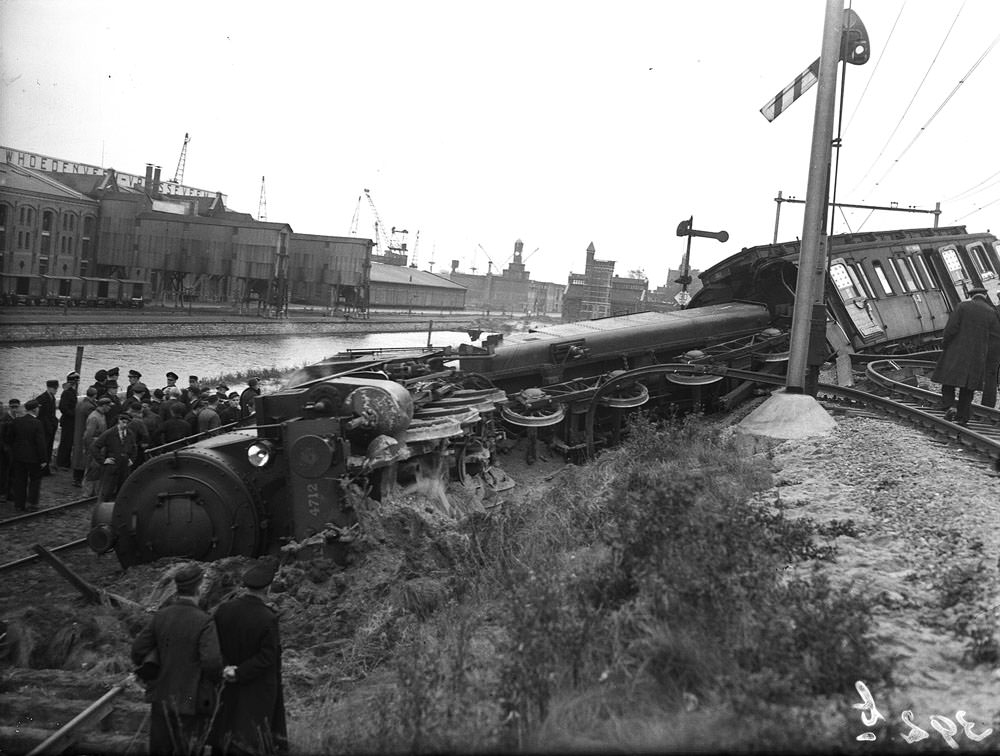
One of the most serious rail incidents documented in this collection took place on October 9, 1946, when the locomotive of the Apeldoorn express train derailed at the Dijksgracht in Amsterdam. The driver, Mr. Broekman from Amersfoort, was killed in the crash. He was one of many railway workers who lost their lives in the difficult operating conditions of the immediate post-war years, when infrastructure was damaged, equipment was worn, and safety systems were still being restored.
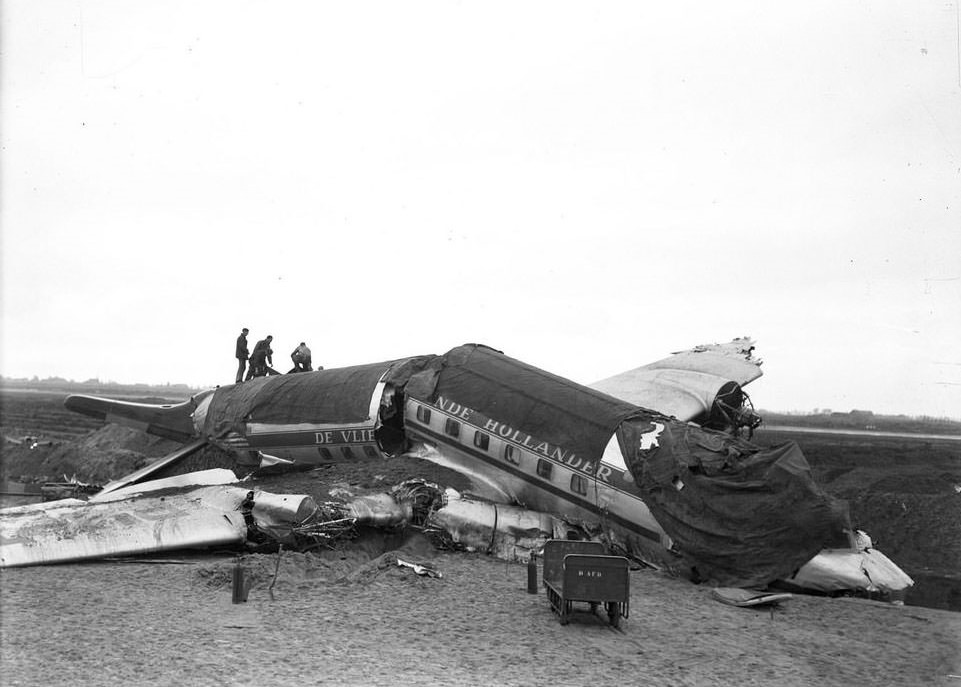
On May 1, 1948, a Douglas DC-6 struck a dike during a training flight at Schiphol Airport. Schiphol sits below sea level, surrounded by the flat polder landscape of North Holland, and dikes are a permanent feature of the terrain around the airport. The DC-6 was one of the most advanced commercial aircraft of its day, but even cutting-edge technology offered no protection against low-altitude navigation errors during training operations. The crash was a sobering event for Dutch civil aviation at a time when air travel was rapidly expanding.





It’s so fascinating to see these photos. I’ve been to Amsterdam twice this year and have absolutely fallen in love with the city, and it’s so well preserved that I recognize a lot of places from the photos
Yea … lucky that it didn’t get bombed into oblivion like so many other cities in ww2, wouldn’t want to imagine how it would look like here otherwise
What’s that big building in the first picture of the amstel? I’m wondering why it’s not there anymore.
Het Paleis voor Volksvlijt, an old exposition hall. It used to be pretty much be where De Nederlandsche Bank is now. Burned down somewhere in the 1920s iirc